A circle tattoo means unity, wholeness, eternity and protection — one unbroken line with no beginning, no end and nowhere for the eye to escape.
I have been drawing and researching tattoo symbolism for years, and the circle is still the design people underestimate most.
It looks like the simplest thing on the flash sheet until you sit with what it actually says about time, closure and belonging.
In my experience, the people who book a circle are almost never after decoration. They want something quiet that carries weight, and they usually already have a reason they have not said out loud yet.
This guide walks through every layer of circle tattoo meaning, the styles that carry each one, where the shape survives on the body, how to heal it, and the mistakes I see over and over. If you like symbolism stripped to its bones, these minimalist tattoo ideas pair well with everything below.
Which Circle Tattoo Meaning Is Right for You?
Before you book anything, it helps to match the meaning you actually want to a style that can carry it.
This is the table I mentally run through with anyone who tells me they want “just a circle”.
| Meaning you want | Style that carries it | Practical size and spot |
|---|---|---|
| Unity and wholeness | One solid bold ring, even weight all the way round | 5–8 cm, outer forearm or upper arm |
| Eternity and infinity | Continuous fine line, no visible join | 4–6 cm, inner forearm or ankle |
| Protection and boundary | Heavy blackwork ring framing a smaller motif | 8–12 cm, back of arm, thigh or sternum |
| Acceptance and imperfection | Ensō brushstroke with an open gap | 6–10 cm, forearm, shoulder blade or calf |
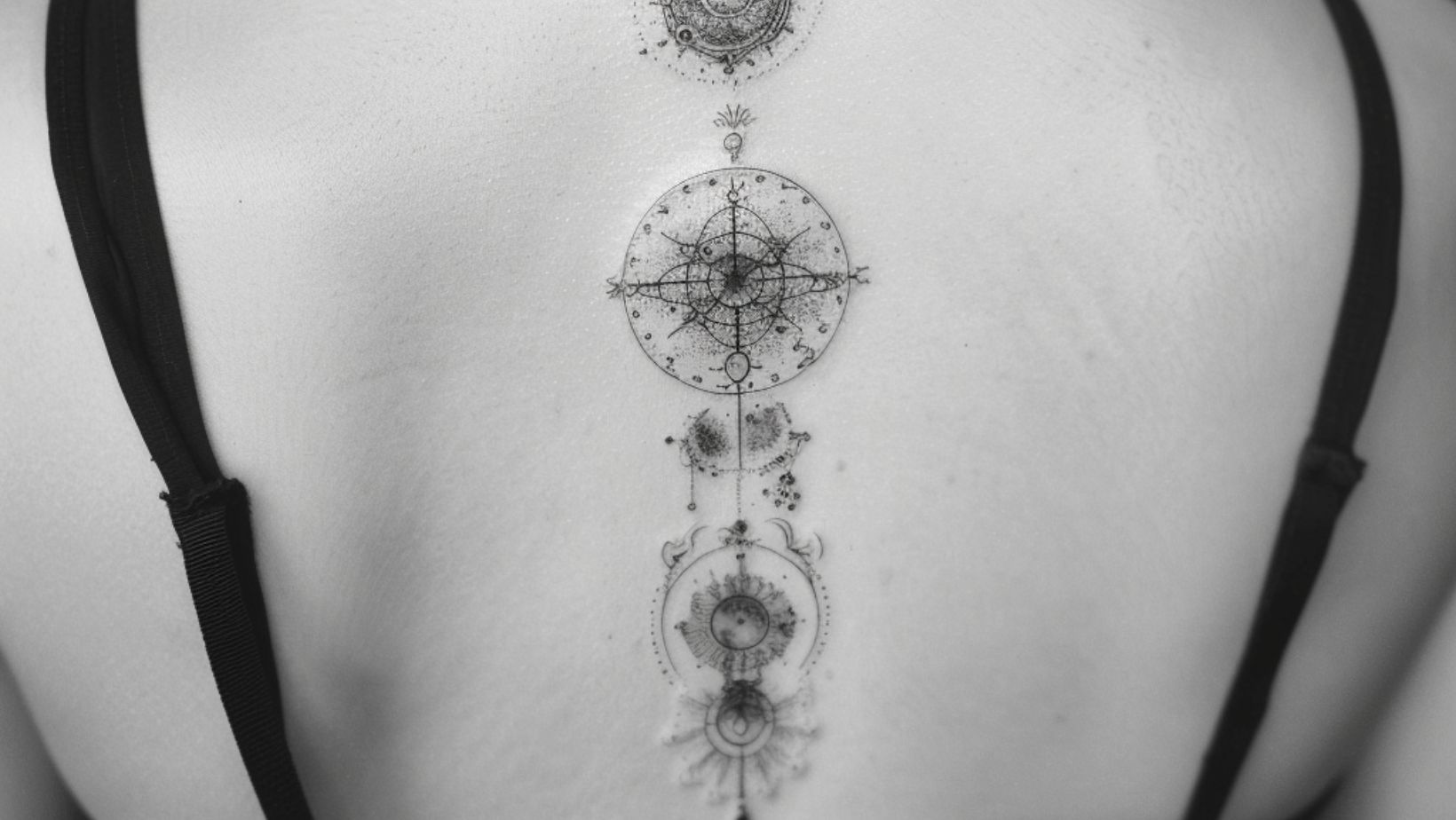
| Cycles and renewal | Moon phases or seasons arranged around a ring | 10–15 cm, spine, forearm band or ribs |
| Spiritual focus | Mandala or sacred geometry inside a circle | 12 cm and up, thigh, shoulder cap or back |
| Commitment to a person | Two interlocking rings or a plain band | Under 3 cm, finger, wrist or behind the ear |
Why Circle Symbolism Runs So Deep
The circle is one of a small handful of shapes that show up in almost every culture without anyone agreeing to it in advance.
Sun, moon, pupil, wedding band, clock face, a fire people sit around — the shape was already loaded long before anyone put it on skin.
That universality is exactly why it works as a tattoo: nobody has to ask you what it is before they feel something about it.
A triangle or a rune sends most viewers hunting for a reference. A circle lands immediately, then quietly holds whatever private meaning you attached to it.
There is a design reason too. The circle is the only closed shape with no corners to distort, so it sits comfortably on almost any part of the body once it is placed correctly.
In my experience, that is also its trap. A shape with nowhere to hide punishes a shaky hand more than any other tattoo I can name.
The Core Meanings of a Circle Tattoo
Most circle tattoos draw on one of six meanings, and the honest answer is that yours will probably be a blend of two or three.
Unity and Wholeness
This is the reading that comes up most often when I ask people why they picked the shape.
A circle has no weak point, no seam and no hierarchy. Every part of the line is equally far from the centre, which is a surprisingly hard thing to say in any other symbol.
People choose it after a stretch of life that felt fragmented — a long illness, a divorce, years of moving cities — and want a mark that says the pieces came back together.
A bold, evenly weighted ring says this better than any decorated version. The moment you add ornament, the eye starts ranking parts of the circle, and the wholeness idea gets diluted.
If this is your meaning, resist the urge to fill it. The empty middle is doing the work.
Eternity and Infinity
A closed loop has no start and no finish, which makes it the oldest visual shorthand for something that does not end.
Wedding bands use it. So do the ouroboros, the zodiac wheel and most depictions of the year.
When people bring me an eternity concept, they usually mean one of two things: a bond that outlasts them, or grief that has settled into something permanent but bearable.
Both suit a continuous fine line with no visible join, because a visible join is exactly the thing the meaning is denying. If you want a more literal version, these infinity tattoo designs take the same idea and twist it into a figure eight.
One honest caveat: a perfectly unbroken thin ring is one of the harder things to heal cleanly, and I will come back to why.
Protection and Boundaries
A circle drawn around something is one of the oldest protective gestures there is.
Ritual circles, city walls, the ring of stones around a fire — the logic is always the same: inside is kept, outside is held off.
Tattooed, this usually takes the form of a heavy ring framing a smaller motif: a name, an animal, a date, a flower.
The thicker the ring relative to what it contains, the more the tattoo reads as guarding rather than decorating.
Every artist I have asked about this design says the same thing — the frame has to be committed. A timid outline around a detailed centrepiece just looks like an afterthought.
Balance and the Whole Self
This is the inward version of unity, and it is the meaning behind most concentric circle tattoos.
Rings inside rings suggest layers of a person: the public one, the private one, the part almost nobody sees.
Some people space the rings evenly to say those layers are in balance. Others deliberately push the inner ring off-centre to say they are not, which I find far more interesting to look at.
When I tested this idea on paper, the off-centre version consistently drew more comment than the symmetrical one. Symmetry reads as calm; a small offset reads as a person.
Keep the gaps between rings at least as wide as the lines themselves, or the whole thing blurs into a thick grey band within a few years.
Cycles, Seasons and Return
Nature almost never runs in straight lines, and the circle is how we draw that.
Moon phases around a ring, four segments for the seasons, a sun on one side and a moon on the other — all of these say the same thing about return.
This is the meaning I most often see chosen after a loss, or after getting sober, because it frames a hard stretch as a phase rather than a destination.
If you want the day-and-night version rather than the lunar one, these sun and moon tattoo ideas cover the same cycle with more contrast.
Practical note: moon phase circles need room. Squeeze eight moons into a 5 cm ring and the crescents close up into blobs as the ink settles.
Spiritual and Sacred Symbolism
The circle anchors a lot of sacred imagery: halos, prayer wheels, rose windows, mandalas.
In tattooing, the sacred reading usually arrives through the mandala — a circular pattern radiating from a single centre point, used as a focus for meditation in Hindu and Buddhist traditions.
If that tradition matters to you, read up on it properly before you wear it, and say so to your artist so the design is handled with some care. Detailed mandala work rewards that conversation.
The circle here is not a frame — it is the structure the whole design grows out of.
That is also why a mandala cannot be shrunk the way a plain ring can. The pattern depends on repetition, and repetition needs space.
Popular Circle Tattoo Variations
Same shape, very different tattoos. These are the versions I see booked most often.
The Ensō (Zen) Circle
The ensō is a circle drawn in one brushstroke, usually left slightly open where the brush lifts.
In Zen practice it stands for the moment the mind lets the body act without interference, and the imperfection is the point rather than a mistake.
It is the one circle tattoo where a wobble is a feature.
That said, a convincing ensō is deceptively hard to tattoo. The brush texture — thick at the start, dry and split at the tail — has to be built deliberately, and artists who mostly do clean linework often flatten it into a plain thick ring.
Ask to see healed ensō work specifically. Fresh photos hide how much of that dry-brush texture survives.
Interlocking Rings and Bands
Two or three overlapping circles are the standard way to tattoo a relationship without tattooing a name.
Overlap them lightly and it reads as two people who stayed distinct; overlap them heavily and it reads as two lives that merged.
A plain unbroken band on the ring finger is the most stripped-down version of the same idea, and it comes with its own set of trade-offs — these wedding ring tattoo ideas go through them.
I will be blunt about finger placement: it is the fastest-fading spot on the body, and most band tattoos there need touching up within a couple of years.
Sacred Geometry and Pattern Circles
Beyond the mandala sits a whole family of pattern circles: the flower of life, seed-of-life grids, dotwork rings and layered geometric wheels.
These lean on repetition and symmetry rather than symbolism you have to explain, and they scale up beautifully across a thigh or a shoulder cap.
If you like the structure more than the spirituality, broader geometric tattoo designs give you the same visual logic without the religious reference.
Dotwork in particular needs an artist who specialises in it, because uneven dot density is glaringly obvious inside a perfect circle.
Fine-Line Minimal Circles
A single thin ring, often under 5 cm, usually on the inner forearm, ankle or behind the ear.
This is the most requested version I come across, and also the one most likely to disappoint two years later.
Very thin lines spread as they settle into the skin, and a line that spreads unevenly on a curve is much more noticeable than one that spreads on a straight edge.
In my experience the sweet spot is a line slightly thicker than the client first asks for, on flat skin, at a size the artist can draw in one confident pass. The fine-line tattoo ideas worth copying are the ones photographed after healing, not the day they were done.
The Ouroboros
A snake or dragon swallowing its own tail, forming a closed loop.
It carries the eternity meaning with a sharper edge — renewal that requires consuming your own past rather than simply outlasting it.
It is also the most demanding circle here, since the body of the snake has to stay an even width all the way round while still reading as an animal. These ouroboros tattoo ideas show how much the proportions vary.
The Circle as Negative Space
The least obvious variation: a solid black field with an untouched circle of skin left inside it.
It inverts the whole symbol — instead of drawing the circle, you draw everything around it, and the meaning tilts toward absence, a gap, something deliberately left empty.
Large areas of solid black are unforgiving work and demand an artist with proven blackout or blackwork experience, plus a longer, more careful heal.
Placement and Sizing That Keeps a Circle Round
A circle is the only common tattoo shape where the body itself can ruin the design without anyone making a mistake.
Skin that wraps around a limb distorts the shape depending on the viewing angle, so a circle stencilled flat on a bicep can read as an oval once the arm hangs naturally.
Flatter, more stable areas — outer forearm, shoulder blade, upper back, sternum, outer thigh, calf — hold a true circle best.
Ribs, inner bicep, the front of the shoulder and anywhere that folds will curve the shape as you move. That is not always bad, but you should choose it knowingly.
Ask your artist to stencil it, then stand up and look in a mirror from three metres away before any needle touches you. This single step has saved more circle tattoos than any other piece of advice I give.
On size: under about 4 cm, detail inside the ring stops being an option. Between 5 and 10 cm you can carry a simple centre motif. Past 12 cm you have room for mandala or moon-phase work.
Aftercare That Protects the Line
Circles punish bad healing more than most designs, because a gap or a blowout on a continuous curve has nowhere to hide.
Follow the written aftercare your artist gives you — they know the ink, the needle configuration and how that particular piece was worked. Where general guidance helps, the American Academy of Dermatology has a plain-language page on caring for tattooed skin.
The two habits that matter most in the first fortnight are simple: keep it clean with unscented soap, and keep it lightly moisturised rather than drowned in ointment.
Do not pick or scratch scabs. On a thin ring, one lifted scab can pull out a section of line and leave a visible break that needs a touch-up.
Keep it out of direct sun while it heals, and use sunscreen on it for life once healed. Fading is what turns a crisp circle into a soft grey smudge, and UV is the main cause.
If you see spreading redness, swelling that worsens after day three, pus, or a fever, contact a doctor rather than waiting it out. Reactions and infections are uncommon but real, and the FDA’s fact sheet on tattoos and permanent makeup and the AAD’s notes on tattoo complications both cover the warning signs. This article is general information, not medical advice.
One more honest note: never attempt to tattoo or remove one yourself. Both belong with a licensed professional, and home removal in particular causes scarring that is far harder to fix than the tattoo ever was.
Common Mistakes With Circle Tattoos
Almost every disappointing circle I have seen came from one of five decisions, all made before the machine switched on.
Going too thin. A hairline ring looks razor-sharp on day one and soft by year three, especially on the inner forearm.
Going too small with detail inside. Anything under roughly 4 cm cannot hold fine interior linework as the ink settles.
Choosing a curved placement without thinking about the distortion, then being surprised the circle reads as an egg.
Booking an artist whose portfolio is all colour realism. Clean geometry is a specific skill, and a freehand-true circle is one of the hardest tests of it.
And the big one: adding ornament to a shape that was working precisely because it was bare. If in doubt, tattoo it plain and add to it in a year.
Still Not Sure Which Circle Is Yours?
Sit with the meaning before you shop for a design. The shape is fixed; what changes is what you are asking it to hold.
If the pull is toward something contemplative or ritual, browse spiritual tattoo ideas and see which of them keep pulling you back after a week.
If you want something quiet that carries a private story, these small meaningful tattoo ideas work on the same logic as a plain ring.
Whichever way you lean, bring your artist the meaning first and the reference images second. In my experience that order produces a far better tattoo than arriving with a screenshot and no story behind it.
Frequently Asked Questions
What does a simple circle tattoo mean?
A plain circle usually means unity, wholeness and eternity — a line with no beginning and no end. Because the shape is universal, it does not carry one fixed cultural meaning, which is exactly why people use it to hold a private one. In my experience most wearers pick it after something in their life came back together, or to mark a bond they expect to outlast them. It is also the least likely design to be misread as belonging to a group or movement you are not part of.
Do two circles mean something different from one?
Usually, yes. Two overlapping circles read as a relationship — two people, two phases of life, or two sides of one person — and the amount of overlap adjusts how merged that relationship looks. Two concentric circles, one inside the other, read instead as layers of a single self. Three or more rings start to feel like a system or a cycle rather than a bond.
Is a circle tattoo hard to do well?
Harder than it looks, and most experienced artists will say so openly. A circle has no corners or detail to distract the eye, so any wobble, thickness variation or uneven curve is immediately visible. Many artists use a stencil or guide rather than working freehand, which is a sign of care, not a shortcut. Ask to see healed photographs of their geometric work before booking.
Where is the best place for a circle tattoo?
Flat, stable skin holds a circle best — the outer forearm, shoulder blade, upper back, sternum, outer thigh and calf are all reliable. Heavily curved or frequently folded areas such as the inner bicep, ribs and the front of the shoulder will distort the shape as you move. Fingers, wrists and feet fade faster than anywhere else and usually need touch-ups. Always check the stencil in a mirror from a few metres back before committing.
Does a circle tattoo have a spiritual meaning?
It can, depending on the version you choose. The ensō comes from Zen Buddhist brush practice, and the mandala is used as a meditative focus in Hindu and Buddhist traditions, so both carry genuine religious weight. A plain ring carries no inherent spiritual meaning at all, which is part of its appeal for people who want the symbolism without the tradition. If you are drawn to a design rooted in a living practice, it is worth reading about it properly and telling your artist why it matters to you.
Quick Summary
- A circle tattoo means unity, wholeness, eternity, protection, balance and natural cycles — most designs blend two or three of these.
- The plainest version says the most; ornament dilutes the wholeness reading rather than strengthening it.
- A thick ring framing a smaller motif reads as protection, while concentric rings read as layers of one person.
- The ensō is the one circle where imperfection is deliberate, but it needs an artist who can build real brush texture.
- Mandala and moon-phase circles need 12 cm or more to survive healing without the detail closing up.
- Flat skin holds a true circle; curved or folding placements will distort it, so check the stencil in a mirror first.
- Go slightly thicker than feels right, since fine lines spread and a spread curve shows more than a spread straight line.
- Protect the healing line from picking and sun, and see a doctor for spreading redness, worsening swelling, pus or fever.