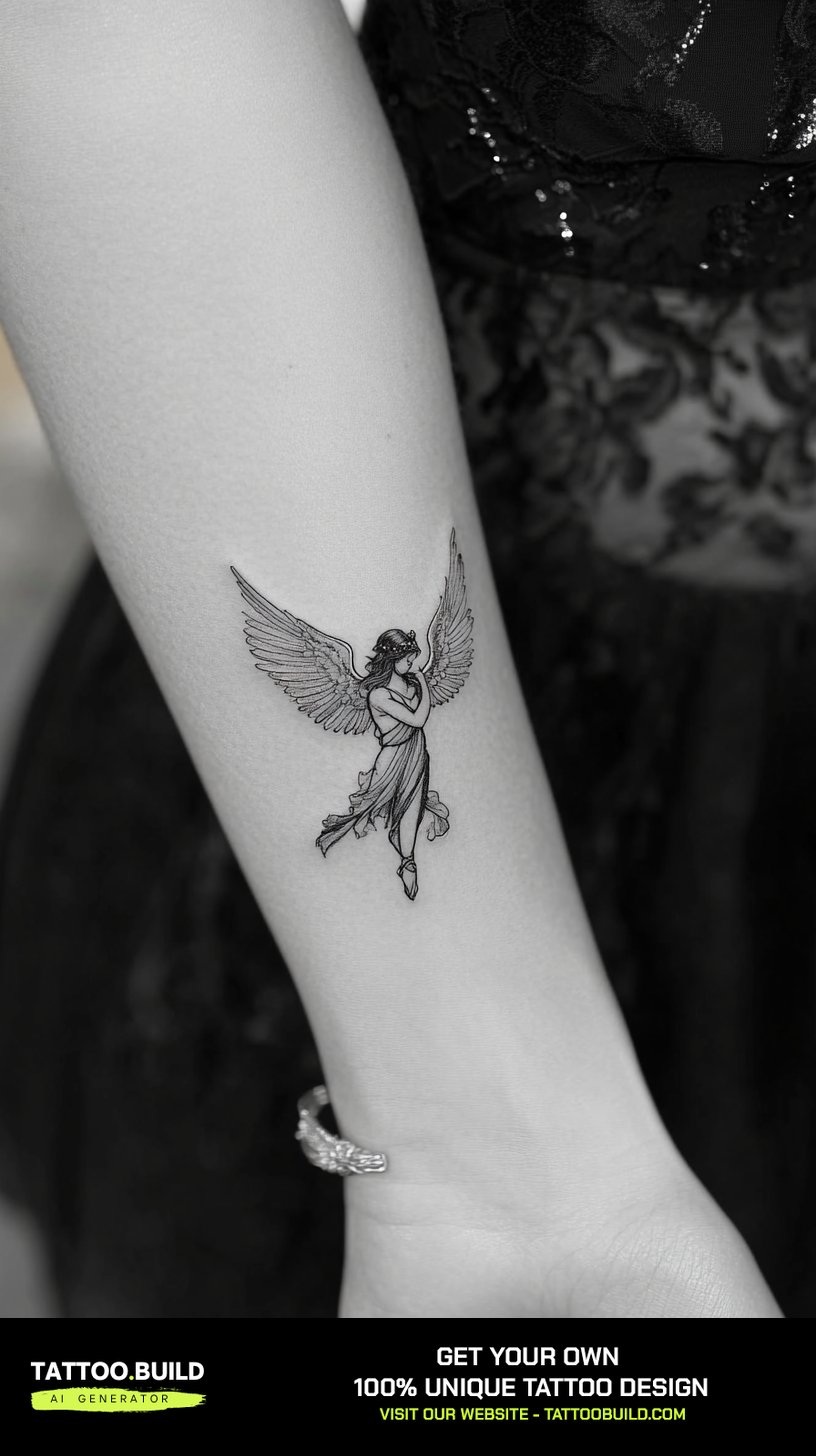
I have been writing about tattoo design for years, and no subject comes back to my inbox as often as this one. An angel tattoo for women works because it carries two meanings at once — protection and loss — and the wearer decides which one shows.
That double meaning is why the same motif can sit on a 19-year-old celebrating a new chapter and on a grandmother marking a death, without either design feeling wrong.
Below are more than thirty designs I have collected, grouped by style rather than by body part, along with the practical notes I wish more people heard before their consultation. If wings alone are what you are drawn to, the wider wing tattoo ideas guide covers that shape in more depth.
A quick warning worth reading first: angels age badly when they are drawn too small. I will come back to that repeatedly, because it is the single most common regret I hear.
Which Angel Tattoo Style Is Right for You?
Every style below is achievable, but they do not cost the same, heal the same, or age the same. This is the comparison I usually sketch out on paper during a consultation.
| Style | Typical session time | Smallest size that still reads | Ages well? | Best for |
|---|---|---|---|---|
| Black & grey realism | 4-8 hours, often split | About the length of your hand | Yes, if the artist leaves open space | Guardian and memorial pieces |
| Fine line | 1-3 hours | Roughly two finger-widths | Softens noticeably over a decade | First tattoos and discreet placements |
| Neo-traditional | 3-6 hours | Palm-sized | Very well – bold outlines hold | Colour work and cherubs |
| Single-needle micro | Under 2 hours | Coin-sized at best | The weakest of the four | Tiny halos, feathers, silhouettes |
| Watercolour | 2-5 hours | Palm-sized | Only with a black underdrawing | Abstract and modern designs |
If you take one thing from that table, take the middle column. Almost every disappointing angel tattoo I have seen was simply too small for the style it was drawn in.
What Angel Tattoos Actually Mean
Angels appear in Jewish, Christian and Islamic tradition as messengers and guardians, which is why the imagery reads as protective almost everywhere in the world.
But meaning in tattooing is mostly personal. When I ask women what their angel stands for, the answer is usually a specific person rather than a doctrine.
The most common brief I receive is a memorial piece — a parent, a grandparent, a child. The angel becomes a way of showing grief without writing a name across your skin.
Others choose it as a promise to themselves. A guardian figure on the shoulder or spine can mean “I am looking after myself now,” and that reading is just as valid.
There is also a darker branch — fallen angels, broken halos, angel-and-demon splits — that speaks to conflict and recovery rather than comfort. None of these meanings cancel each other out, and nobody needs to explain their tattoo to a stranger.
30+ Angel Tattoo Ideas for Women
These are grouped by design family. Bring two or three examples to a consultation rather than one, so your artist can see the range you are comfortable with.
1. Guardian Angel Tattoos
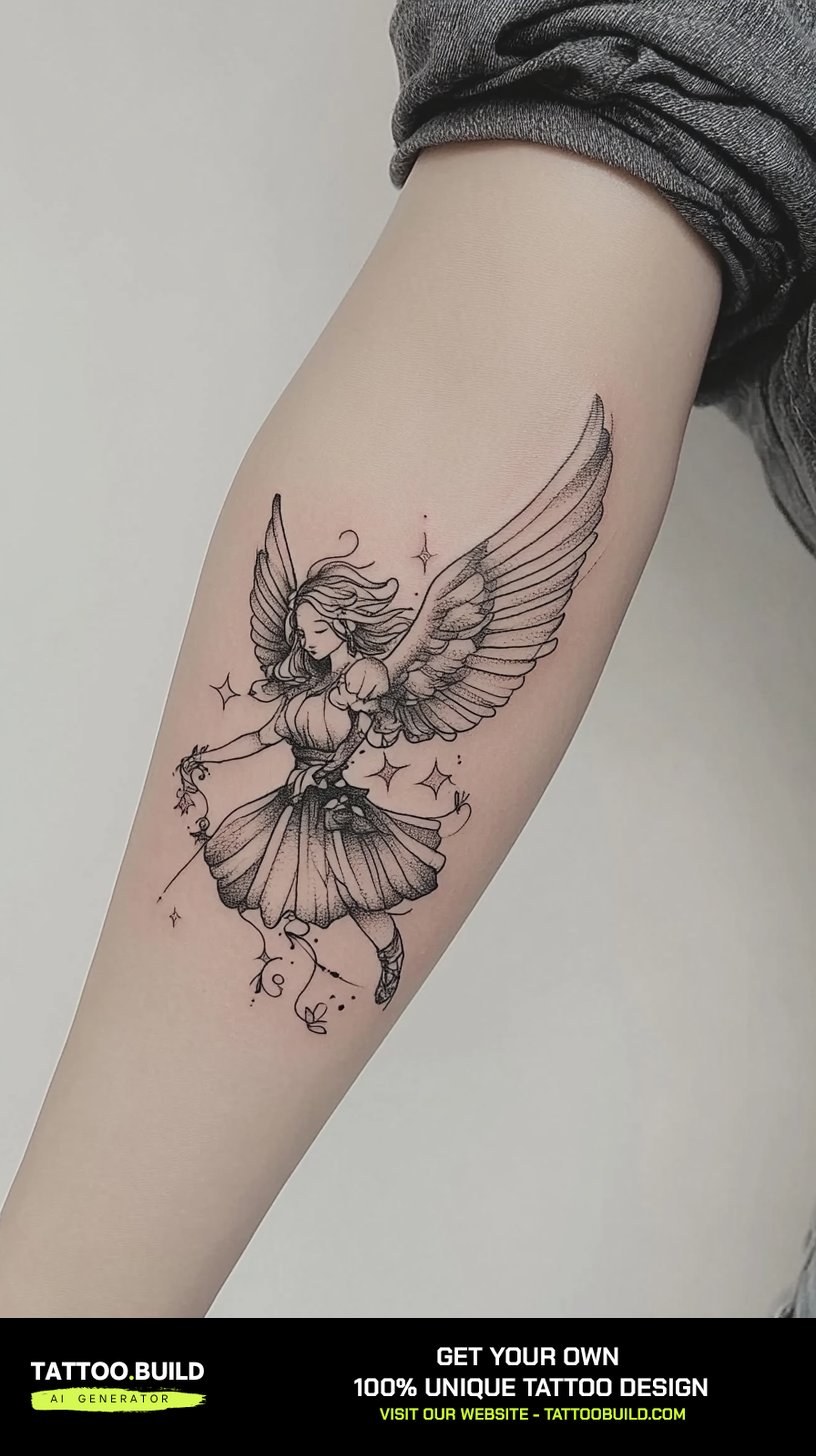
The guardian angel is the backbone of this whole category — a full figure, usually winged, usually watching over something or someone.
These want space. In my experience, anything under about 15 cm tall starts losing the face, and the face is what carries the emotion.
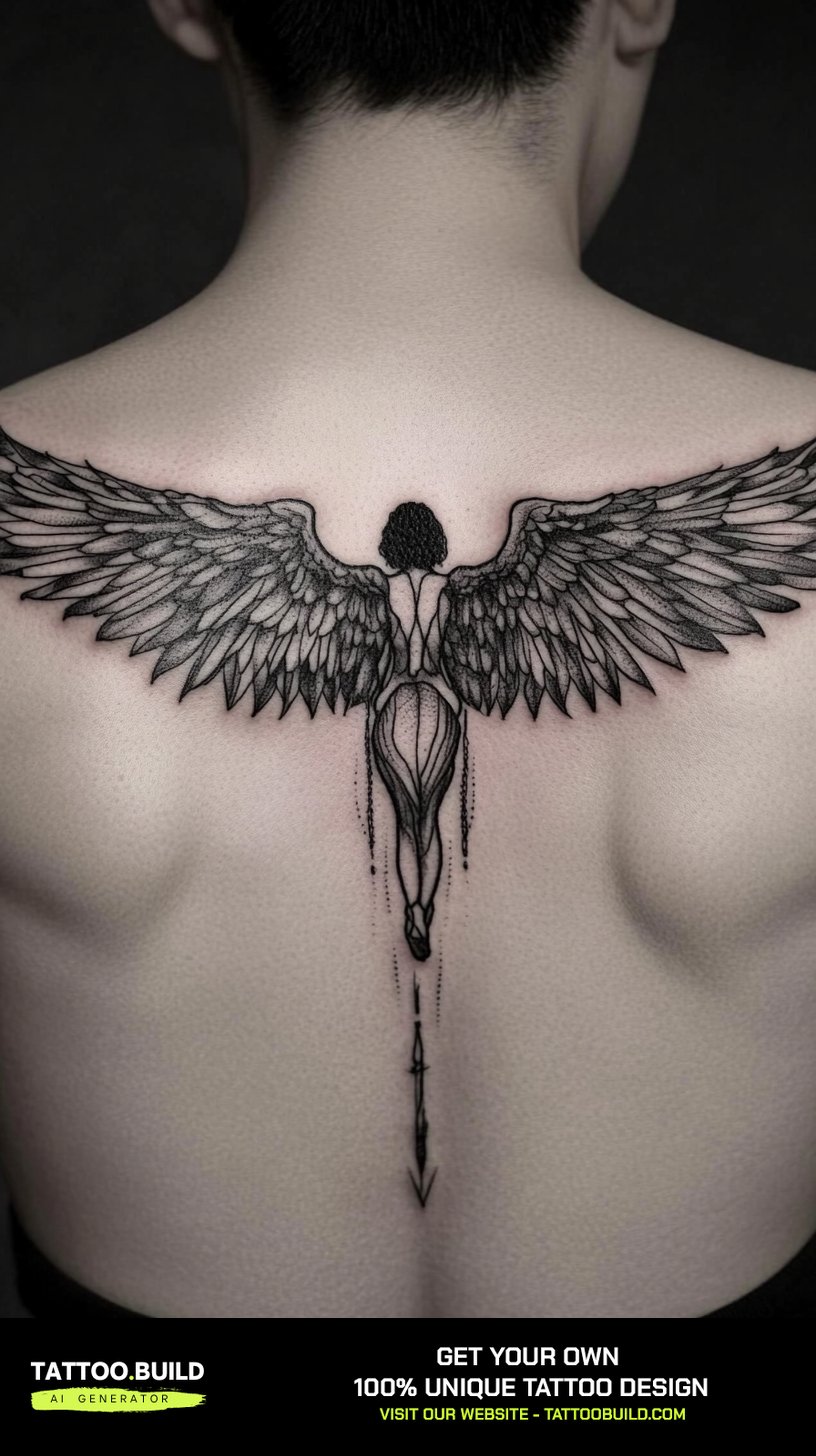
The upper back, the outer thigh and the full forearm are the placements that work most reliably. All three give a tall, narrow canvas that suits a standing figure.
Ask your artist to leave breathing room in the shading. Solid grey packed edge to edge looks striking in the studio and turns muddy within five or six years.
If you want the piece to read as protective rather than mournful, ask for the head lifted and the eyes open. A bowed head almost always reads as grief.
2. Angel Wings Tattoos
Wings without a body are the most requested variation, and the most misjudged.
Spread across the shoulder blades they are genuinely beautiful, but they are also a large commitment — expect multiple sessions and a healing period that makes bra straps uncomfortable for a week.
A single wing running down one arm is the version I recommend more often. It costs less, hurts less, and the asymmetry looks deliberate rather than unfinished.
Feather detail is where wings live or die. Every artist I have asked says the same thing: fewer, larger feathers age better than many small ones.
3. Fallen Angel Tattoos
A fallen angel keeps the wings but loses the serenity — drooping feathers, a lowered head, sometimes broken or bare wing frames.
Women choose this one to mark a hard period they came out of, not one they are still in. That distinction matters, and a good artist will ask about it.
Heavy black shading suits the subject, so this is one of the few designs where a dark, dense approach is the right call. Keep it large enough to justify that weight.
4. Praying Angel Tattoos
Clasped hands and a bowed head make this the most explicitly devotional design in the list.
It is also the most forgiving at medium size, because the silhouette does the work. Even when the face softens with age, the posture stays readable.
The inner forearm is the placement I see most, partly because the wearer can look at it. That sounds obvious, but it is worth thinking about — some tattoos are for other people and some are for you.
Soft grey wash suits this design better than hard black. The gentleness of the pose and the harshness of solid black tend to fight each other.
5. Cherub Tattoos
Cherubs come from Renaissance painting more than from scripture — the round-faced winged infants that Raphael and his contemporaries made famous.
The theological cherub of Jewish and Christian tradition is a far stranger creature, which is a fun thing to know and a terrible thing to bring up at a family dinner.
Practically, cherubs are the friendliest design here. They read as warm rather than solemn, and they work in colour where most angel tattoos stay black and grey.
Neo-traditional is the style I would push you toward. Bold outlines keep the face defined, and the palette suits soft skin tones and cloud work.
6. Angel Feather Tattoos
If you want the meaning without the figure, a single feather is the cleanest shorthand there is.
It is also the most placement-flexible design in this article — forearm, ribs, ankle, behind the ear, along the spine, all of it works.
Fine-line feathers with scattered fragments drifting off the edge have been popular for years now, and they do soften over time. Ask for slightly thicker linework than the drawing suggests.
For more variations on this shape alone, the feather tattoo drawings for females collection is worth a look before you commit.
7. Angel and Demon Tattoos
The split design — one side light, one side dark — is about internal conflict rather than religion.
Composition is everything here. A mirrored layout down the spine or the centre of the back gives the two halves equal weight, which is the whole point.
Done badly, it becomes two unrelated tattoos sharing a border. Ask to see healed examples specifically, not just fresh photos, before booking.
There is a dedicated angel and devil tattoo ideas guide on this site with more layouts if this is the direction you are leaning.
8. Minimalist Angel Tattoos
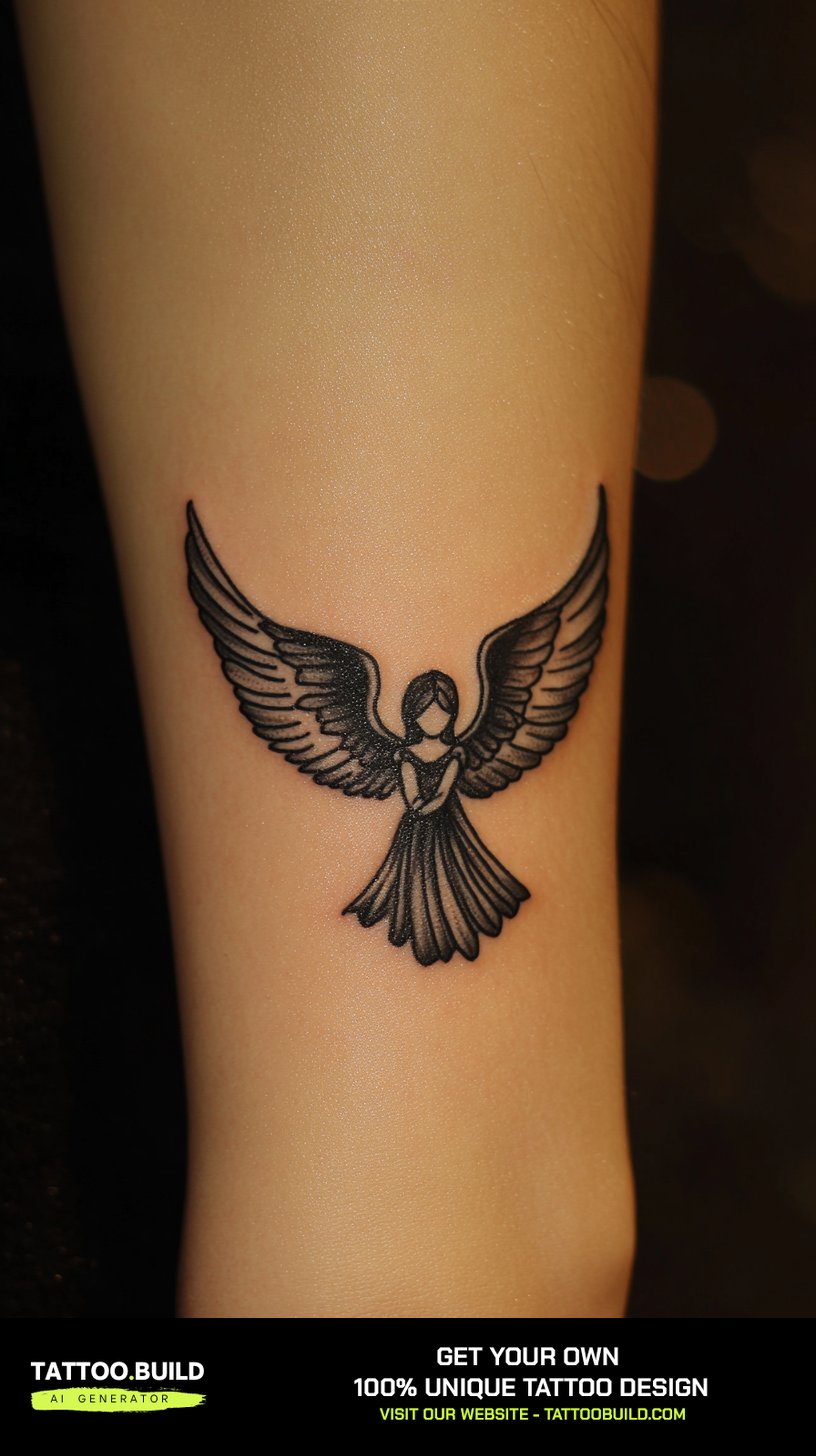
Single-line angels, tiny silhouettes, a halo and two strokes for wings — this is the fastest-growing corner of the category.
I will be honest about the trade-off. Micro tattoos spread. Ink migrates slightly under the skin over years, and at this scale a small amount of spread closes the gaps that make the design legible.
That does not make them a bad choice. It makes them a choice with a shelf life, and plenty of people are fine with a touch-up at year eight.
Behind the ear, the inner wrist and the back of the arm are the placements that hold up best. Fingers, hands and feet are the ones that fade fastest.
If you are building a set of small pieces rather than one statement tattoo, the small tattoo ideas for ladies roundup pairs well with these.
9. Angel Halo Tattoos
The halo alone is the most understated option in this article — often no bigger than a bracelet, sometimes floating above a short quote or a name.
A broken or tilted halo is a common variation and reads very differently: imperfection rather than protection.
The collarbone is the placement I see most, and it suits the shape. Just be aware that bone-adjacent areas are among the sharper spots to sit through.
10. Angel Heart Tattoos
Wings wrapped around a heart is the design I most often see chosen for a living person rather than a lost one.
It is compact, which makes it one of the few angel designs that genuinely works at small and medium sizes without falling apart.
Colour is optional here and I would usually skip it. A red heart against black wings dates faster than the same design in grey.
11. Abstract and Watercolour Angels
Sketchy linework, geometric fragments and watercolour bleed all fall into this group. It is the most contemporary-looking family in the list.
Watercolour needs a black skeleton underneath. Every artist I have asked who does this style well builds a grey or black underdrawing first, then lays colour over it, so the piece still has structure once the softer pigments fade.
If someone offers you pure watercolour with no black at all, that is a reasonable moment to get a second opinion.
The thigh takes this style well — a large, flat, relatively protected canvas. The classy feminine thigh tattoo guide covers placement in more detail.
12. Sleeping and Memorial Angels
A sleeping angel resting on a cloud is the softest memorial design in common use, and often the one chosen when the loss involved a child.
Dates, initials and short phrases are frequently added beneath. Keep text small and separate from the figure — lettering packed into artwork is the first thing to become unreadable.
Take your time with this one. Memorial tattoos made in the first weeks of grief are the ones I most often hear regretted, and no artist worth booking will rush you.
Variations Worth Considering
If none of the twelve above is quite right, these adjacent directions come up often in consultations.
Doves instead of angels
A dove carries much of the same peace-and-passing symbolism with a fraction of the detail, which makes it far easier to place small.
Wings integrated into an existing tattoo
Adding wings to a piece you already have is often cheaper and more cohesive than starting a new design beside it. Bring healed photos to the consultation.
Script with a single wing
A short line of handwriting with one wing at the end gives you the meaning and the personal detail without the cost of a full figure.
Spine placement
A vertical angel or feather down the spine is dramatic and easy to cover for work. It is also a sharper spot than most people expect — the feminine spine tattoo guide is worth reading first.
Aftercare and Keeping the Detail Sharp
Angel tattoos live on shading, and shading is the first thing bad healing destroys. This section matters more here than it would for a bold traditional piece.
Follow the aftercare instructions your own artist gives you — they know their ink, their machines and their local climate. Where general guidance helps, the American Academy of Dermatology’s advice on caring for tattooed skin is a reliable starting point.
Sun exposure is the main long-term enemy of grey shading. Once healed, sunscreen on the piece is the single highest-value habit for keeping it crisp.
Watch for anything beyond normal tenderness — spreading redness, heat, pus, fever, or a rash that appears weeks or months later. Those are reasons to see a doctor, not to ask the internet. The AAD keeps a plain-language overview of unexpected tattoo skin reactions that is worth knowing about before you sit down.
Nothing in this article is medical advice. If you have eczema, psoriasis, keloid scarring, a known pigment allergy or are on immunosuppressive medication, talk to a dermatologist before booking, not after.
Common Mistakes and How to Avoid Them
Going too small is first, and it is not close. A design that looks perfect on paper at 4 cm loses its face at 4 cm on skin.
Choosing an artist by price rather than by portfolio is second. Angel faces are portrait work, and portrait work is a specialism — plenty of excellent artists do not do it well.
Packing solid black into every shadow is third. Ask for contrast, not density.
Booking a memorial piece too soon is fourth, and the only one that cannot be fixed with a touch-up.
Still weighing it up? The forearm tattoo ideas for females and classy shoulder tattoos for women guides both cover placement trade-offs in more depth, and the angel tattoo drawings roundup is useful if you are still deciding where a first larger piece should go.
Frequently Asked Questions
How much does an angel tattoo for women usually cost?
It varies enormously by region and artist, so any single number would be misleading. What I can say is that angel designs sit at the higher end for their size, because faces and feather detail take longer than most motifs of the same dimensions. A small fine-line feather is an hour or two of work; a full-back guardian figure in realism is usually several sessions. Ask for an hourly rate and an honest session estimate rather than a flat quote.
Where do angel tattoos hurt the least?
The outer thigh, the outer upper arm and the forearm are the areas most people find most tolerable, because there is muscle and fat between the needle and the bone. Ribs, spine, collarbone, sternum, hands and feet are consistently reported as sharper. Pain is genuinely individual though, and a calm artist with a good pace matters more than the exact spot. If you are anxious, book a short first session somewhere forgiving before committing to a large piece.
Do small angel tattoos age badly?
They age faster than large ones, yes. Ink spreads slightly under the skin over the years, and at micro scale that spread closes the gaps that make a tiny angel legible. In most cases this shows up somewhere between year five and year ten. It is not a reason to avoid small tattoos, just a reason to expect a touch-up and to keep the design simpler than you think you need.
Is an angel tattoo disrespectful if I am not religious?
In my experience the overwhelming majority of people wearing them are not making a religious statement, and I have never heard an artist raise it as a concern. Angels have been secular art for centuries. If you are worried about a specific tradition or a specific family member’s reaction, the honest answer is that only they can tell you — and it is worth asking before the appointment rather than after.
Can an angel tattoo cover an existing tattoo?
Often, yes. Wings in particular are useful for cover-ups because feather detail hides irregular shapes underneath better than smooth shading does. Whether it works depends on how dark and how large the original is, and a cover-up nearly always has to be bigger and darker than the piece it replaces. Take healed photographs to a consultation with an artist who lists cover-ups specifically.
Quick Summary
- Angel tattoos carry two meanings at once — protection and loss — and you choose which one shows.
- Size is the single biggest predictor of whether you will still like the tattoo in ten years.
- Black and grey realism suits guardian and memorial pieces; neo-traditional suits cherubs.
- Fewer, larger feathers age far better than many small ones.
- Micro and single-line angels will spread over time — budget for a touch-up.
- Watercolour needs a black underdrawing or it loses structure as it fades.
- Sunscreen on healed grey shading is the highest-value long-term habit.
- Never book a memorial piece in the first weeks of grief.