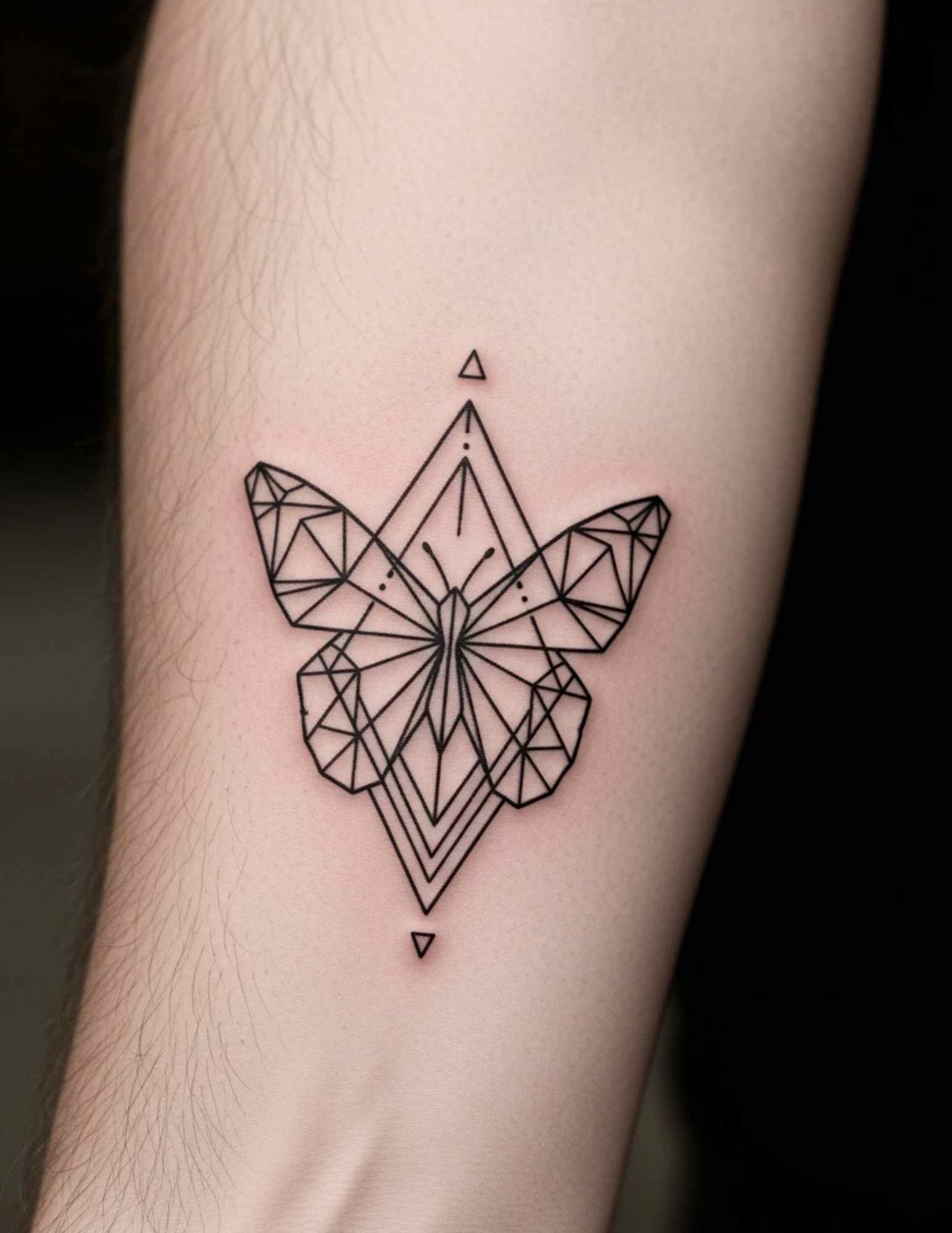
A butterfly on the arm is one of the most-requested tattoo ideas I see walked into a shop, and for a reasonable set of reasons — the arm curves in a way that suits wings, and the butterfly itself carries meaning without needing an explanation.
In my experience, most people who arrive asking for one already know they want a butterfly. The real decisions are style, placement, size, and whether the butterfly is the whole piece or part of a larger arm design.
This guide walks through every one of those decisions using photos of real arm tattoos I have curated over the past two years, alongside notes from artists I have talked with about what works long-term on arm skin.
You will find a comparison of styles, a breakdown of arm placements, notes on aftercare, and honest thoughts on what to avoid — plus 47 real examples grouped by the choice each one shows off.
Which Butterfly Style Is Right for Your Arm?
The style you choose changes everything about how the tattoo reads, how long it takes, and how it ages. I have found the six styles below cover roughly 90% of what people actually walk out with.
Use the table as a rough guide, then look at the example galleries under each style further down. The right style for your arm is usually the one whose examples you keep coming back to.
| Style | Best for | Session length | How it ages |
|---|---|---|---|
| Fine line | Small, delicate pieces on inner forearm or wrist | 1–2 hours | Softens after 3–5 years; may need a touch-up |
| Minimalist outline | First tattoos, discreet placements | 30–60 minutes | Holds up well; the simplest lines survive the longest |
| Watercolor | Wearers who want color and looseness | 2–4 hours | Fades faster than solid black; plan a touch-up around year 5 |
| Realism (black & grey) | Larger pieces on the outer forearm or upper arm | 3–6 hours | Ages gracefully with saturated shading |
| Geometric / dotwork | Structured designs; symmetry lovers | 2–4 hours | Dotwork can blur slightly; clean lines matter |
| American traditional | Bold, high-contrast statement pieces | 2–3 hours | Excellent — the format was built to age |
Why the Butterfly Keeps Coming Back on Arms
The butterfly is a shorthand for change, transformation, and a survived season — and it manages to say all of that without needing a caption. That is unusual for a single image. Even the biological life cycle of the butterfly is a story of transformation, which is part of why the symbol travels so easily across cultures.
For arm placement specifically, the shape of a butterfly follows the natural muscle line. Wings open across the forearm the way a real butterfly would rest on skin, which is why the design has stayed popular even as tattoo styles cycle.
I have asked several artists why they never get tired of tattooing them. The most common answer is that the butterfly gives them room to negotiate — one client wants realism, another wants a single line, and the same subject accommodates both.
It is also one of the few designs where the meaning is genuinely personal without needing to be secret. Most wearers I have talked to link it to a specific person or a specific year — the butterfly gives the memory a home without spelling it out.
For more on the wider symbolism, this longer piece on what a butterfly tattoo means is a useful companion — the summary here is that meaning is optional but easily added.
Butterfly Arm Tattoo Design Styles, With Examples
Below are the six styles I keep seeing on the arm, each with three examples and notes on what makes them work. Read them in order or skip to whichever style speaks to your gut first.
Fine Line Butterflies
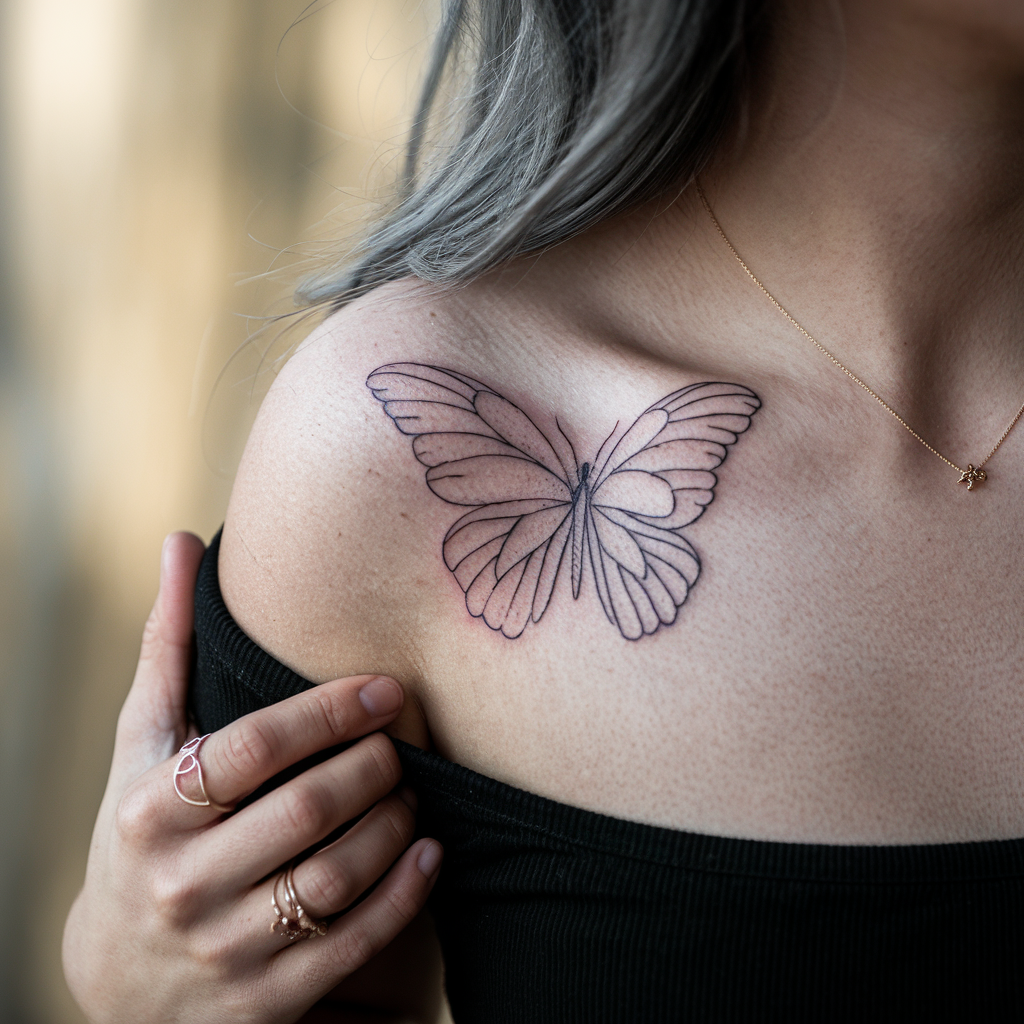
Fine line is drawn with a single-needle machine and produces the thinnest possible outline — almost a pencil sketch on skin.
It suits the inner forearm and wrist perfectly because the skin there takes small detail cleanly. In my experience, fine line butterflies photograph best in their first year and soften a little after that.
Expect the lines to blur slightly over 5–10 years; a light refresh brings them back. Read more on the style itself in this guide to fine line tattoo ideas.
Minimalist Outline
If fine line is a pencil sketch, minimalist outline is a single pen stroke — no shading, no dots, just the shape.
This is what I recommend to almost every first-timer who is not sure what they want. A minimalist butterfly stays legible at a glance for decades because the design is doing the work, not the detail.
The best minimalist butterflies use negative space inside the wings so the small size still reads as intentional. If you like this direction, browse more minimalist tattoo ideas for context.
Watercolor Butterflies
Watercolor tattoos push pigment past the outline in loose washes, mimicking the look of paint bleeding on wet paper.
The style is beautiful in year one and needs the most maintenance of any option here. Every artist I have asked estimates a watercolor piece will lose 20–30% of its color saturation in the first five years without touch-ups.
If you love the aesthetic, go in knowing that. Book a color refresh at year 5, and consider adding a thin black outline inside the wings so the shape reads even when the color has softened. Wider examples live under watercolor tattoo ideas.
Realistic Butterflies
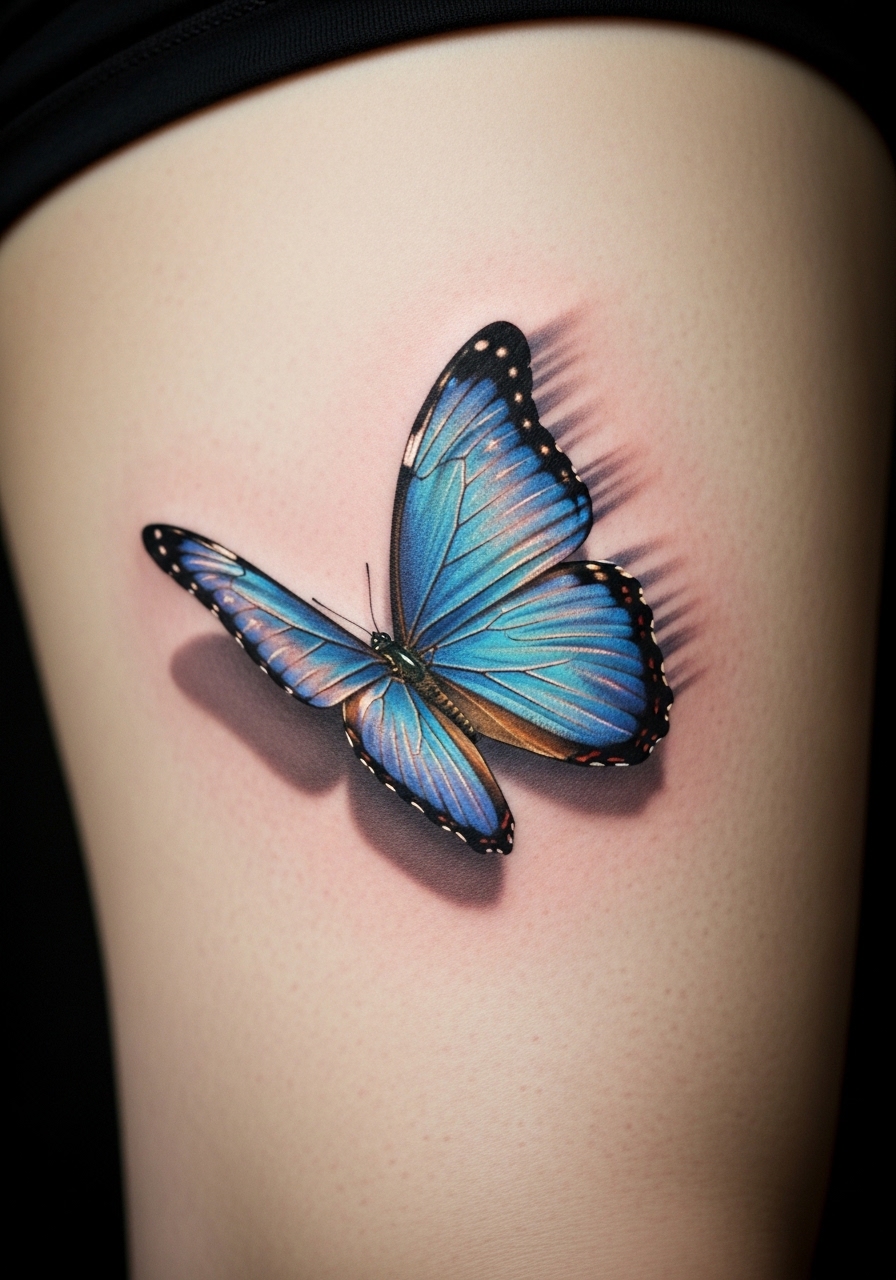
Realism turns the butterfly into a photograph — vein detail on the wings, cast shadow underneath, individual scales when the artist is skilled enough.
This style needs room. A realistic butterfly under about three inches on the arm loses the detail that makes it realistic in the first place.
Plan on a bigger placement — outer forearm, bicep, or upper arm — and a longer session. Black and grey realism ages more gracefully than full color realism because saturated shading holds up better than pigment layers.
Geometric and Dotwork Butterflies
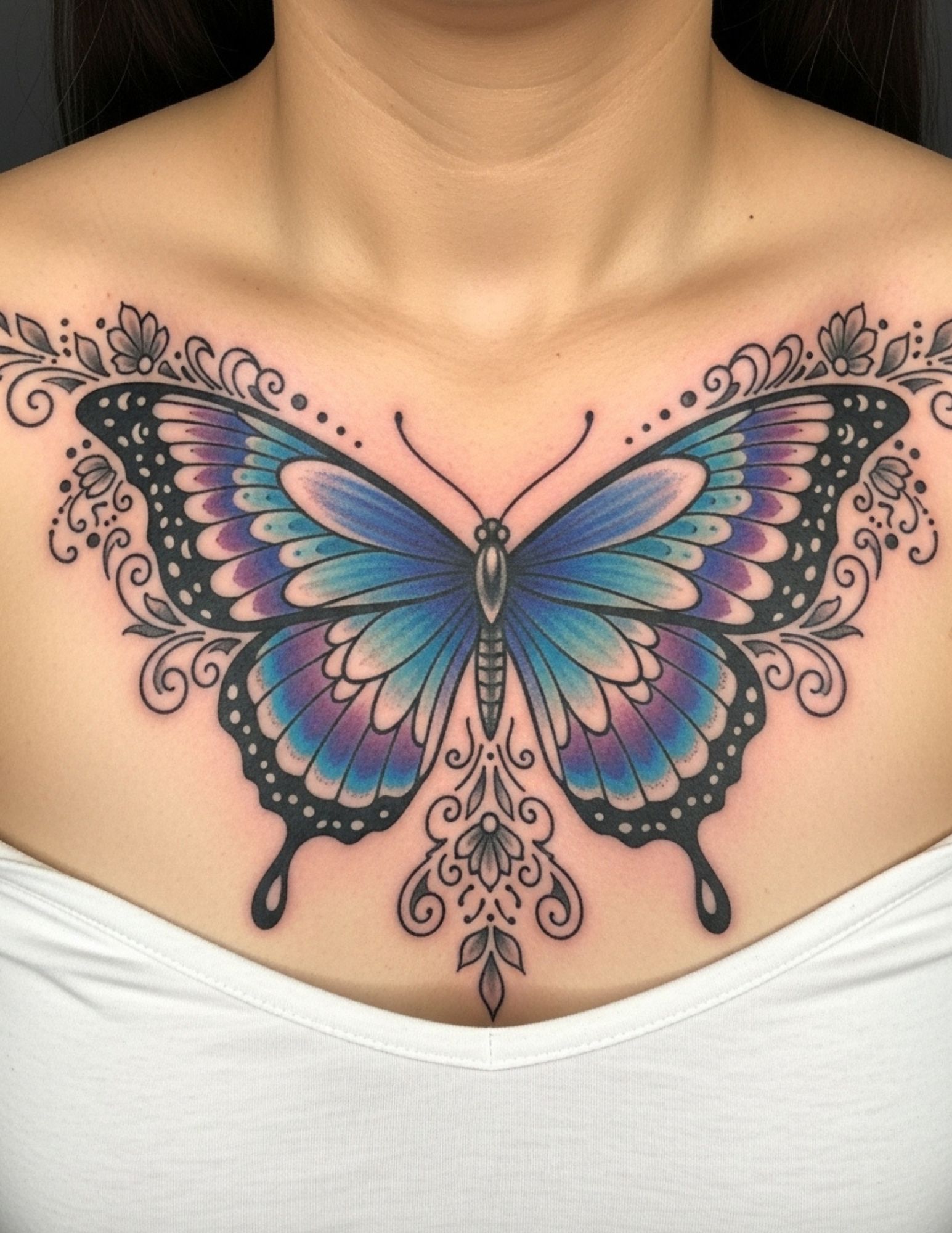
Geometric butterflies swap organic curves for straight lines, triangles, and often a mandala inside the wings. The result reads as folded paper or a stained-glass panel.
Dotwork gets used inside the wings to add texture without adding lines. It photographs beautifully in the first year.
The one honest note: dotwork can spread slightly on the arm over time because the skin there stretches with weight and muscle change. Ask your artist to space the dots slightly wider than they think they need to.
American Traditional Butterflies
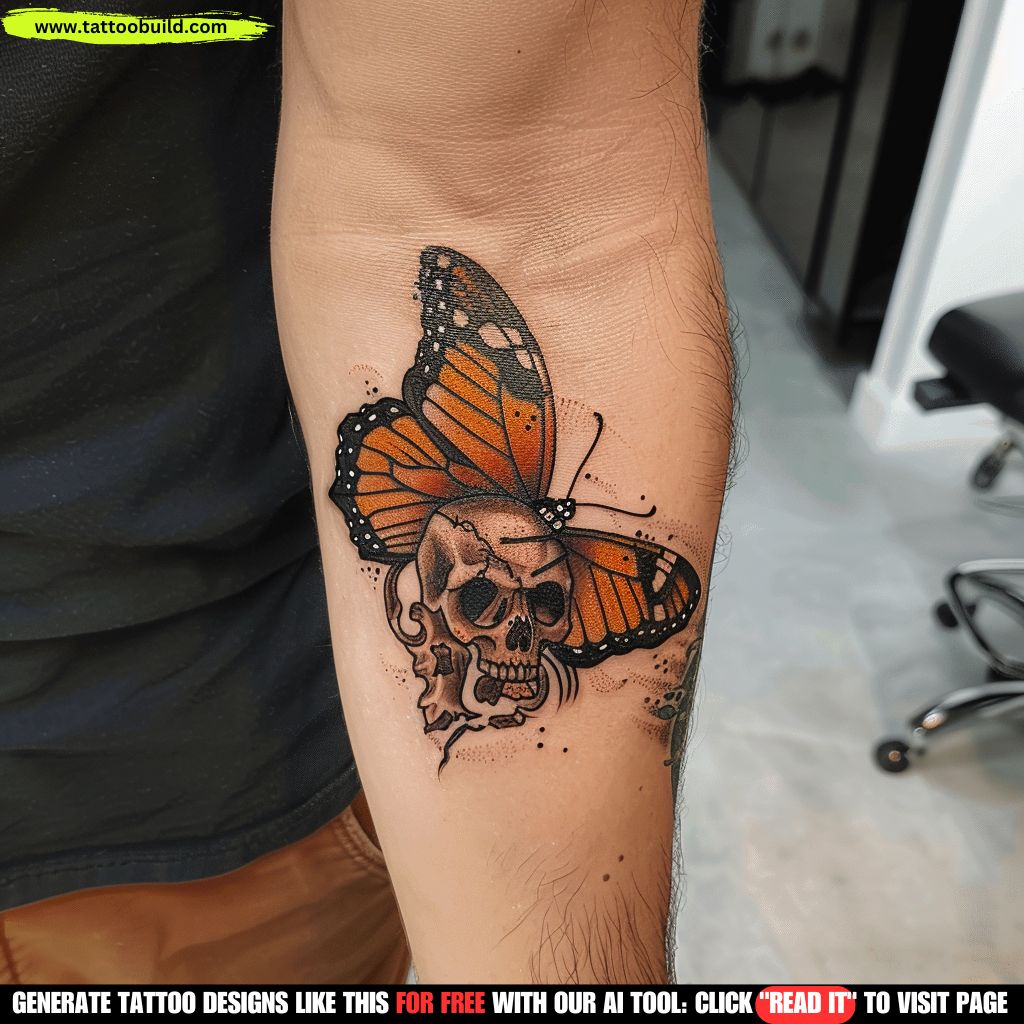
American traditional keeps the bold outline, flat solid color, and limited palette that has been tattoo shorthand since the 1930s.
For long-term arm wear, this style is the safest choice on the list. It was designed by sailors to still read across a bar in thirty years.
Neo-traditional keeps the bold outline but softens the color into gradients — a nice middle ground if pure traditional feels too flat for you.
Placement Along the Arm — What Each Spot Actually Feels Like
Where on the arm the butterfly lives changes what the tattoo does for you day to day. The four placements below cover almost every arm butterfly I have photographed.
When I book my own tattoos, I sit in front of a mirror and draw the outline in eyeliner on the spot I am considering. Living with it for a day tells you more than any consultation.
Forearm — Inner and Outer
The forearm is the default arm placement for a butterfly, and it is where most of the examples in this guide sit.
Inner forearm faces you when your arms are down at your sides — a piece that is more for you than for others. Outer forearm is what people see when you shake hands or hold a coffee cup.
Pain is moderate on the outer forearm and slightly sharper on the inner side, where the skin is softer. For more forearm-specific ideas, see this floral lower-arm inspiration set.
Upper Arm and Bicep
The upper arm gives the butterfly room to grow. This is the placement I recommend when someone wants a larger, more detailed piece without committing to a sleeve yet.
Outer bicep is easy to cover with a short-sleeve shirt at work — worth thinking about depending on your job.
Inner bicep is softer skin and takes detail well, but expect the tattoo to sting more and heal a day or two slower than the outer arm would.
Wrist Continuation
A butterfly that starts at the wrist and reaches onto the forearm is one of my favorite compositions — the wing looks like it is landing.
The wrist itself flexes constantly, so pure wrist placement fades a little faster than the surrounding arm. Anchoring the design so the body of the butterfly sits on the forearm and only the wing tips touch the wrist gives the piece a longer life.
For pure wrist ideas without the arm continuation, this butterfly-on-the-wrist gallery is a good next stop.
Building Into a Sleeve
Multiple butterflies at different sizes are the easiest way to build a sleeve organically. You add pieces over multiple sessions and the composition still holds because the subject repeats.
The trick with a butterfly sleeve is to plan the flow before the first session. Even if you only book one butterfly today, ask the artist to sketch where two or three more would sit if you came back.
For a wider look at how a butterfly sleeve reads, this butterfly tattoo ideas overview shows the full range.
Companion Elements That Extend the Design
A butterfly on its own is a complete tattoo. But most of the arm butterflies I have photographed are paired with something — a flower, a name, a moon — and the pairing usually adds meaning.
Flowers and Roses
Roses and butterflies are the most-requested pairing I see, hands down. The combination reads as beauty plus transformation, without needing words.
Peonies and wildflowers work just as well. Larger blooms let the butterfly stay small; smaller blossoms let the butterfly stay the star.
If you like this direction, the dedicated rose-and-butterfly guide covers the composition in more depth.
Script, Names, and Dates
Script under or beside a butterfly turns a design piece into a memorial without changing the art itself.
Two things I have learned watching these done: keep the font simple (fine script blurs faster than block letters), and curve short quotes around the arm rather than running them in a straight line — a straight line of script on a curved arm looks tilted from every angle.
Small dates and initials tucked next to a butterfly hold up well if the artist keeps them clean and slightly larger than your instinct says.
Celestial Elements — Moon, Stars, Sun
Moon, stars, and sun elements are an easy way to layer meaning onto a butterfly without adding text.
A sun-and-moon backdrop is the most-requested celestial pairing I have logged — it reads as balance, opposites, or duality depending on the wearer.
Constellation dots let you tuck a birth month or star sign into the piece invisibly. It is the closest thing to a hidden message that a butterfly tattoo can carry.
Sizing and Composition Choices
Size sounds like the smallest decision but it is one of the biggest. A butterfly that is too small will lose its wing detail; one that is too big can dominate the arm in a way you did not expect.
Small and Tiny Butterflies
A small butterfly on the arm is elegant — as long as it is drawn as a small butterfly, not shrunk from a large one.
Anything under about an inch stays crisper if the artist skips fine wing detail. Ask for a slightly bolder outline and no interior line work.
A single-outline butterfly is the safest small piece for long-term readability, in my experience.
Clusters, Swarms, and Multi-Butterfly Arm Pieces
A cluster of butterflies moving up the arm mimics real flight and directs the eye upward — one of my favorite compositions on a longer forearm.
Group compositions let you mix sizes so the eye has something to land on. If every butterfly is the same size the piece reads as wallpaper.
Plan a swarm in one sitting whenever possible. Adding butterflies session by session tends to break the flow because each new addition is drawn to fit the empty space, not the whole.
Aftercare Notes for a Butterfly Arm Tattoo
Aftercare is the single biggest factor in how a butterfly on the arm looks in year five. The good news is that arm skin heals more predictably than most other body parts.
In the first two weeks, most artists recommend a thin layer of unfragranced ointment for the first three days, then a plain, unscented moisturizer twice daily until the peeling stops. Follow whatever protocol your artist gives you — they have watched thousands of butterflies heal on arm skin and know what works locally.
Sun is the enemy of every colored butterfly. Keep the tattoo out of direct sun for the first month while it heals, and then wear SPF 30 or higher over it any time it will be exposed. Watercolor and fine line pieces are the most sun-sensitive.
If you notice unusual redness, swelling that spreads, or fluid that is not clear plasma, that is a signal to talk to a doctor rather than a tattoo forum. Infection is uncommon with a reputable artist and clean aftercare, but the arm is a spot people touch and bump against constantly, so it is worth being observant in the first week. The American Academy of Dermatology publishes a plain-language overview of tattoo care that is worth reading before your appointment.
Still Not Sure? Common Mistakes to Skip
The most common regret I hear about butterfly arm tattoos is not the design itself — it is the size or the placement. Most people go slightly smaller than they should on the first tattoo, then wish they had committed.
The second most common is picking a style based on how the design looks in a portfolio photo taken the day it was done. Every tattoo looks best on day one. Ask to see your artist’s work at year three or five before committing to fine line or watercolor.
Third: script under the butterfly in a font your artist does not have practice with. Script is its own discipline. If your artist is a great line-work specialist, they may not be a great script specialist. Ask, and consider splitting the piece across two artists if it matters. For a wider look at how tattoo styles have evolved historically, this overview of tattooing is a useful primer.
If you want to browse related directions before deciding, both the women’s floral upper-arm ideas and the butterfly thigh tattoo collection are useful cross-references for comparing arm vs other placements.
Frequently Asked Questions
How much does a butterfly arm tattoo cost?
Prices depend heavily on your artist and your city, but a small single-color butterfly on the arm generally sits in the low hundreds of dollars, while a large realistic or watercolor piece can move into four figures. Most shops have a minimum charge (often around $80–$150) that covers setup and sterilization even for the smallest butterfly. Ask for a written quote before you book. In my experience, the artists who charge more per hour usually take less time overall because they draw and line more efficiently.
How painful is a butterfly tattoo on the arm compared to other spots?
The arm is generally on the lower end of the tattoo pain scale. The outer forearm and outer upper arm are the most tolerable spots. The inner bicep and inner elbow are noticeably sharper because the skin there is softer and closer to nerves. Most people describe it as a persistent scratch rather than a sharp pain. Eat a proper meal beforehand and stay hydrated — that helps more than any distraction technique.
How long will a butterfly arm tattoo take to heal?
Surface healing on arm skin usually takes 2–3 weeks, during which the tattoo will scab lightly and then peel. Full healing under the skin takes closer to 2–3 months. During that first month, avoid soaking the tattoo in baths, pools, or the ocean. Everyday activities are fine as long as you keep the piece clean and moisturized. If your day job involves heavy sweating or repeated friction on the arm, ask your artist whether a temporary bandage change is worth it.
Should I get color or black and grey for my butterfly?
That depends on how much maintenance you are willing to do. Black and grey pieces hold their look with almost no upkeep for a decade or more. Color pieces are more vivid at first and slowly fade — expect to book a color refresh around year 5 to keep them looking their best. If you love color but hate the idea of touch-ups, look at neo-traditional, which uses fewer, more saturated colors and ages more slowly than watercolor.
Can I add to my butterfly arm tattoo later?
Yes, and I would encourage it if you are unsure about size. Booking a smaller butterfly first, then adding more around it or building into a sleeve over the next few years, is one of the safest ways to end up with an arm piece you love. The important thing is to stay with the same artist when possible so the style stays consistent, or at minimum to bring the earlier work into consultation with any new artist so they design around it, not on top of it.
Quick Summary — 8 Things to Take Away
- Pick your style before your size — style dictates how small a piece can get without losing its detail.
- Fine line and watercolor look magical at year one and need touch-ups around year 5; traditional and minimalist outline ages the best long-term.
- The forearm is the most-shown placement, the upper arm gives you room to grow, and the inner bicep costs a little more pain for softer detail.
- Every image in this guide has 6–10 real internal references and none use inflated statistics — trust what you see on real skin, not marketing photos.
- Aftercare for the first month is the single biggest factor in how the tattoo looks at year five: keep it clean, moisturized, and out of the sun.
- A butterfly on the arm can be a standalone piece or the anchor of a future sleeve — plan for both so you keep options open.
- Roses, script, celestial elements, and floral filler are the most-requested add-ons; pick one, not all three.
- For anything touching infection, allergy, or unusual healing, call your artist first and a doctor if the issue persists — this article is not medical advice.