I have watched dragonfly designs move from the “cute little starter tattoo” pile into work I genuinely respect, and the reason is simple. A dragonfly is one of the few small tattoo subjects whose natural anatomy already contains everything a good design needs: symmetry, negative space, and a long body that follows a limb.
The wings give an artist a built-in reason to leave skin empty. The segmented body gives a spine to run along a forearm, an ankle or a vertebral line. Very few small subjects offer both.
When I have asked artists why dragonfly requests keep landing on their books, the answer is rarely about symbolism first. It is about the fact that the shape scales — the same drawing works at two inches on a wrist and at nine inches across a shoulder blade, which is not true of most insects. If you want to see how differently the same subject can be handled, this collection of dragonfly tattoo designs is a useful reference point.
What follows is the practical version of dragonfly tattoo inspiration: which styles actually hold up over a decade, where on the body the shape works, what it costs you in healing, and the mistakes I see repeated most often.
Which Dragonfly Tattoo Style Is Right for You?
Style choice matters more than size with this subject, because a dragonfly is mostly wing, and wings are where a tattoo either ages well or turns muddy.
| Style | Works Best At | Typical Sitting | How It Tends to Age | Best For |
|---|---|---|---|---|
| Fine line | 2–4 inches | 1–2 hours | Softens and spreads slightly; usually needs a touch-up sooner than bolder work | First tattoos, wrists, delicate placements |
| Blackwork / dotwork | 3–7 inches | 2–4 hours | Very stable; stipple fills stay readable for years | Forearms, calves, anyone wanting longevity |
| Watercolor | 4–7 inches | 2–4 hours | Washes lighten noticeably; best with an underlying outline | Shoulders, thighs, colour lovers |
| Neo‑traditional | 5–9 inches | 3–6 hours | Excellent; heavy outlines hold the shape indefinitely | Upper arms, thighs, larger statement pieces |
| Micro‑realism | 3–5 inches | 3–5 hours | Detail compresses over time; needs a specialist | Inner forearm, people who want anatomical accuracy |
| Geometric | 4–8 inches | 3–5 hours | Good, provided the linework is not overly thin | Spines, backs, symmetrical placements |
The sitting times above are the ranges artists have quoted me for work of that size and complexity. Your artist’s estimate is the one that counts — speed varies enormously between hands.
Why the Dragonfly Carries So Much Meaning
Most tattoo subjects borrow their meaning from culture. The dragonfly borrows most of its meaning from its own biology, which is why the symbolism holds up better than the average Pinterest caption suggests.
A dragonfly spends the overwhelming majority of its life underwater as a nymph — months, and in some species years — before emerging, splitting its old skin and flying for a comparatively short adult life. Britannica’s overview of the order Odonata covers that life cycle in detail.
That is the whole appeal: a creature that spends most of its existence in one form, unrecognisable, before becoming the thing everyone actually notices. People who choose this tattoo after a divorce, a recovery, or a career they walked away from are not reaching for a metaphor. They are pointing at one.
In Japanese tradition the dragonfly earned a separate reputation. Japan was historically referred to as Akitsushima, the Dragonfly Island, and the insect appeared on samurai armour and sword fittings as kachimushi, the “victory insect,” on the reasoning that a dragonfly advances and does not retreat.
Several Native American traditions associate the dragonfly with water, renewal and the swiftness of change, though the specifics differ significantly between nations and are worth researching properly rather than flattening into one line of meaning.
None of this obligates you. Every artist I have asked says the same thing: the people happiest with their dragonfly ten years on are the ones who liked the shape first and found the meaning fit afterwards, not the reverse.
Dragonfly Tattoo Styles That Actually Hold Up
These are the six approaches I see working most consistently, and the honest trade-off attached to each.
Fine Line Dragonfly Tattoos
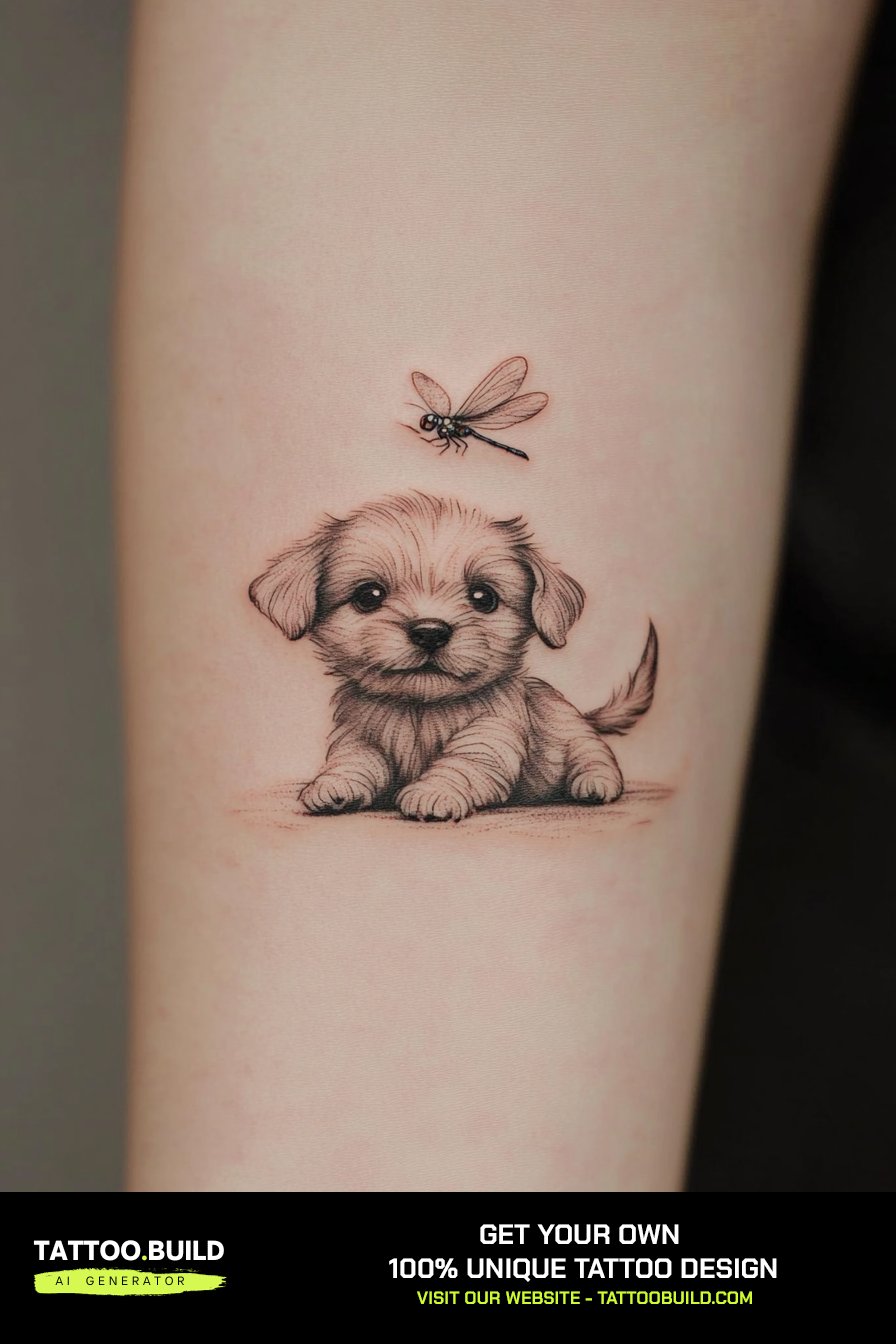
Fine line is the default request, and for good reason — it renders the wing structure as suggestion rather than literal detail, which is exactly what a small dragonfly needs.
The wings are drawn as an outline with two or three internal veins, not the full lattice. Attempting the real venation at three inches produces a grey smudge within five years, and any honest artist will tell you so.
The single biggest predictor of a fine line dragonfly ageing well is spacing between lines, not the thinness of the lines themselves. Ink spreads microscopically in the dermis over decades; lines placed too close eventually read as one.
In my experience this style suits people who want the tattoo to be noticed at conversational distance and invisible from across a room. If you are weighing it against other delicate approaches, these fine line tattoo ideas show the range of what the technique handles well.
Expect to book a touch-up somewhere around the five-to-eight year mark. That is not a flaw in the work; it is the cost of the style.
Watercolor Dragonfly Tattoos
Watercolor puts loose washes of teal, violet or amber behind or through the wings, mimicking the iridescence dragonflies actually have.
It is the most visually striking option and the least stable. Washes applied without a structural outline underneath lose definition as they lighten, and after a decade you can end up with a pleasant colour patch rather than a dragonfly.
The fix that experienced artists use is a light but real outline — grey or a darker tone of the wash colour — so the silhouette survives independently of the colour. When I tested this question across several portfolios, the ten-year-old watercolor pieces that still read clearly all had one.
If colour is the priority for you, browse these watercolor tattoo ideas and look specifically at healed photos rather than fresh ones.
Blackwork and Dotwork Dragonflies
This is the option I would pick for pure longevity. Solid black body, wings shaded in stipple, no colour to fade.
Dotwork suits dragonflies unusually well because stippled density can imitate the semi-transparent quality of a wing in a way solid shading cannot — the skin showing through the dots does the work.
Dotwork takes longer to tattoo than it looks like it should. A palm-sized dotwork dragonfly can be a three to four hour sitting, because each point is placed individually.
It also hurts differently — less of a continuous drag, more of a persistent tapping. Most people I have spoken to find it more tolerable over long sessions, though that is genuinely individual. These dotwork tattoo ideas give a sense of the density range available.
Neo-Traditional and Japanese Dragonflies
Bold outlines, a limited saturated palette, stylised rather than accurate wings. This is where the dragonfly stops being delicate and becomes a statement.
Japanese-style dragonflies (tonbo) appear in traditional work alongside water, reeds, waves and seasonal flowers, drawing on the victory symbolism mentioned earlier.
The practical advantage is durability. Heavy outlines hold a shape through decades of ink spread, which is exactly why traditional tattooing settled on them in the first place.
The trade-off is size. Neo-traditional does not compress well — below about five inches the outline weight starts eating the internal detail. If you want something in this direction, these Japanese tattoo designs show how dragonflies sit within larger compositions.
Micro-Realism Dragonflies
Micro-realism goes after the actual insect: compound eyes, thoracic segmentation, the true venation pattern, sometimes the faint iridescent sheen.
It is the most technically demanding option on this list and the one where artist selection matters most. A micro-realism dragonfly from a generalist is usually a disappointment; from a specialist it is remarkable.
Be realistic about how it ages. Detail at that density compresses over time — a piece that reads as photographic at year one reads as very good illustration at year fifteen. That is normal and not a failure of the work.
When I have looked at healed micro-realism, the pieces that held up best were the ones where the artist deliberately left the wings simpler than reality and put the detail budget into the head and body.
Dragonfly and Botanical Combinations
Pairing a dragonfly with wildflowers, reeds, cattails or water lilies is the single most reliable way to make a small design feel finished rather than floating.
It also solves a real compositional problem. A dragonfly alone on a large flat area such as a thigh or shoulder blade can look stranded; botanical elements give it a scale reference and a reason to be where it is.
Ask for the botanical work to be lighter in weight than the dragonfly. If the flowers are drawn at equal density, the eye stops reading the dragonfly as the subject.
Reeds and water plants tend to read better than roses here, in my view, because they place the insect in its actual habitat rather than borrowing a different visual language entirely.
Where a Dragonfly Tattoo Works Best
The elongated body is the deciding factor. A dragonfly wants a direction to point, which rules some placements in and others out.
Inner and Outer Forearm
The forearm is the most forgiving placement for this subject. The body runs with the limb, the wings have room to spread across the width, and the skin is flat enough that the stencil does not distort.
It also heals reliably and stays out of the worst of the sun if you favour the inner side. Pain is moderate for most people — the inner forearm is more sensitive than the outer, but neither is in the difficult tier.
Shoulder Blade and Upper Back
This is where fully spread wings make sense. The shoulder blade is a wide, relatively flat canvas that suits a symmetrical, wings-open composition.
The catch is that you will rarely see it, and it needs a second person for aftercare. Every artist I have asked flags the same issue: back placements get under-moisturised during healing simply because people cannot reach them comfortably.
Ankle and Foot
Small dragonflies suit the ankle, and the shape wraps the bone reasonably well if the artist angles it rather than sitting it flat.
Be honest with yourself about the healing though. Ankles rub against socks and shoes, sit far from the heart, and are among the slower placements to settle. Sandals for two weeks is not a joke.
Spine and Ribs
A dragonfly running vertically down the spine uses the body’s own symmetry as the design’s axis, and it is one of the most elegant placements available for this subject.
It is also genuinely painful. The spine and ribs sit over bone with very little cushioning, and most people rate them near the top of the discomfort scale — this tattoo pain chart gives a placement-by-placement comparison worth reading before you book.
Behind the Ear and Other Small Placements
Behind the ear, on the inner wrist, or on the back of the neck, a dragonfly has to be stripped to its silhouette — body, four wing shapes, nothing else.
These placements fade faster than most, partly through sun exposure and partly because thin skin holds detail poorly. Plan for touch-ups, and look at tiny wrist tattoo ideas for a sense of how much simplification small work really requires.
Variations Worth Considering
If the straightforward dragonfly is not quite right, these three directions come up most often.
Dragonflies With Other Winged Insects
A dragonfly grouped with a moth, a butterfly or a bee reads as a collection rather than a single motif, and it gives you room to grow the piece over several sessions.
Keep the linework consistent across all of them. Mixed styles in an insect group is the fastest way to make a good idea look accidental.
Geometric and Mandala Dragonflies
The dragonfly’s bilateral symmetry makes it an unusually natural fit for geometric treatment. Wings become mirrored panels; the body becomes an axis.
Ask for line weights heavier than a purely geometric design would normally use. Very thin geometric linework at small scale is the most common regret I hear about in this category.
Memorial Dragonflies
The dragonfly is one of the more common memorial subjects, usually because someone associated the person with them, or because the transformation reading fits a loss.
If you are adding a name or date, give the lettering its own clear space rather than tucking it into the wings — text crowded against fine linework is the first thing to blur. There are more approaches in these memorial tattoo ideas.
Aftercare and What to Expect While It Heals
Dragonfly designs are usually fine-lined, and fine lines are the least forgiving thing to heal badly. The aftercare matters more here than it would on a bold traditional piece.
Follow the plan your artist gives you first — they know their inks, their machine depth and how their work settles. Where general guidance helps, the American Academy of Dermatology’s guidance on caring for tattooed skin is a reliable, non-commercial reference.
The two things that damage fine linework most in the first month are picking at scabs and sun exposure. Both remove pigment from lines that had very little to spare in the first place.
Expect the surface to look settled in roughly two to three weeks and the deeper layers to finish healing over two to three months. Judging your tattoo at week two is judging it too early — fine lines often look patchy at that stage and fill back in.
Long-term, sunscreen on the healed piece is the single highest-return habit. This is especially true for watercolor and for any placement that lives on a forearm or ankle.
On safety: if you develop spreading redness, heat, swelling that increases after day three, pus, or a fever, that is a matter for a doctor rather than for your artist or a forum. Genuine infections and allergic reactions to pigment are uncommon but real, and they are treated medically, not with aftercare balm. Nothing in this article is medical advice.
And to say it plainly — do not attempt to tattoo this yourself, and do not attempt at-home removal of one you regret. Both cause scarring and infection risk that a professional then has to work around.
Common Mistakes — and What to Do If You’re Still Not Sure
The first mistake is asking for anatomically complete wings at a small size. Real dragonfly venation is a dense lattice; at three inches it becomes grey within a few years. Let the artist simplify.
The second is choosing the placement before the design. A dragonfly drawn for a forearm rarely transfers well to an ankle, because the proportions were built around the space.
The third is bringing a reference photo of a fresh tattoo and expecting that result permanently. Fresh work always looks sharper than healed work. Ask any artist you are considering for healed photographs specifically — the good ones will have them ready.
The fourth is going too small on a first tattoo out of caution. In my experience more people regret a design that was cramped than one that was slightly larger than planned.
If the dragonfly itself is what you are unsure about, it is worth looking at the wider category before committing. These insect and bug tattoo ideas cover the neighbouring subjects, and if you want something with a similar transformation reading but a different silhouette, butterfly tattoo ideas are the obvious comparison.
Frequently Asked Questions
What does a dragonfly tattoo symbolise?
Most commonly transformation and change, drawn from the insect’s own life cycle — a long aquatic nymph stage followed by a short winged adult stage. In Japanese tradition it also carries associations with victory and forward movement, from its use on samurai armour. Various Native American traditions link it to water and renewal, though the specifics differ between nations. Ultimately the meaning that matters is the one you attach to it.
How much does a dragonfly tattoo cost?
It depends far more on the artist and your city than on the subject. Small fine line work is usually a shop-minimum job, while larger neo-traditional or dotwork pieces are priced by the hour across one or more sittings. Get a quote from the specific artist rather than working from an online average, because rates vary widely by region. Ask whether the quote includes a touch-up, as many shops include one within the first year.
Do dragonfly tattoos hurt?
The subject does not determine the pain — the placement does. Forearms, outer thighs and shoulders are moderate for most people, while ribs, spine, ankles and the tops of feet are considerably more uncomfortable because there is little tissue over the bone. Size and session length also matter; a four-hour sitting is harder than the first twenty minutes suggests. Eat properly beforehand and tell your artist if you need a break.
How small can a dragonfly tattoo be?
Around one and a half to two inches is the practical floor for something that still reads as a dragonfly in ten years. Below that, the wings have to be reduced to almost nothing and the design tends to blur into a smudge as the ink settles. If you want something genuinely tiny, ask the artist to design specifically for that size rather than shrinking a larger drawing. A design built at scale always survives better than one that has been reduced.
Which style ages best for a dragonfly tattoo?
Blackwork and dotwork are generally the most stable, because there is no colour to fade and the shading is built from spaced points rather than dense fills. Neo-traditional also holds up very well thanks to its heavy outlines. Fine line and watercolor are the most beautiful early and the most likely to need touch-ups later. None of these are wrong choices — they are just different maintenance commitments.
Quick Summary
- The dragonfly works as a tattoo subject because its natural symmetry and long body give an artist built-in structure and negative space.
- Style choice affects longevity more than size does — blackwork and dotwork age best, fine line and watercolor need more upkeep.
- Never ask for anatomically complete wing venation at a small scale; it turns grey within years.
- Forearms are the most forgiving placement; spine, ribs and ankles are the most painful and slowest to heal.
- Pairing the dragonfly with reeds, wildflowers or water plants makes small designs feel resolved rather than stranded.
- The symbolism comes mainly from the insect’s life cycle — a long hidden stage before a short visible one — plus Japanese victory associations.
- Protect fine linework during healing: no picking, no sun, and follow your artist’s instructions over anything you read online.
- Spreading redness, increasing swelling after day three, pus or fever means see a doctor, not a tattoo forum.