If you are collecting drawings of tattoo roses before you book, the drawing matters more than the flower. A rose is only as good as the linework holding it together — and most of the designs that fail on skin failed on paper first.
I have spent a lot of hours looking at rose flash, and the pattern is consistent: the drawings that age well are the ones with clear petal edges, real contrast, and space between elements.
The sixteen drawings below are all from our own reference set. I have written what each one is actually doing, what it would cost you in session time, and where it tends to sit best on the body. If you want a wider net first, our full round-up of rose tattoo ideas covers finished work rather than sketches.
Treat these as conversation starters for your artist, not files to hand over and copy. Every artist I have asked prefers a reference plus a sentence about why you like it.
Which Rose Drawing Style Is Right for You?
Style decides almost everything downstream: session length, healing appearance, and how the piece looks in ten years. Here is how the four common approaches compare.
| Style | What the Drawing Looks Like | Smallest Size That Works | Best For |
|---|---|---|---|
| Black & grey realism | Soft graphite shading, no hard outline, petals defined by tone | Roughly palm-sized | Forearm, upper arm, thigh — anywhere with flat surface area |
| Bold traditional | Heavy outline, limited shading, simplified petal count | Roughly a business card | Anyone who wants it still readable decades later |
| Fine line | Thin single-weight lines, lots of white space, minimal fill | A few inches, but larger holds up better | Inner arm, ribs, ankle — low-friction placements |
| Blackwork | Solid black shapes, form carried by negative space | Medium and up | High-contrast pieces and cover-up work |
None of these is objectively better. In my experience the regret comes from mismatching style to size — a realism drawing shrunk to two inches, or a bold traditional rose blown up until the outlines look clumsy.
What Makes a Rose Drawing Actually Tattooable
A drawing on paper has no constraints. Skin has several, and they are the reason your artist will redraw whatever you bring in.
The first is line weight. Ink spreads slightly under the skin over years, so lines that sit close together on paper can merge into a grey mass on a healed tattoo.
The second is contrast. Roses read as roses because of the dark valleys between petals — if a drawing shades everything at the same mid-tone, the bloom flattens once it heals.
The third is placement geometry. A rose drawn as a flat circle fights the curve of a forearm; the ones that sit well are usually drawn on a slight diagonal with the stem giving the eye a direction to travel.
The fourth is honest size. Most artists I have spoken to will quietly upsize a detailed rose rather than cram the detail in, because the detail is the whole point.
Rose symbolism is genuinely old — the flower has carried meanings of love, secrecy and mourning across a lot of cultures, as this overview of rose symbolism lays out. That history is why the same flower works on a memorial piece and a romantic one.
10 Rose Tattoo Drawings Worth Borrowing Ideas From
Each of these does one thing well. I have flagged what that thing is, so you can pull the idea rather than the whole design.
1. Classic Rose Trio
Three blooms, black and grey, with the leaves shaded as heavily as the petals. That last detail is what sells it — most amateur rose drawings leave the foliage as bare outline and the piece ends up looking unfinished.
The petals here are layered so that each one overlaps the one behind it at a slightly different angle, which is what creates the three-dimensional read.
This is the safest starting point of the ten. It has no symbolic baggage, it scales from a four-inch forearm piece up to a full outer thigh, and it works in any orientation.
Expect two to four hours for a mid-size version, depending on how deep the artist takes the shading. If you like this tonal approach, our guide to the black shaded rose tattoo goes further into how that grey is built.
2. Sword Wrapped in Roses
A sword running vertically with roses breaking up the blade and hilt. The appeal is structural, not just symbolic — the sword gives the composition a spine, and the roses stop it from reading as a plain weapon tattoo.
Note how the hilt is drawn with more detail than the blade. That is deliberate: it keeps the eye at the top of the piece where the flowers are densest.
This shape suits long, narrow placements. Forearm, outer calf, and the side of the ribs all take a vertical sword-and-rose well.
The risk with this one is detail density in the hilt. In my experience that ornamental scrollwork is the first thing to blur, so ask your artist to simplify it rather than reproduce it line for line.
3. Skull and Roses with a Dagger
The oldest pairing in tattooing, and it survives because the shapes complement each other — hard bone against soft petal, smooth cranium against textured leaves.
What makes this particular drawing work is that the roses fill the awkward negative space around the jaw and temple, so the composition has no dead corners.
The dagger adds a third element and, honestly, a third thing to go wrong. If you want the piece to stay legible at smaller sizes, drop it.
Skull and rose is the combination I see most often on regretted small tattoos — not because the idea is bad but because people get it too small. Give it room. Our dedicated skull rose tattoo drawing guide has more compositions in this vein.
Rose designs and the prompts behind them
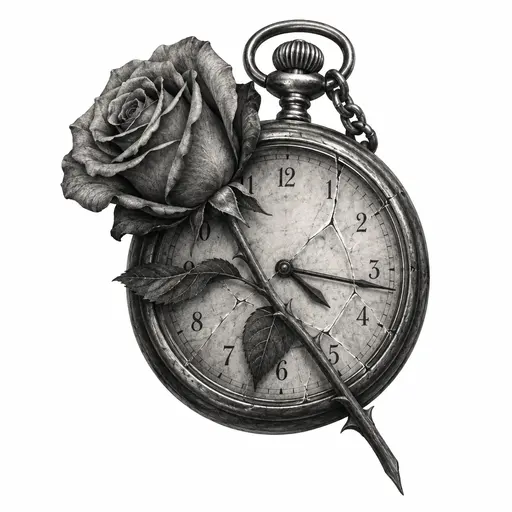
An old pocket watch stopped at 4:17, its glass cracked, a single rose lying across the face
Use this idea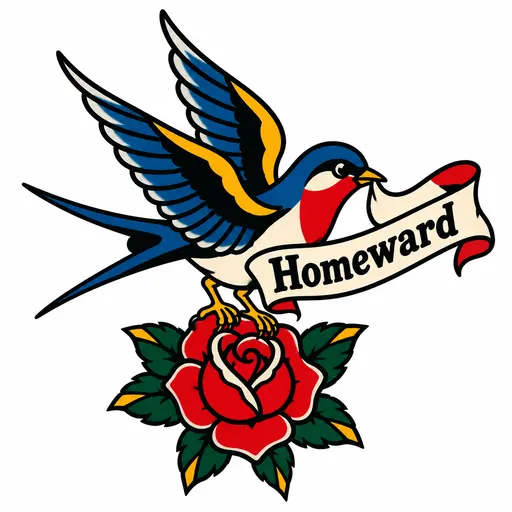
A swallow carrying a banner that reads "Homeward", with a red rose beneath its feet
Use this idea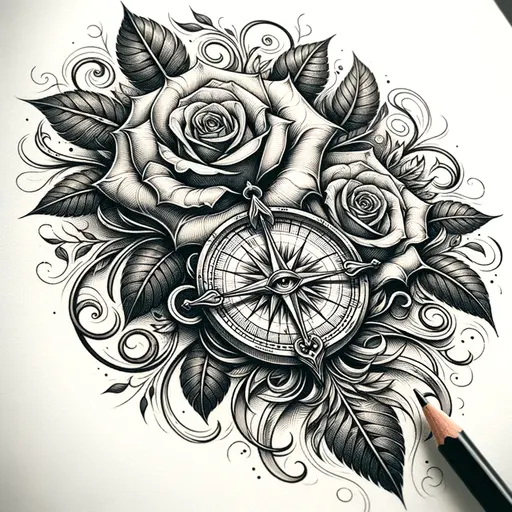
2 roses, stems with thorns, leaves compass eye of providnce
Use this idea
4. Hourglass with Roses – Minimal Version
An hourglass framed by roses, with the glass itself drawn plainly. The restraint is the whole design decision here.
When both the timepiece and the flowers are heavily detailed, the eye has nowhere to rest and the tattoo reads as noise from a metre away.
This version keeps the frame simple and lets the petals carry the detail, which is the right call for anything under six inches.
Time-and-flower pieces tend to mean something specific to the person wearing them — a birth, a loss, a countdown. If timepieces are the direction you are heading, our clock tattoo drawings collection covers the mechanical side properly.
5. Hourglass with Roses – Detailed Version
The same concept with fuller leaves and a shaded wooden frame. This is what the previous design looks like when you commit to a larger canvas.
The extra leaf work does real compositional work: it softens the rectangle of the frame and helps the piece sit against the curve of a thigh or forearm.
I would not attempt this one under about seven inches. The frame shading needs room to stay separate from the leaf shading.
Budget four to six hours. Detailed frame work is slow, and rushing it is exactly how you end up with a grey block instead of visible wood grain.
6. Four-Rose Cluster
Four blooms at varying stages of opening — one bud, two half-open, one fully bloomed. That variation is the technique worth stealing.
Drawing every rose fully open makes a cluster look repetitive; mixing the stages gives it a natural rhythm and a clear focal flower.
This composition flows rather than sits. It is drawn to travel along a limb, which makes it a strong candidate for a forearm band or the start of a sleeve.
Clusters are also the easiest piece to extend later. Every artist I have asked prefers starting a sleeve with something like this rather than a single centred rose.
7. Snake and Roses
A serpent winding between the blooms. The snake solves a real problem in multi-rose designs — it links the flowers so they read as one piece rather than three separate stickers.
The scales also give you a texture contrast against the petals, which helps both elements stay distinct once healed.
Snakes suit wrapping placements: around a forearm, down a calf, along the ribs. The body of the snake can follow the limb in a way a stem cannot.
One honest caution — scale texture is detail-heavy and can grey out over time. Ask for larger, fewer scales than the drawing shows.
8. Butterfly Resting on a Rose
Lighter than most of this set, and shaded so that the butterfly is noticeably paler than the flower it sits on.
That tonal separation is the trick. When both elements are shaded to the same depth, the butterfly disappears into the petals.
This is a good candidate for a shoulder blade or upper arm, where the piece can be seen whole rather than wrapped.
It also scales down better than the skull or hourglass designs, because the shapes are simple and the contrast is built in.
9. Antique Hourglass with Scrollwork
The most ornate drawing here: a decorative hourglass with filigree around the frame and roses at the base.
It is genuinely beautiful on paper and genuinely difficult on skin. Filigree is fine repeated linework, and fine repeated linework is the first casualty of ink spread.
If you want this, get it big — ribs, thigh, or upper back — and accept it as a multi-session piece.
I would only take this drawing to an artist who specialises in ornamental work. A generalist can do it, but the difference shows within a couple of years.
10. Cross Wrapped in Roses
Roses clustered where the beams of a cross intersect, with the stems trailing down the vertical.
The clustering is what keeps it from looking severe. A bare cross is a stark shape; the flowers give it warmth without changing the meaning.
Memorial pieces are the usual context here, and the drawing leaves obvious room for a name or date along the vertical beam.
Vertical placements again: forearm, spine, outer calf. Our cross tattoo drawings guide covers the variations if the cross itself is the priority.
Four Rose Drawing Styles Worth Exploring
The ten above are variations on one visual language. These four sit outside it, and each solves a different problem.
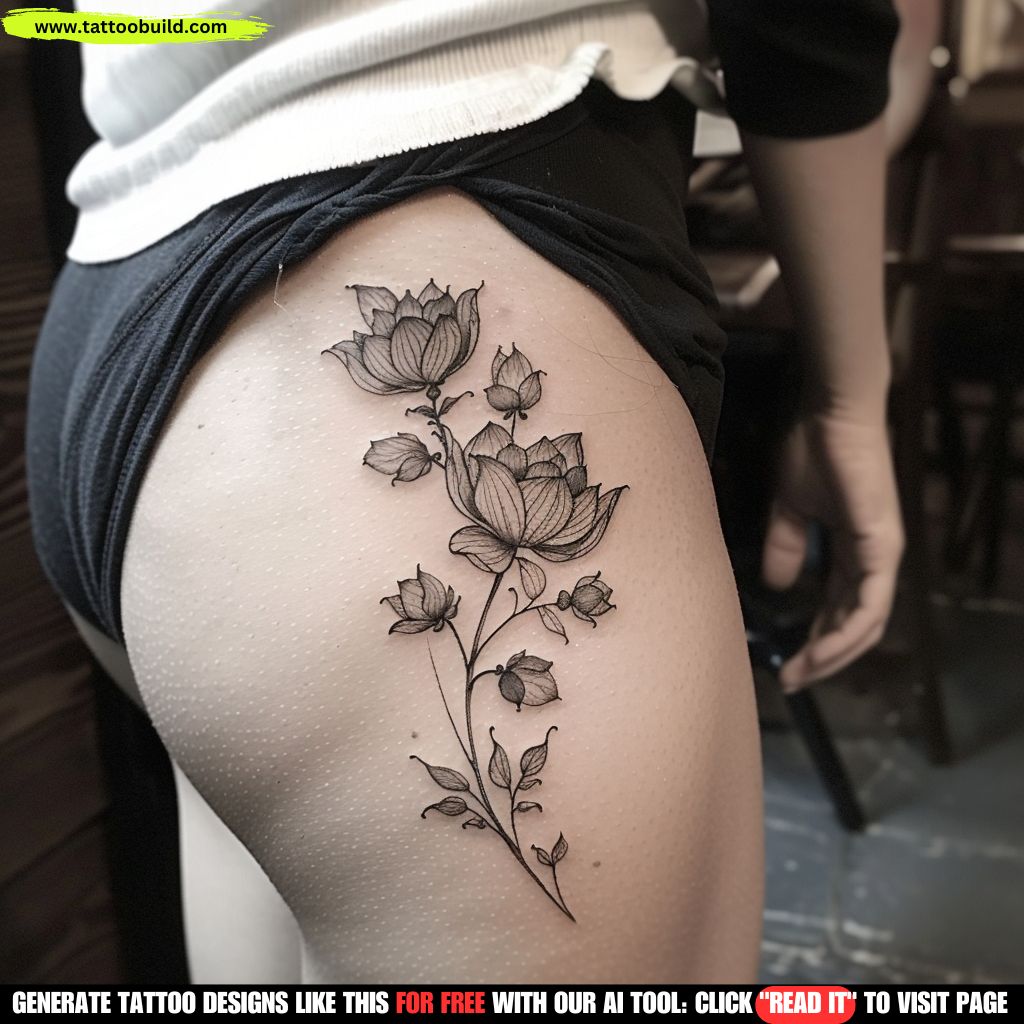
Fine Line: A Rose and a Bird
A single long-stemmed rose with a bird in flight above it, drawn almost entirely in thin single-weight line.
Fine line trades longevity for delicacy. It looks exceptional freshly healed and it does soften faster than bold work — that is the honest trade, not a flaw.
It suits inner arm, inner forearm and ankle, where the skin sees less friction and less sun. Our flower tattoo drawings collection has more in this register.
Blackwork: The Solid Silhouette
A rose built entirely from solid black shapes, with the petal structure carried by the gaps rather than by shading.
This is the highest-contrast option on the list and the one that ages best. There is no fine detail to blur because there is no fine detail.
It is also the strongest cover-up candidate here. If you are working over existing ink, this style buys you the most coverage. For more in this vein, see black rose tattoos for women.
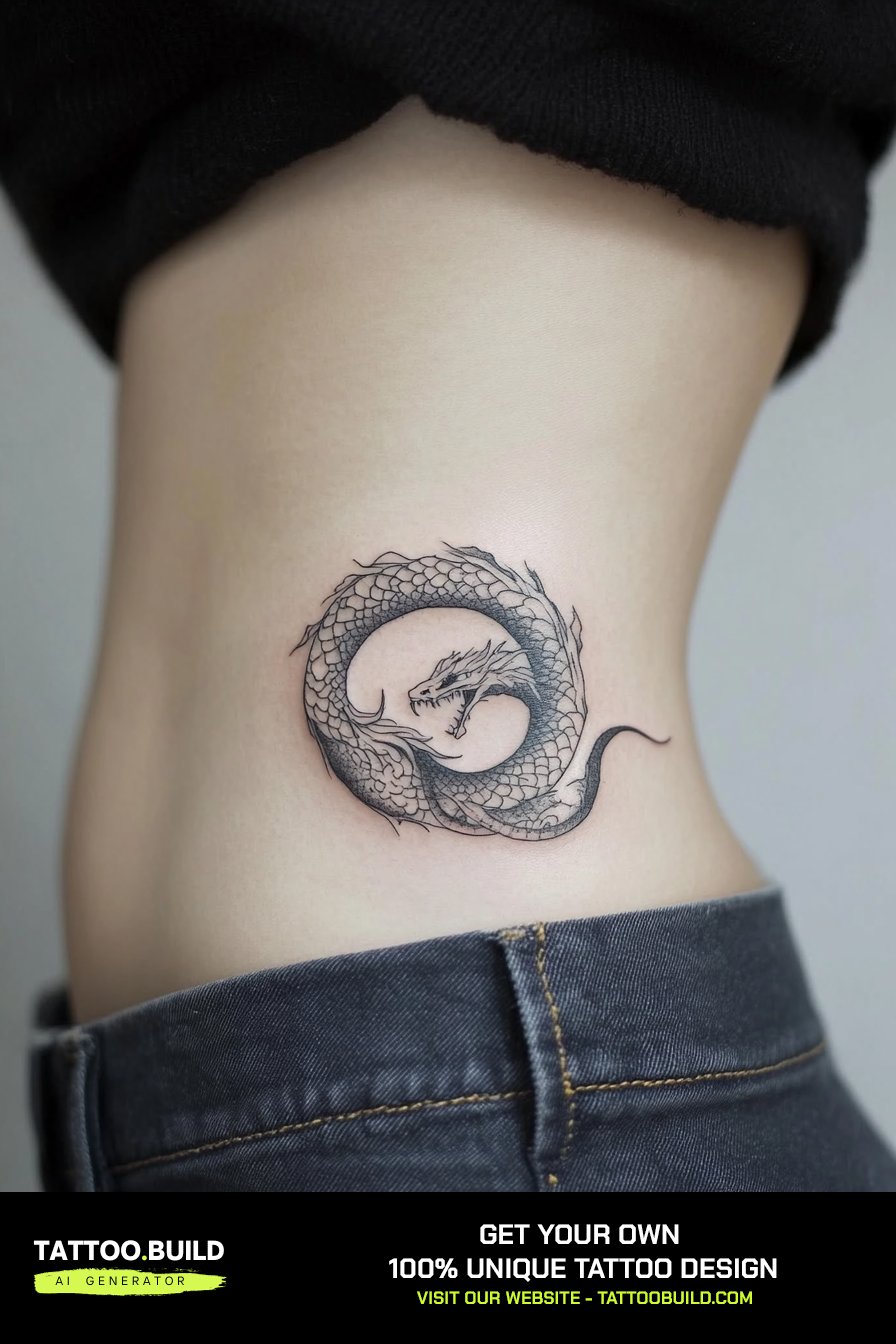
Rose With a Creature: The Dragon
A scaled dragon curling down to a single shaded bloom. The rose functions as an anchor point and a softener rather than the subject.
This is worth studying if you already have a large piece planned and want the rose to be supporting cast.
The composition is long and narrow, which makes it a natural for a spine, outer thigh or full forearm.
Dotwork: Stippled Skull and Rose
A skull shaded entirely in stipple, with a rose sitting on the crown. Tone is built from thousands of individual dots rather than from packed shading.
Dotwork is slow — expect noticeably longer sessions than an equivalent grey-shaded piece — and it heals with a distinctive soft, granular texture.
It is a specialist style. Not every shop has someone who does it well, and it is worth travelling for.
How to Use These Drawings With Your Artist
Bring three to five references, not thirty. In my experience a small, consistent set tells an artist far more about your taste than a sprawling folder.
Say what you like about each one. “I like how open the petals are here” is useful; “I like this one” is not.
Be explicit that you want their interpretation, not a copy. Most artists will not directly reproduce another artist’s design, and the version they draw for your body will fit better anyway.
Bring the placement to the consultation too — wear something that lets them see and mark the area. A rose drawn for a flat forearm needs adjusting for a shoulder.
On aftercare, follow the instructions your artist gives you for your specific piece rather than anything you read online. If a healing tattoo becomes hot, swollen, or increasingly painful after the first few days, that warrants a doctor, not a forum thread — the FDA’s guidance on tattoos and the American Academy of Dermatology’s care advice both cover the warning signs.
Common Mistakes With Rose Tattoo Drawings
The first is sizing down. A drawing scaled to fit a wrist loses the petal separation that made it good in the first place.
The second is stacking symbols. Rose plus skull plus dagger plus banner plus clock is four ideas competing for one space.
The third is ignoring the body. A design chosen flat on a screen can fight the curve it lands on — worth checking against real placements like a rose tattoo on the back shoulder before committing.
The fourth is picking a style that does not match how you want it to age. Fine line and bold traditional are both good choices; they are good choices for different people.
Still weighing it up? Browse rose flower tattoos for guys for masculine framing, or our broader cool tattoo drawings library if the rose is not settled yet.
Frequently Asked Questions
What does a rose tattoo actually mean?
There is no single fixed meaning. Historically the rose has stood for love, beauty, secrecy and mourning across a range of cultures, and modern tattooing has kept all of those in circulation. Colour shifts it further — red is usually read as passion, white as purity or remembrance, black as loss or defiance. In practice most people I have spoken to attach a personal meaning that has little to do with the traditional readings, and that is entirely valid.
How much does a rose tattoo cost?
It depends far more on hours than on the design itself, and shop rates vary enormously by city and by artist experience. A simple bold-outline rose is usually a single short session; a shaded realism piece or an ornamental hourglass can run across several. Ask for an hourly rate and an honest session estimate at consultation rather than a flat quote off a photo. Reputable artists will give you a range and explain what would push it higher.
Can I bring a drawing I found online straight to my artist?
Bring it as a reference, not as a file to copy. Most artists will not directly reproduce another artist’s original design, both as a professional courtesy and because a drawing made for someone else’s body rarely fits yours. What works is bringing the reference and explaining what you like about it. Your artist will then draw something that suits your placement, your size, and your skin.
Which rose tattoo style lasts the longest?
Bold traditional and blackwork generally hold up best, because they rely on thick lines and solid contrast rather than fine detail. Black and grey realism ages well too when it is drawn large enough for the tonal range to survive. Fine line pieces are the most likely to soften over the years, particularly in high-sun or high-friction placements. None of this is a reason to avoid a style — it is a reason to size it appropriately.
Where does a rose tattoo hurt least?
Fleshier areas with more padding — outer thigh, outer upper arm, forearm — are usually reported as more tolerable than areas over bone or dense nerve clusters like ribs, sternum, hands and feet. Pain is genuinely individual though, and session length matters as much as location. If you are uncertain, a shorter first session in a forgiving spot is a reasonable way to find out.
Quick Summary
- Pick the style before the design — realism, bold traditional, fine line and blackwork all age differently.
- Petal separation is what makes a rose read as a rose; protect it by sizing up rather than cramming detail.
- Vertical compositions like the sword, cross and dragon suit forearms, calves and spines.
- Clusters with mixed bloom stages flow along a limb and extend easily into a sleeve later.
- A snake, dragon or banner can link multiple roses into one composition instead of separate elements.
- Ornamental filigree and fine scale texture are the first details to blur — simplify them deliberately.
- Bring three to five references and explain what you like about each, then let your artist draw it for your body.
- Follow your artist’s aftercare instructions, and see a doctor if a healing tattoo worsens after the first few days.