A half sleeve lives or dies at the drawing stage, long before a needle touches skin. I have watched more half sleeves go wrong on paper than in the chair.
The pattern is always the same. Someone collects twenty images they like, hands the pile to an artist, and expects a single coherent piece to come out the other side.
What actually works is choosing one subject, one style, and one direction of flow, then letting everything else serve that. If you are still gathering references, our wider collection of half sleeve tattoo drawing ideas is a good place to start narrowing down.
Below are nineteen drawings I have pulled apart section by section — what each one is doing, where it sits on the arm, and who it tends to suit.
Which Half Sleeve Style Is Right for You?
Style choice narrows everything else: session count, how the piece ages, and how much of the arm you can realistically cover.
| Style | Best for | Typical session load | How it ages |
|---|---|---|---|
| Black & grey realism | Portraits, animals, religious imagery | Usually the heaviest — several long sittings | Soft greys can fade first; needs touch-ups |
| Fine line botanical | Flowers, moons, delicate arrangements | Lighter, often the fewest sessions | Thin lines spread over time; keep gaps generous |
| Japanese / irezumi | Koi, waves, dragons, full-arm flow | Long, structured, planned as one unit | Among the most durable when done traditionally |
| Polynesian & tribal | Wrapping the whole arm in solid black | Moderate, but dense packing is tiring | Very well — bold black holds its shape |
| Neo-traditional & ornamental | Symbols, cards, clocks, decorative panels | Moderate and easy to split into stages | Strong outlines keep it readable for decades |
There is no single best option here. The right style is the one your chosen artist already draws well, which is a far more reliable filter than picking a style first and hunting for someone to execute it.
What Makes a Half Sleeve Drawing Actually Work
A half sleeve normally covers shoulder to elbow, or elbow to wrist. That is a curved, moving surface, not a flat page.
The drawings that survive the jump to skin are the ones built with that curve in mind. In my experience the giveaway is whether the design has a clear top and bottom — something that leads the eye along the arm rather than sitting on it like a sticker.
The second thing is negative space. Every artist I have asked has said the same thing in different words: the untattooed skin is what makes the tattooed skin legible.
Third is scale. Detail that reads beautifully on an A4 sheet often collapses when it is shrunk to fit a forearm, and that is where most disappointment comes from. Budget matters too — our breakdown of what a sleeve tattoo costs is worth reading before you commit to a multi-session piece.
A good half sleeve drawing is a plan, not a picture. It should tell the artist where the piece starts, where it ends, and what fills the space between.
Half Sleeve Tattoo Drawings by Theme
These nineteen designs cover the themes that come up most often. I have grouped them so you can see how each approach handles the same arm-shaped problem.
Botanical and Floral Half Sleeves
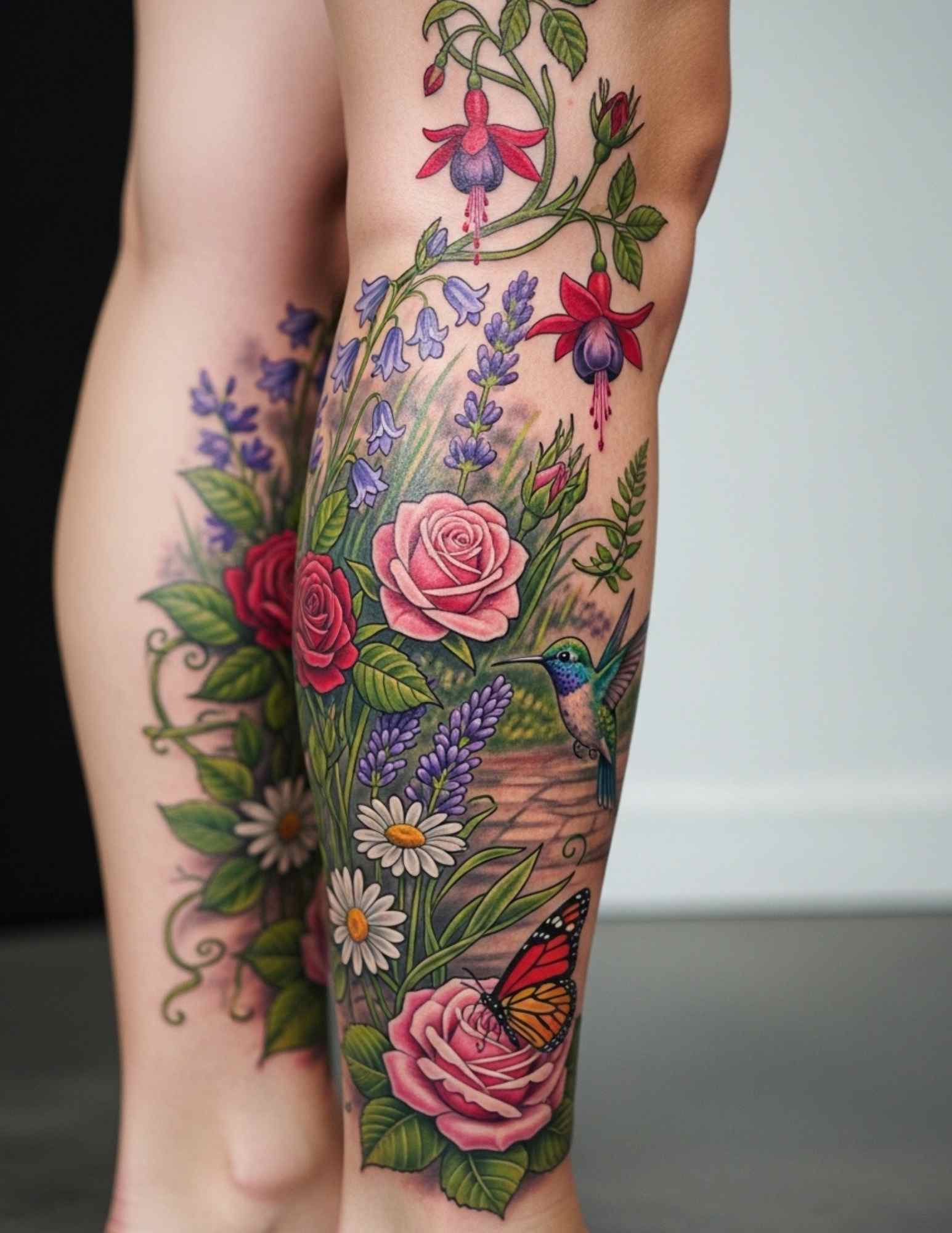
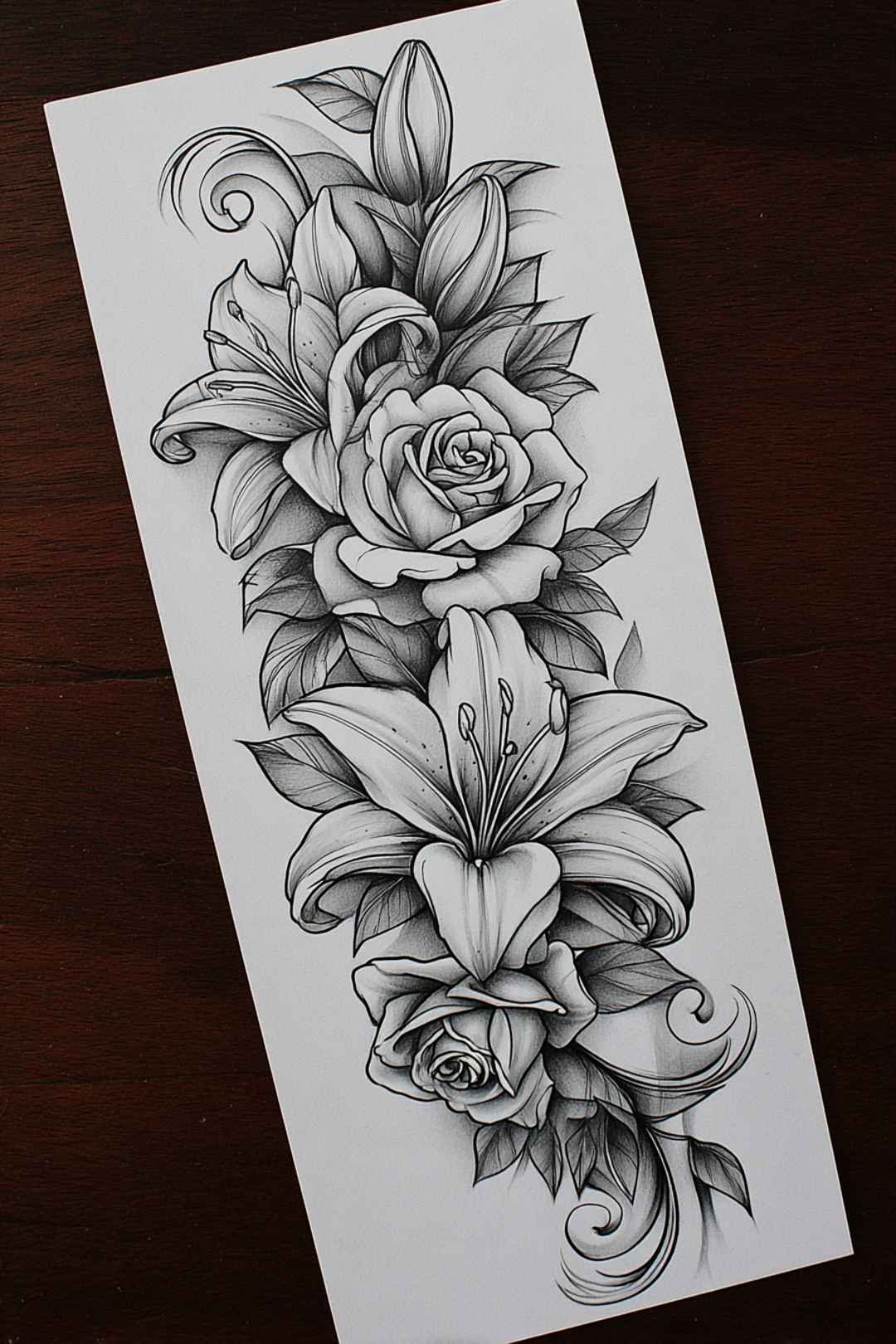
Florals are the most forgiving half sleeve subject, because a bouquet can be stretched, compressed or extended without breaking.
That flexibility is why I recommend them to people who are not sure whether they will eventually want a full sleeve. You can add another bloom in two years and nothing looks bolted on.
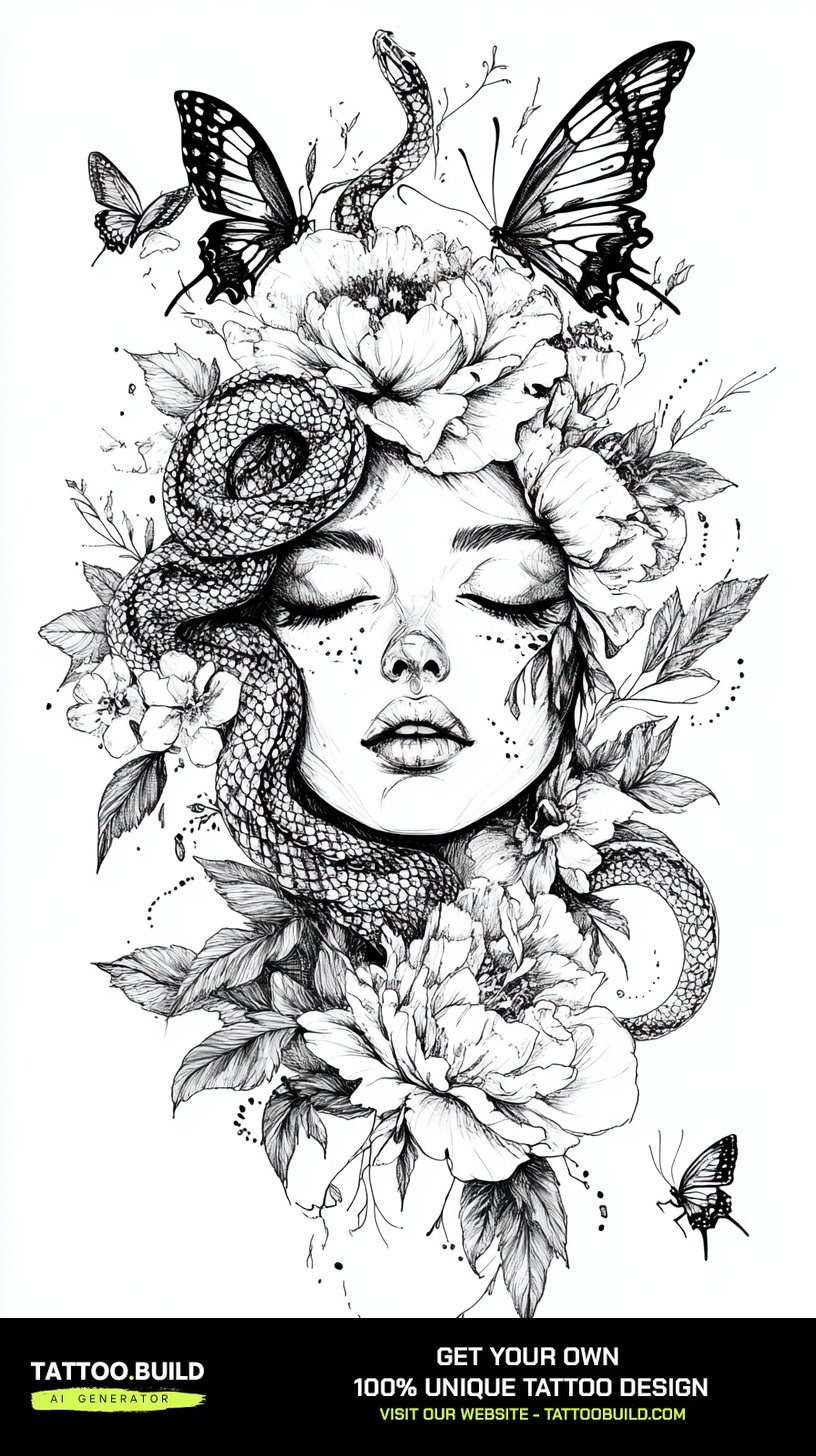
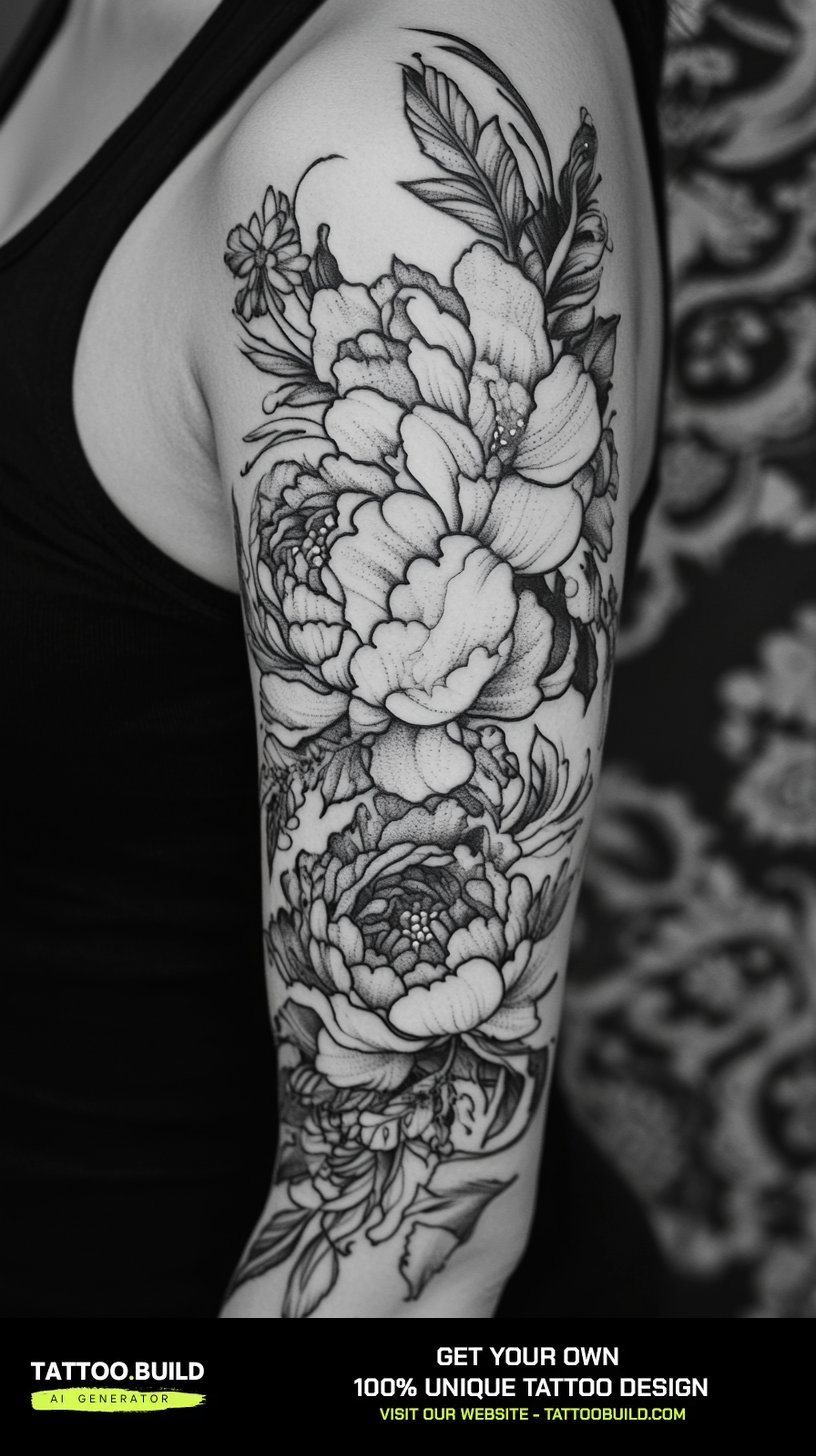
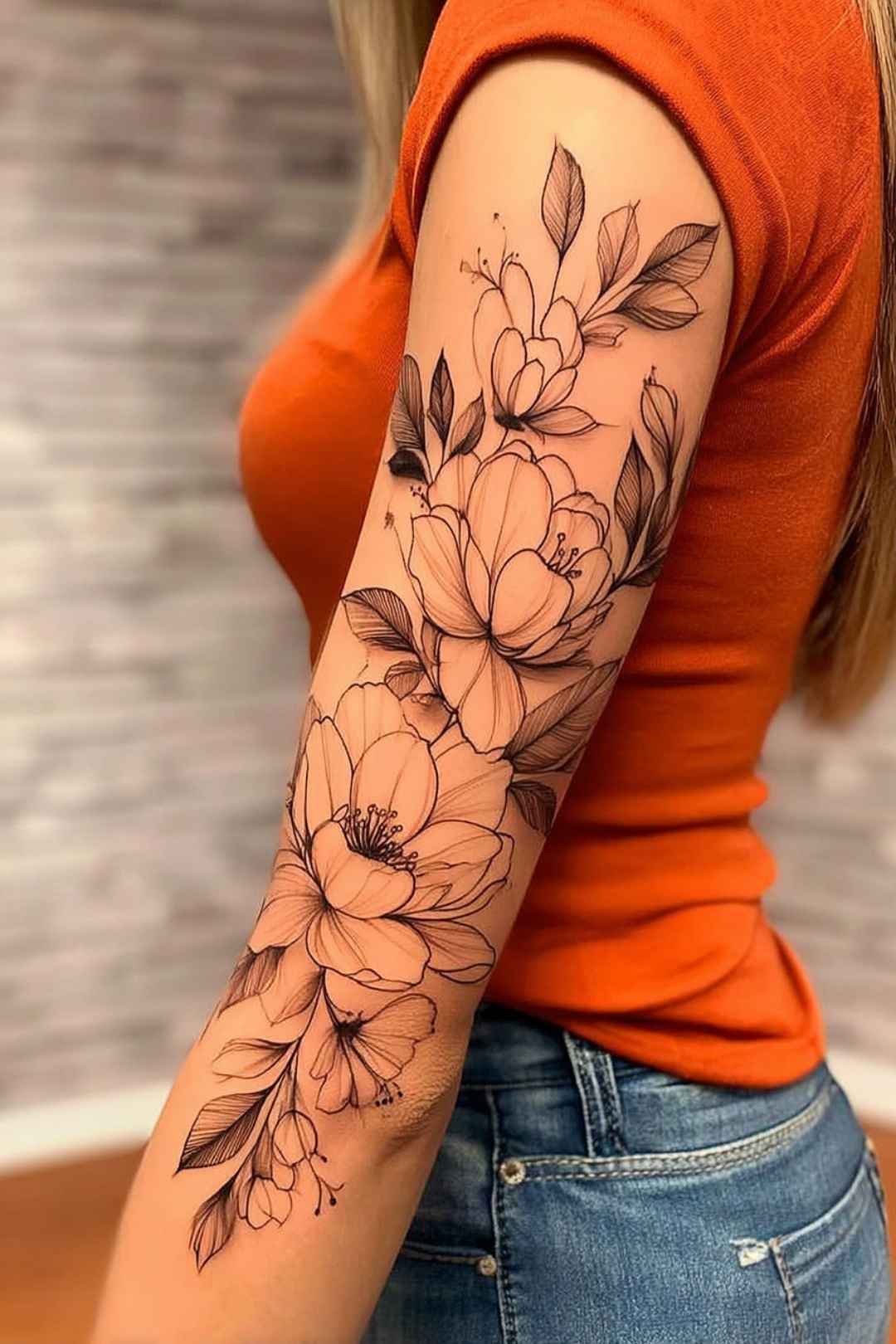
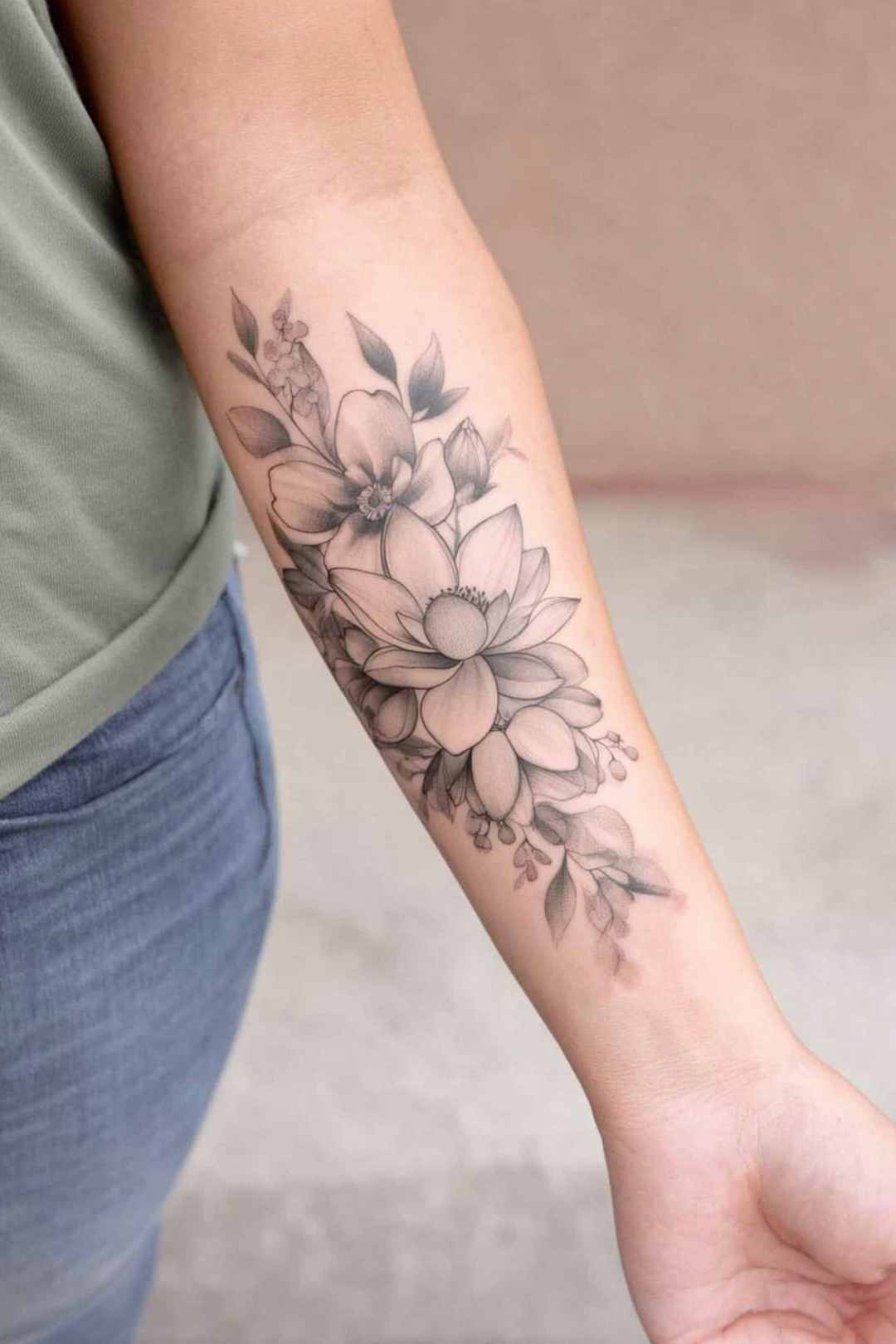
The drawings below range from soft pencil shading to crisp fine line. The pencil-style pieces need an artist comfortable with whip shading; the fine line ones need restraint more than skill.
Leave more space between petals than the drawing suggests. Ink spreads slightly over the years, and tightly packed fine line florals are the designs most likely to blur. There is more on this in our guide to floral half sleeve tattoos.
Adding a moon or a butterfly, as in the two designs below, gives a floral panel an anchor point — something the flowers can radiate out from.
Japanese-Inspired Koi and Wave Work
Japanese sleeves are the oldest solved version of this problem. The style exists precisely because someone needed to cover an arm coherently.
Waves, wind bars and cloud forms are not decoration in traditional work — they are the connective tissue that fills space and directs flow.
The drawing below mixes a koi with a sunflower, which is not traditional, but the wave linework still does the structural work. If you want the traditional grammar rather than the aesthetic, read up on Japanese tattoo designs before your consultation.
Nature, Forests and Mountain Scenes
Landscape half sleeves have one built-in advantage: a horizon line gives you a natural way to divide the arm.
The risk is flatness. A photographic mountain range rendered in grey wash can turn into a smudge from three feet away, which is the distance most people will ever see it from.
Both drawings here solve that with a strong dark element — dense pine silhouettes in one, heavy gear shapes in the other — to hold the composition together.
Dark, Horror and Skull Concepts
Horror work is the most demanding thing on this list. Heavy black next to fine detail is unforgiving.
When I have seen these go well, the artist has planned the black masses first and let the detail sit inside them. When they go badly, it is the reverse.
The beast skull below uses smaller skulls as filler, which is a neat trick — the filler is thematically part of the piece rather than background noise.
The steampunk clock design takes a different route, using a single accent colour against grey so the eye knows exactly where to land.
Realism Portraits and Religious Imagery
Portrait realism is where artist selection matters more than design selection.
A mediocre portrait is obvious in a way that a mediocre flower is not, because everyone reading it knows what a face is supposed to look like.
If you are set on a portrait, look for an artist whose healed portrait photos you can see — not just fresh ones. Healed work is the only honest evidence.
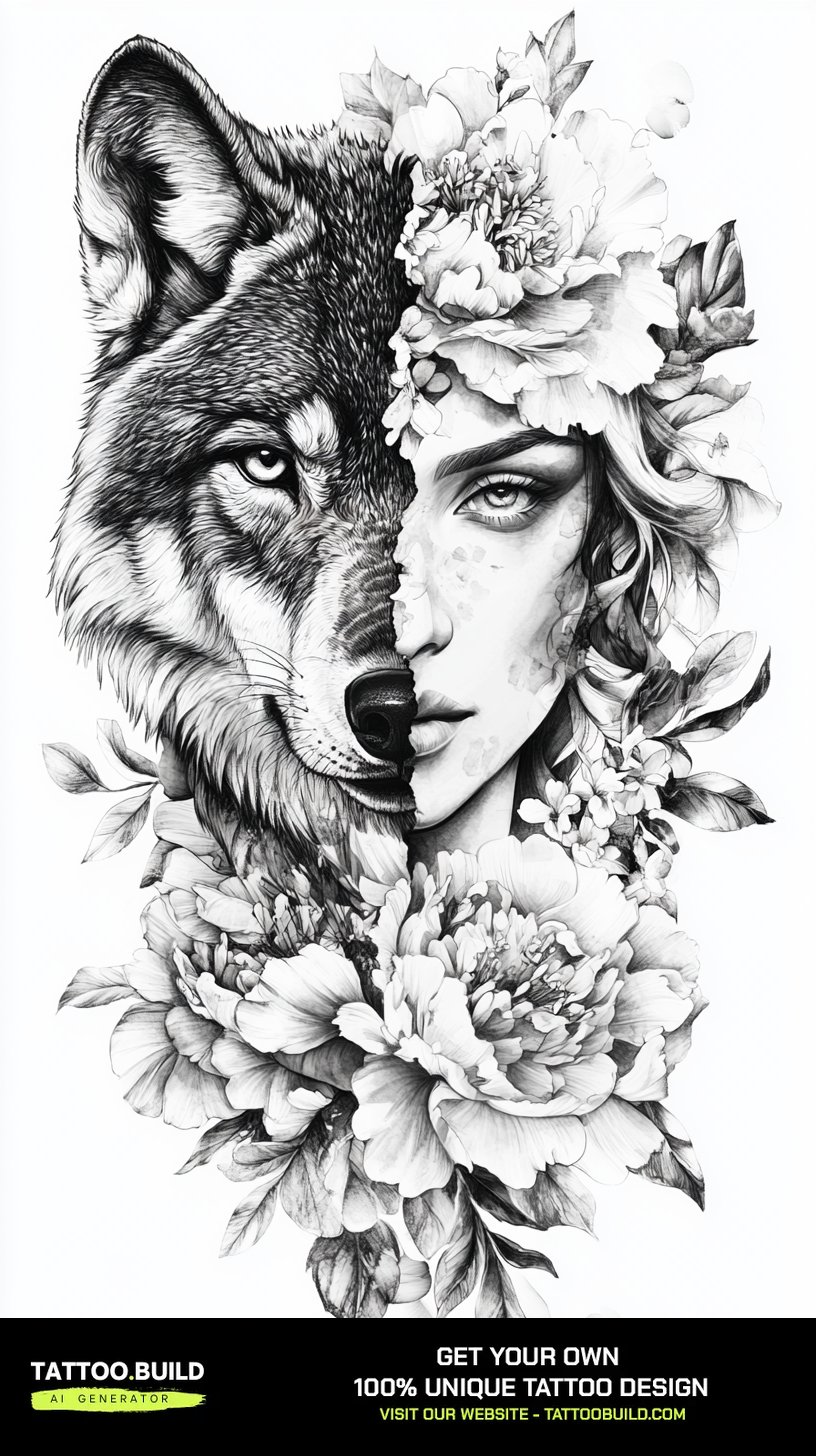
The split-face design below is a smart compromise: half the piece is a portrait, half is foliage, so the technical risk is halved too.
Cards, Clocks and Symbol Stacks
Stacked symbols are the most common half sleeve structure I see on men, and they are popular for a good reason.
Each element can be tattooed in its own session, which spreads the cost and the pain over months rather than weeks.
The weakness is coherence. Without smoke, drapery or a background wash tying the objects together, a symbol stack reads as a list. The three drawings below all use something — smoke, ribbon, filigree — as glue, and our men’s sleeve tattoo drawings collection shows more of the same approach.
Tribal, Ornamental and Blackwork Patterns
Solid blackwork ages better than almost anything else, and Polynesian-derived work is designed to follow muscle rather than ignore it.
One caution worth stating plainly: Polynesian and Maori patterns carry specific cultural meaning, and many practitioners consider certain motifs inappropriate for outsiders. Ask an artist from that tradition rather than assuming.
The neo-tribal and ornamental pieces below have no such constraint — they are contemporary graphic design, and they are among the most durable options in this entire article. See more in our blackwork tattoo designs roundup.
Alternatives to a Full Half Sleeve
A half sleeve is a serious commitment of time and money. These are the smaller commitments I most often suggest instead.
The Quarter Sleeve
Shoulder to mid-bicep. It gives you a substantial piece that a t-shirt still covers, and it can be extended down later without redesign.
Forearm-Only Panels
Elbow to wrist is technically a half sleeve, but it reads as a single visible panel. It also hurts less than the inner bicep for most people.
The Patchwork Approach
Separate tattoos placed with deliberate gaps, added over years, eventually forming a loose sleeve. It suits people who cannot commit to one theme, and it is increasingly common among the women’s half sleeve designs I see.
Starting With the Centrepiece
Get the one element you are certain about, live with it for six months, then decide what surrounds it. Nothing is lost if you stop there.
Getting Your Half Sleeve Drawing Right
Bring three to five references, not thirty. Every artist I have talked to says the same thing about oversized reference piles: they signal indecision, not direction. If you are short on connective material, browse tattoo sleeve filler ideas separately from your main subject.
Ask for the stencil to be placed and then walk around. Look at it in a mirror, from across the room, with your arm hanging naturally. Ten minutes here saves years of regret.
On healing, follow whatever your artist tells you over anything you read online, including this page. The American Academy of Dermatology publishes sensible general guidance on caring for tattooed skin, and the Mayo Clinic covers the risks worth knowing before you book.
If a healing tattoo becomes hot, swollen, increasingly painful after the first few days, or starts leaking anything beyond normal plasma, that is a doctor visit, not a forum question. Allergic reactions to specific pigments are uncommon but real, and only a clinician can assess one.
Still Not Sure? Common Half Sleeve Mistakes
Choosing the design before the artist. The drawing is worth less than the hands executing it.
Filling every square centimetre. Density looks impressive fresh and muddy at five years.
Underestimating the sitting. The inner bicep and the elbow ditch are genuinely unpleasant for most people — our tattoo pain chart sets expectations honestly.
Mixing incompatible styles. Fine line botanicals beside heavy blackwork rarely settle into one piece unless the artist has deliberately planned the transition. Looking through complete half sleeve drawing collections helps you see which combinations actually hold together.
Frequently Asked Questions
How long does a half sleeve tattoo take?
It depends almost entirely on style and detail level. Fine line botanical work can sometimes be finished in one or two long sittings, while black and grey realism or a traditional Japanese half sleeve usually runs across several sessions spaced weeks apart. Your artist can give you a realistic estimate once the design is settled, and that estimate is worth asking for before you book. Sessions are normally spaced to let each area heal properly rather than to suit your calendar.
Should I get the drawing done before I choose an artist?
In most cases, no. Artists draw in their own style, and a design made by someone else often has to be substantially redrawn to work on a curved arm. Bring references and a clear idea of subject and mood, then let the artist you have chosen produce the drawing. If you have commissioned artwork you love, show it as a reference rather than a template.
Can a half sleeve be extended into a full sleeve later?
Usually yes, but it is far easier if you say so at the start. An artist who knows a full sleeve is coming will leave the lower edge open rather than closing it with a border or a hard line. Retro-fitting a full sleeve onto a design that was finished off cleanly at the elbow often means adding a visible seam. Mention it at the consultation even if you are only sixty percent sure.
Which half sleeve styles age the best?
Bold blackwork, traditional Japanese and strong-outlined neo-traditional work generally hold up best over decades, because thick lines and solid black keep their shape as skin changes. Very fine line work and soft grey wash tend to need touch-ups sooner. That is not a reason to avoid them, just something to factor in. Ask your artist how their own healed work from five years ago is holding up.
Does a half sleeve hurt more than a single tattoo?
The per-minute pain is similar, but the duration is what people underestimate. Sitting for several hours across multiple sessions is a different experience from a twenty-minute piece, and areas like the inner bicep, elbow ditch and armpit side are noticeably sharper than the outer arm. Eat properly beforehand and tell your artist when you need a break. There is no prize for sitting through it silently.
Quick Summary
- Pick one subject, one style and one direction of flow before anything else.
- Choose the artist first, then let them produce the drawing in their own hand.
- Leave generous negative space — it is what keeps the piece readable in ten years.
- Florals and symbol stacks are the easiest structures to extend later; portraits are the least forgiving.
- Bold black and traditional Japanese work generally ages better than fine line or soft grey wash.
- Say up front if a full sleeve might follow, so the lower edge is left open.
- Expect several sessions, and expect the inner bicep and elbow ditch to be the hard parts.
- Follow your artist’s aftercare instructions, and see a doctor for anything that looks like infection.