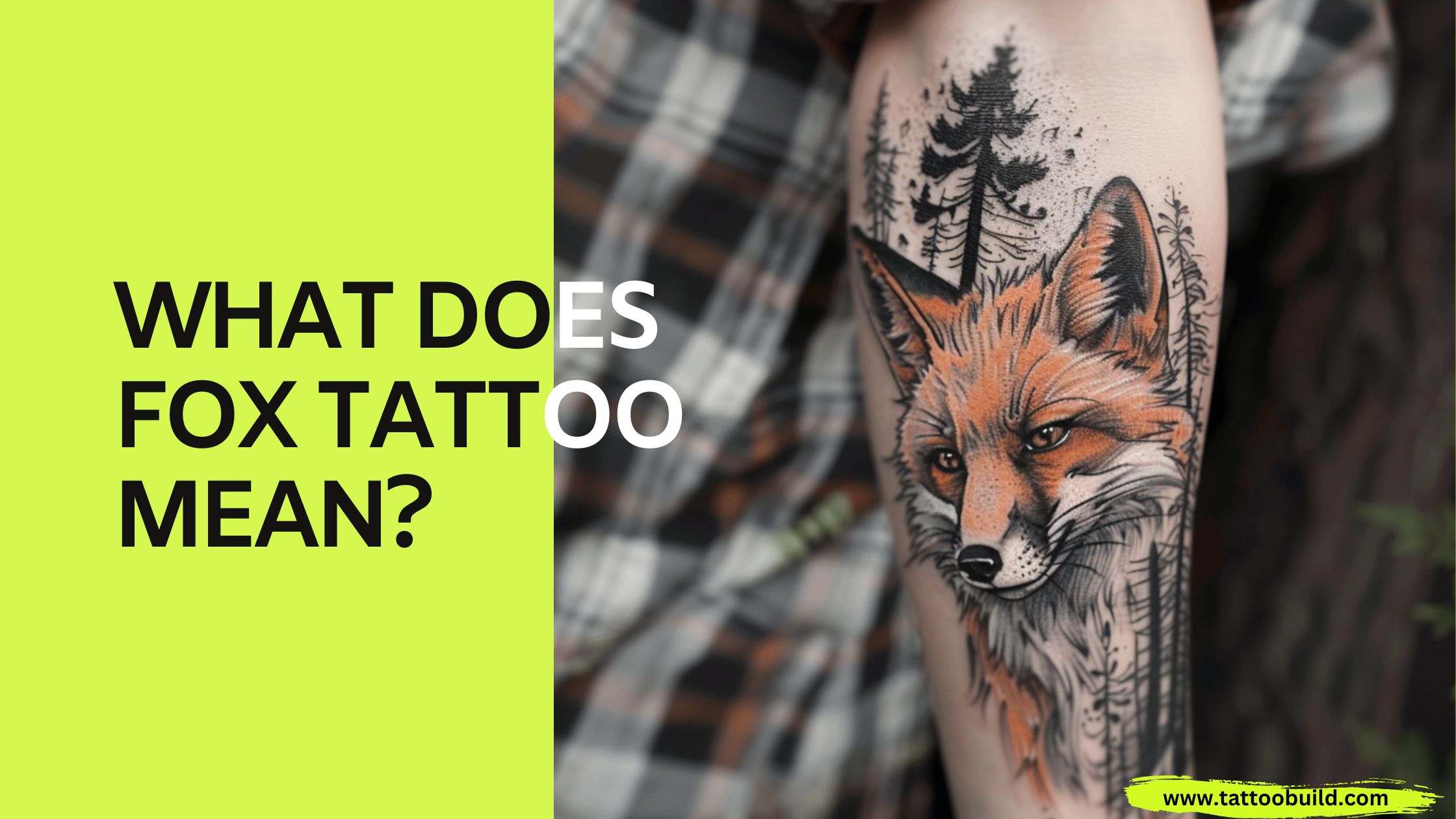
A fox tattoo usually means intelligence, adaptability and independence — the ability to think your way out of a corner rather than fight your way out. That is the meaning most wearers land on, and it is the one most artists will assume unless you tell them otherwise.
But the fox is not a single symbol. It shifts depending on which culture you borrow from, and that is exactly why it is such a rewarding animal to wear.
I have spent a lot of time looking at animal tattoos and asking people why they chose the one they did, and the fox answers are consistently the most personal. Almost nobody says “it looked cool” — they say it reminded them of a period when they had to be clever to survive.
This guide walks through every meaning the fox carries, how those meanings change by culture and style, and how to choose a design that still reads as a fox in ten years. If you are comparing it against other animal pieces, the wolf tattoo guide covers a very different kind of symbolism — loyalty and pack instinct rather than solitary wit.
Which Fox Tattoo Style Is Right for You?
Different styles push the fox toward different meanings. A realistic fox reads as reverence for the animal; a geometric one reads as intellect and design.
Here is how the four most-requested approaches actually compare in practice.
| Style | Meaning it emphasises | Best size & placement | How it ages | Sitting time |
|---|---|---|---|---|
| Realistic / black and grey | Respect for the animal, wildness, instinct | 4 in and up — forearm, calf, thigh, upper back | Very well at size; fur detail softens but stays readable | Often 4–8 hours, sometimes split over two sessions |
| Geometric / linework | Intelligence, order, problem-solving | 3 in and up — forearm, shoulder, sternum | Strong, provided the lines are not hair-thin | Usually 2–4 hours |
| Watercolor | Playfulness, transformation, emotion | 3–6 in — shoulder, upper arm, thigh | The weakest of the four unless anchored with linework | Usually 3–5 hours |
| Traditional / neo-traditional | Trickster, charm, folklore | 3–5 in — outer arm, calf, chest | The best of the four — bold outlines hold for decades | Usually 2–4 hours |
If you want one line of advice from that table: bold outlines are what keep a fox looking like a fox after twenty years. Everything inside the outline is negotiable.
Why the Fox Carries So Much Meaning
Foxes show up in the folklore of almost every culture that has them, which is unusual for a mid-sized predator.
Part of that is biology. Foxes are found across most of the Northern Hemisphere and adapt to farmland, forest and now city streets, so nearly every culture has had a chance to watch one and build a story around it.
According to Britannica, the red fox in particular has one of the widest natural ranges of any land mammal.
The other part is behaviour. A fox does not overpower anything — it observes, waits, and takes the opening, which is why the stories about it are always about wit rather than strength.
That is the thread running through every meaning below. Whether the fox is a guardian, a trickster or a shapeshifter, it is always the one who is thinking.
Fox Tattoo Meanings and What They Symbolize
Intelligence and Cunning
This is the meaning that brings most people to the fox, and it is the one I hear first in nearly every conversation about these tattoos.
Cunning here is not deception. In the folklore it reads far closer to resourcefulness — the fox is the one who finds the gap in the fence.
People often choose it after a stretch where they had to out-think a situation rather than outlast it: a career change, a legal fight, a rebuild after something fell apart.
If you want the design to lean into this meaning, ask for a sharp, alert expression and eyes that meet the viewer. A fox rendered mid-glance reads as intelligent; a fox rendered asleep reads as peaceful.
That one choice changes the whole tattoo, and it costs nothing to specify at the consultation.
Transformation and Adaptability
Foxes survive almost anywhere, and that flexibility is the second most common meaning behind the tattoo.
Urban foxes have adapted to living alongside people in a way most wild predators never manage — a detail that resonates with anyone who has had to rebuild in an unfamiliar place.
Every artist I have asked about this says the same thing: clients who choose the fox for adaptability tend to want movement in the pose. A fox turning, running or looking back over its shoulder carries the idea better than a static portrait.
The seasonal coat change is another angle worth mentioning to your artist if transformation is the point for you.
Freedom and Independence
Foxes are largely solitary hunters, and that solitude is the point for a lot of wearers.
This is where the fox separates most clearly from the wolf. The wolf means the pack; the fox means doing it alone and being fine with that.
I have seen this meaning chosen most often by people leaving something structured — a long marriage, a corporate job, a place they grew up in.
Designs that lean this way usually place the fox in open space rather than framed by ornament, often with a small landscape or a moon behind it.
Guardianship and Protection
This meaning surprises people, because the fox has a reputation as a thief rather than a protector.
It comes mostly from Japan, where stone fox statues stand at the entrances of Inari shrines as guardians rather than pests.
Some wearers use the fox as a memorial or a protective figure for a child or a parent, and in those cases a pair of foxes — one larger, one smaller — is a common and very effective composition.
If protection is your reason, say so at the consultation. It changes the posture your artist draws, usually toward a forward-facing, grounded stance.
The Kitsune: Fox Meaning in Japanese Culture
The kitsune is the single richest source of fox symbolism, and it is worth understanding properly before you wear one.
In Japanese folklore the kitsune is an intelligent fox spirit that gains tails as it ages — the nine-tailed kitsune being the most powerful and the most commonly tattooed. You can read a broad overview at this Kitsune reference.
Kitsune split roughly into two types: zenko, the benevolent foxes associated with the deity Inari, and yako, the mischievous ones. The mask is the most tattooed element of all.
My honest advice here is to treat this as a real tradition rather than an aesthetic. If you want a kitsune done properly, find an artist who works in Japanese style — our guide to Japanese tattoo designs is a reasonable starting point for understanding the visual grammar.
Number of tails, mask type and flanking elements all carry meaning, and an artist who works in the style will tell you what you are actually committing to.
The Trickster in European and Native Folklore
Outside Japan, the fox is most often a trickster, and the tone of that varies enormously by region.
In the medieval European Reynard cycle the fox is a con artist who outwits nobles and clergy, which is where the modern “sly fox” idea largely comes from.
In several Indigenous North American traditions the fox appears as a clever helper or a bringer of fire rather than a villain — worth knowing if that is the tradition you are drawing from, and worth researching carefully rather than borrowing loosely.
Wearers who choose the trickster reading usually want a bit of humour in the piece: a smirk, a raised brow, sometimes clothing.
Playfulness, Charm, and Sensuality
There is a lighter set of meanings that gets overlooked in most articles on this subject.
Foxes are genuinely playful animals, and a lot of people choose them simply because the fox matches how they move through the world — quick, funny, a little disarming.
The word “foxy” also does real work here, and some wearers lean into that deliberately with softer linework and warmer colour.
None of these lighter meanings are less legitimate than the folkloric ones. A tattoo you chose because it makes you smile is a good tattoo.
Popular Fox Tattoo Styles and Placements
Once you know which meaning you want, the style is what delivers it. Here is what each one actually does to a fox.
Realistic and Black-and-Grey Fox Tattoos
Realism gives you the most reverent version of the fox, and the most demanding one technically.
Fur is the hardest part — it is built from thousands of short strokes, and an artist without a realism portfolio will usually flatten it into a grey mass.
Give it room. In my experience anything under about four inches loses the fur detail within a few years, at which point you have a soft brown shape.
Geometric and Minimalist Fox Tattoos
Geometric foxes translate the animal into angular planes, which suits the intelligence meaning almost too neatly.
They are also forgiving: clean lines and flat shapes hold up over decades far better than gradient shading does.
Minimalist versions strip it further, sometimes to a single continuous line. These are the ones I would be most careful with — very fine lines can blur with age, so ask your artist to use a slightly heavier weight than the flash suggests.
Both directions are covered in more depth in our geometric tattoo and fine-line tattoo guides.
Watercolor Fox Tattoos
The red fox is one of the few animals whose natural colour genuinely suits watercolour treatment.
The usual caution applies: watercolour without underlying linework tends to lose definition faster than other styles, so most experienced artists anchor it with a subtle outline.
Ask to see healed photographs of watercolour work, not fresh ones. Our watercolour tattoo guide goes into what holds and what does not.
Traditional and Neo-Traditional Fox Tattoos
If you want the tattoo to still look deliberate in thirty years, this is the safest style on the list.
American traditional gives you heavy outlines, limited colour and a stylised fox that reads instantly from across a room.
Neo-traditional keeps the bold outline but allows richer shading and decorative elements — florals, moons, art nouveau framing. It is currently the most requested direction I see for foxes.
The same logic applies to other animal pieces, as the traditional bear tattoo guide explains.
Placement and How It Changes the Design
Placement is not just about visibility — it changes what the artist can draw.
The forearm is the most popular spot and for good reason: it is flat, easy to heal, and it fits a fox at a size where detail survives. Our forearm tattoo ideas covers composition on that spot.
Thighs and calves give you the most room for a full-body fox, and ribs and sternum suit a curled or sleeping pose that follows the body line.
On pain, the honest summary is that bony, thin-skinned areas hurt more — ribs, sternum, ankles — and fleshy areas hurt less. There is a fuller breakdown in our guide to the most painful tattoo spots.
Getting a Fox Tattoo: Practical Tips
Bring reference photographs of real foxes, not just other tattoos. Artists consistently produce better animal work from wildlife photography than from copies of existing designs.
Decide your meaning before the consultation. Whether you want cunning, protection or transformation changes the pose, the expression and sometimes the entire composition, and it is much cheaper to decide that before the stencil exists.
Choose an artist by portfolio, not by convenience. If you want realism, look for healed realism in their gallery; if you want a kitsune, look for Japanese work. A good artist in the wrong style is still the wrong artist.
On healing, the surface of a new tattoo typically closes in about two to three weeks, with the deeper layers settling over a few months. Follow whatever aftercare your artist gives you, keep it clean, and keep it out of the sun once healed — UV exposure is the single biggest cause of fading.
If something looks wrong during healing — spreading redness, heat, pus, or a fever — that is a matter for a doctor rather than a tattoo forum. Mayo Clinic has a clear overview of tattoo risks and when to seek medical help. Nothing in this article is medical advice.
Common Mistakes to Avoid
Going too small for the style. A realistic fox at two inches becomes an unreadable smudge within a few years — match the size to the amount of detail you want.
Wearing a kitsune without knowing what it means. Tail count and mask type carry real significance, and it is worth ten minutes of reading before a permanent decision.
Copying another person’s tattoo exactly. Most artists will decline it anyway, and the ones who agree are rarely the ones you want.
Choosing colour without thinking about skin tone. Orange reads very differently across different complexions, and a good artist will tell you honestly whether black and grey will serve the design better.
Still weighing it against other animals? The deer tattoo guide and the bird tattoo meanings guide cover two of the most common alternatives, and comparing the three usually makes the decision obvious.
Frequently Asked Questions
What does a fox tattoo mean?
A fox tattoo most commonly means intelligence, cunning, adaptability and independence. Depending on the cultural reference, it can also mean protection and good fortune, which is the Japanese kitsune reading, or mischief and trickery, which comes from European folklore. Many wearers also choose it simply for playfulness and charm. The specific meaning is largely set by the style and pose you choose rather than by the animal alone.
Is a fox a good first tattoo?
Yes, in the right style. A traditional or simple linework fox is an excellent first tattoo because it sits comfortably at a small to medium size and usually takes only a few hours. A full-colour realistic fox is a much bigger commitment in time, cost and pain and is better approached once you know how you handle sitting. If it is your first, the forearm or outer upper arm are the easiest places to start.
What is a kitsune fox tattoo?
A kitsune is a fox spirit from Japanese folklore that is said to gain tails and power as it ages, up to nine. Kitsune are traditionally divided into benevolent foxes associated with the deity Inari and more mischievous ones. As a tattoo it usually appears either as a multi-tailed fox or as the well-known kitsune mask. Because the details carry real meaning, it is worth getting one from an artist who works in Japanese style.
Are fox tattoos for men or women?
Both, and the split is genuinely even. The style is what shifts the feel rather than the subject: bold traditional and black-and-grey realism tend to read as more masculine, while fine-line, floral and watercolour treatments tend to read as more feminine. The same fox can go either way depending on linework and colour. Tell your artist the feel you are after and they will adjust the design accordingly.
Where is the best place for a fox tattoo?
The forearm is the most popular placement because it is flat, heals easily and fits a fox at a size where detail survives. Thighs and calves give the most room for a full-body fox or a scene, while ribs and the sternum suit a curled pose that follows the body’s line. Smaller foxes work well on the ankle, wrist or behind the ear. Bony areas hurt more than fleshy ones, so factor that in alongside visibility.
Quick Summary
- Core meaning: intelligence, cunning and resourcefulness — thinking your way out rather than forcing your way out.
- Second meaning: adaptability and transformation, drawn from the fox’s ability to survive almost anywhere.
- Third meaning: freedom and independence, which is what separates the fox from the pack-minded wolf.
- Japanese reading: the kitsune is a fox spirit tied to protection and fortune, with tail count and mask type carrying real significance.
- European reading: the trickster, from the Reynard stories — charming, funny, slightly disreputable.
- Style sets the meaning: realism reads as reverence, geometric as intellect, watercolour as playfulness, traditional as folklore.
- Size matters most for realism: below roughly four inches, fur detail tends to blur within a few years.
- Longevity: bold outlines age best; very fine lines and unanchored watercolour age worst.