A sleeve is the biggest commitment most people make to a single tattoo idea, and it is also the one I see rushed most often. The coolest sleeve tattoos for women are almost never the ones with the most going on — they are the ones where every element earns its place and the arm still reads clearly from across a room.
I have watched a lot of sleeves come together, from single-session blackwork forearms to floral full sleeves stitched over eighteen months. The pattern is consistent: the pieces that hold up were planned as one composition first and filled in second.
This guide walks through the styles that actually suit a sleeve, how to plan the layout before any needle touches skin, what the sessions and healing really involve, and where to start if this is your first large piece. If you already know you want the whole arm covered, the full sleeve tattoo ideas for women gallery is a useful companion to this page.
Everything below comes from watching real arms heal, not from a mood board.
Which Sleeve Style Is Right for You?
Style choice drives everything downstream — session count, cost, how the piece ages, and how much of your arm stays visible skin.
Here is how the main sleeve approaches compare, based on what artists have quoted me and what I have seen after a few years of healing.
| Style | Typical Sessions | Pain Level | How It Ages | Best For |
|---|---|---|---|---|
| Fine line botanical | 3–6 | Moderate | Softens noticeably; may need a touch-up at 5–10 years | Delicate, airy sleeves with visible skin |
| Black and grey illustrative | 5–10 | Moderate to high | Very well; contrast holds for decades | Storytelling sleeves with depth |
| Blackwork / dark feminine | 4–8 | High (solid packing) | Excellent, provided the black is packed evenly | Bold, graphic arms that read from a distance |
| Full colour floral | 6–12 | High | Colour fades faster than black; sunscreen matters | Vivid, high-impact statement sleeves |
| Geometric / mandala | 4–8 | Moderate to high | Well, though wobbles in the geometry become obvious | Symmetry lovers and ornamental designs |
| Patchwork sleeve | Open-ended | Low per sitting | Depends entirely on the individual pieces | Building slowly without one master plan |
If you cannot pick a row, that is useful information: it usually means you want a hybrid, and a consultation is a better next step than more scrolling.
What Actually Makes a Sleeve Look Cool
The word people reach for when a sleeve works is flow — and flow is a structural thing, not a stylistic one.
A sleeve is a cylinder that bends in two places. Elements have to sit so that the arm reads well straight down, raised, and turned outward, which is why artists build sleeves around the outer arm and let the inner arm carry lighter work.
Negative space does more heavy lifting than any single design element. Skin left bare between motifs is what gives the eye somewhere to rest and what stops a sleeve from turning into a grey blur after ten years.
Scale is the second thing. Detail that looks stunning on a screen at 1,200 pixels wide often cannot survive at actual size on a forearm, because ink spreads slightly in the skin as it heals and closely packed lines merge.
Every artist I have asked describes the same test: step back six feet. If the composition still has a clear shape and a clear focal point from there, it will hold up. If it dissolves, the design is too busy for the space.
Sleeve Tattoo Ideas for Women, by Style
These are the directions I see chosen most, with the practical trade-offs of each.
1. Floral Sleeves
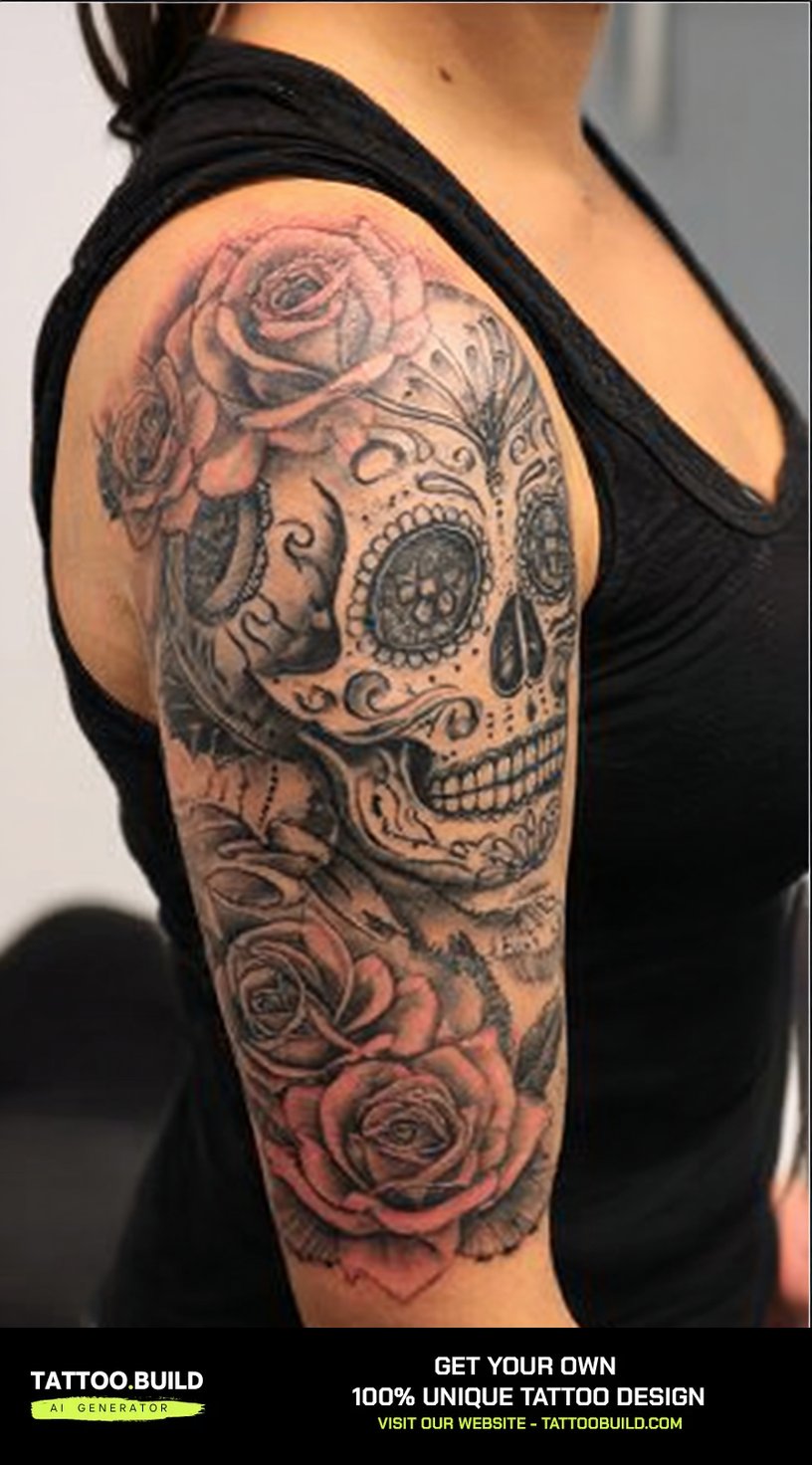
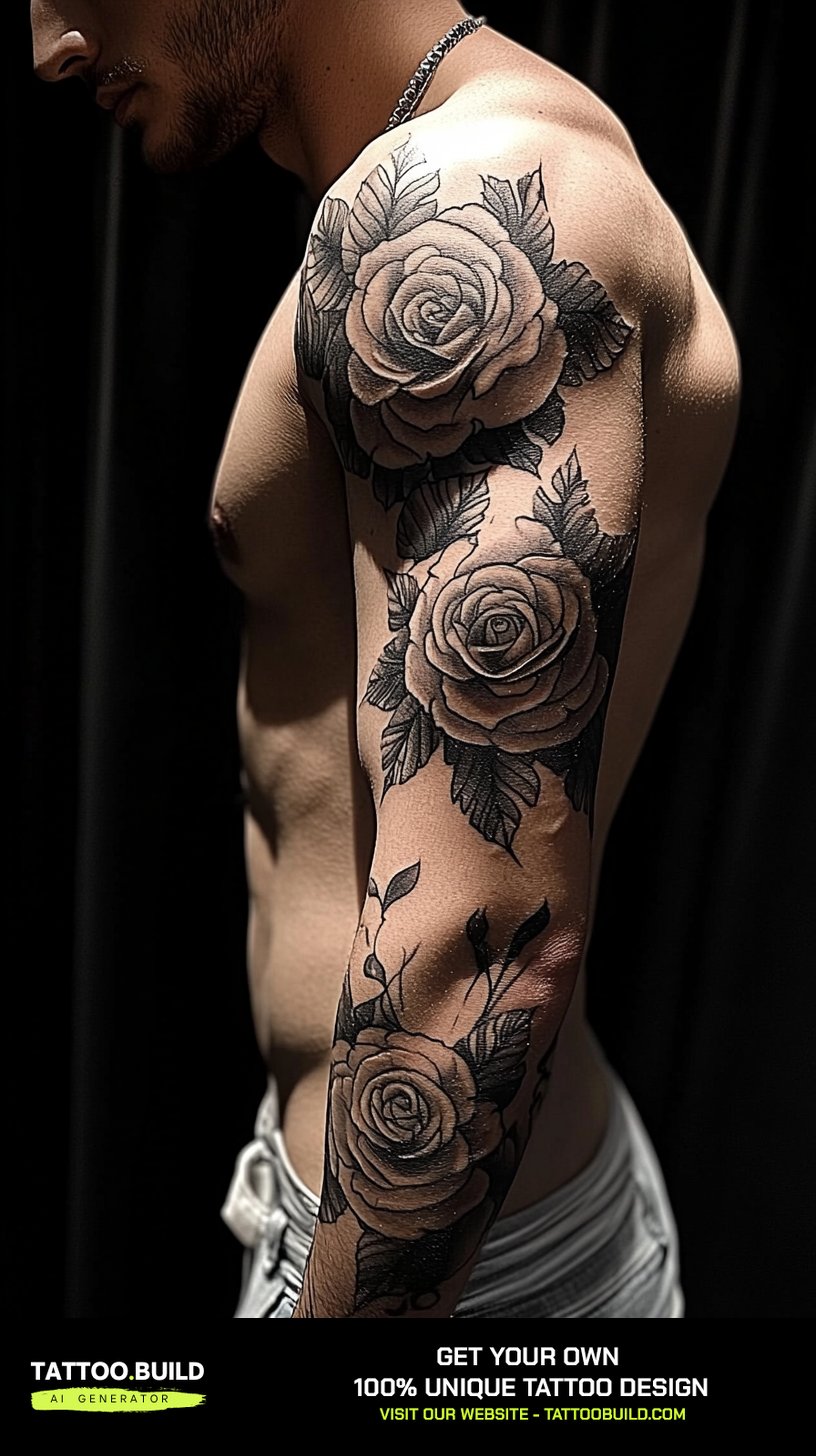
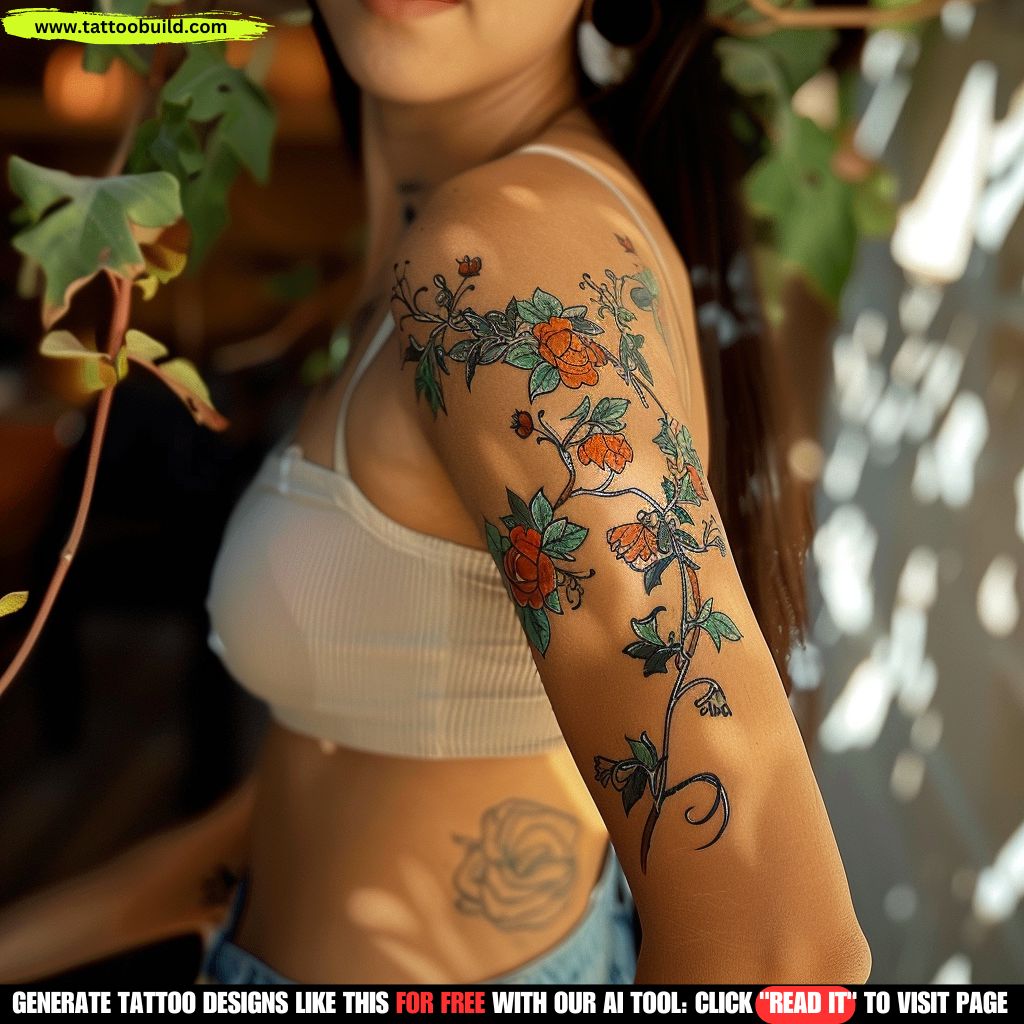
Florals remain the most requested sleeve direction for women, and for a good structural reason: flowers, stems and leaves are naturally suited to filling a curved surface.
Stems give an artist a ready-made way to connect one focal bloom to the next without inventing filler, so the piece flows instead of looking like separate stickers.
The choice that matters most is bloom size. Three or four large flowers with breathing room between them will read far better in five years than a dozen small ones packed edge to edge.
Peonies, roses and magnolias are the workhorses because they have obvious petal structure and shade beautifully in black and grey. If you want to see how a single flower carries a whole arm, the rose tattoo ideas for women collection is a good reference.
In my experience, floral sleeves are also the most forgiving to extend — you can add a section later and the botanical language absorbs it.
2. Fine Line and Delicate Work
Fine line sleeves have exploded in the last few years, and they are genuinely lovely — with one honest caveat.
Single-needle lines are thin by design, and thin lines spread as skin ages. Fine line work usually needs a touch-up sooner than bolder styles, which is not a flaw so much as a maintenance schedule you should know about upfront.
When I tested how these age by looking at healed forearms rather than fresh photos, the pieces that still looked sharp had one thing in common: real gaps between the elements.
The technique also suits people who want a sleeve that reads as light rather than heavy. There is a whole set of fine line sleeve tattoo ideas worth browsing if that is your direction.
Ask to see your artist’s healed fine line work specifically. Fresh photos tell you almost nothing about how their lines settle.
3. Blackwork and Dark Feminine
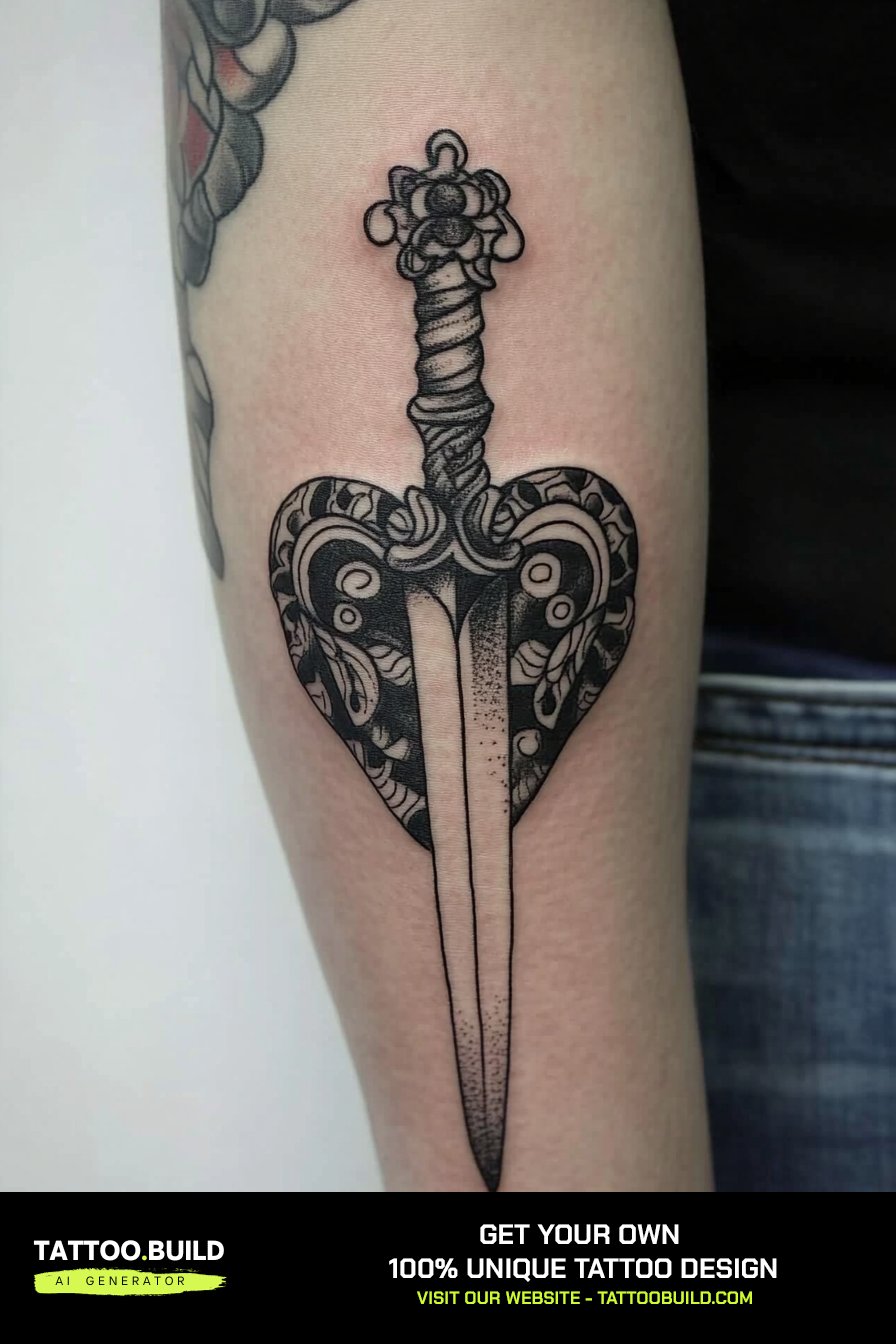
Blackwork sleeves use solid black masses as the main design element, often with sharp negative-space shapes cut out of them.
They are the most durable option on this list. Well-packed black holds its edge for decades, which is why traditional tattooing leaned on it so heavily.
The trade-off is the sitting. Packing solid black across a shoulder is genuinely uncomfortable and usually needs to be split across sessions to give the skin a break.
Dark feminine sleeves — heavy shading softened with fine ornamental accents — have become one of the most requested hybrids, and the dark feminine tattoo gallery shows the range.
One honest limitation: blackwork is difficult to cover or lighten later. Be surer about this one than you would be about a fine line piece.
4. Nature and Botanical Beyond Flowers
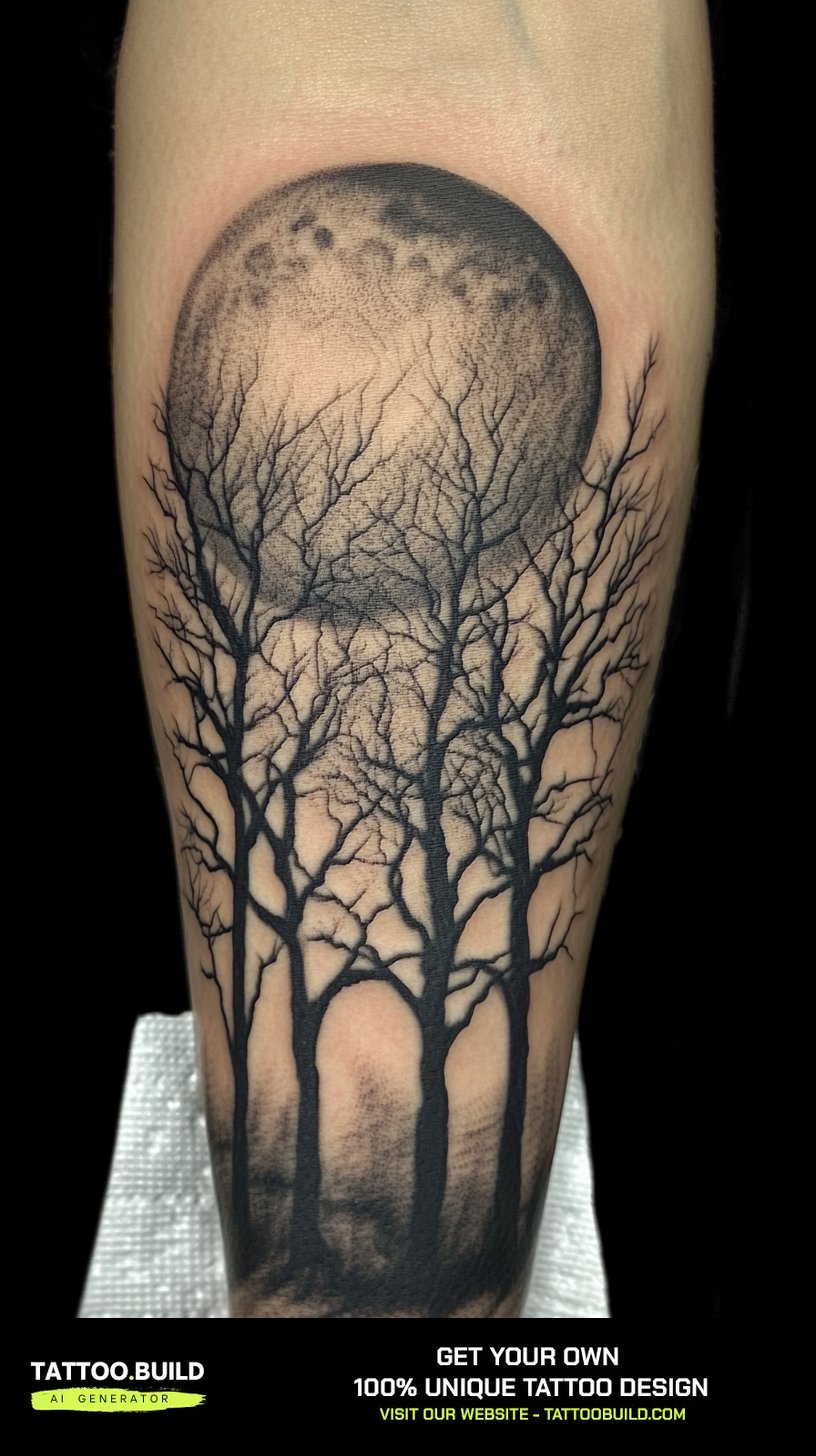
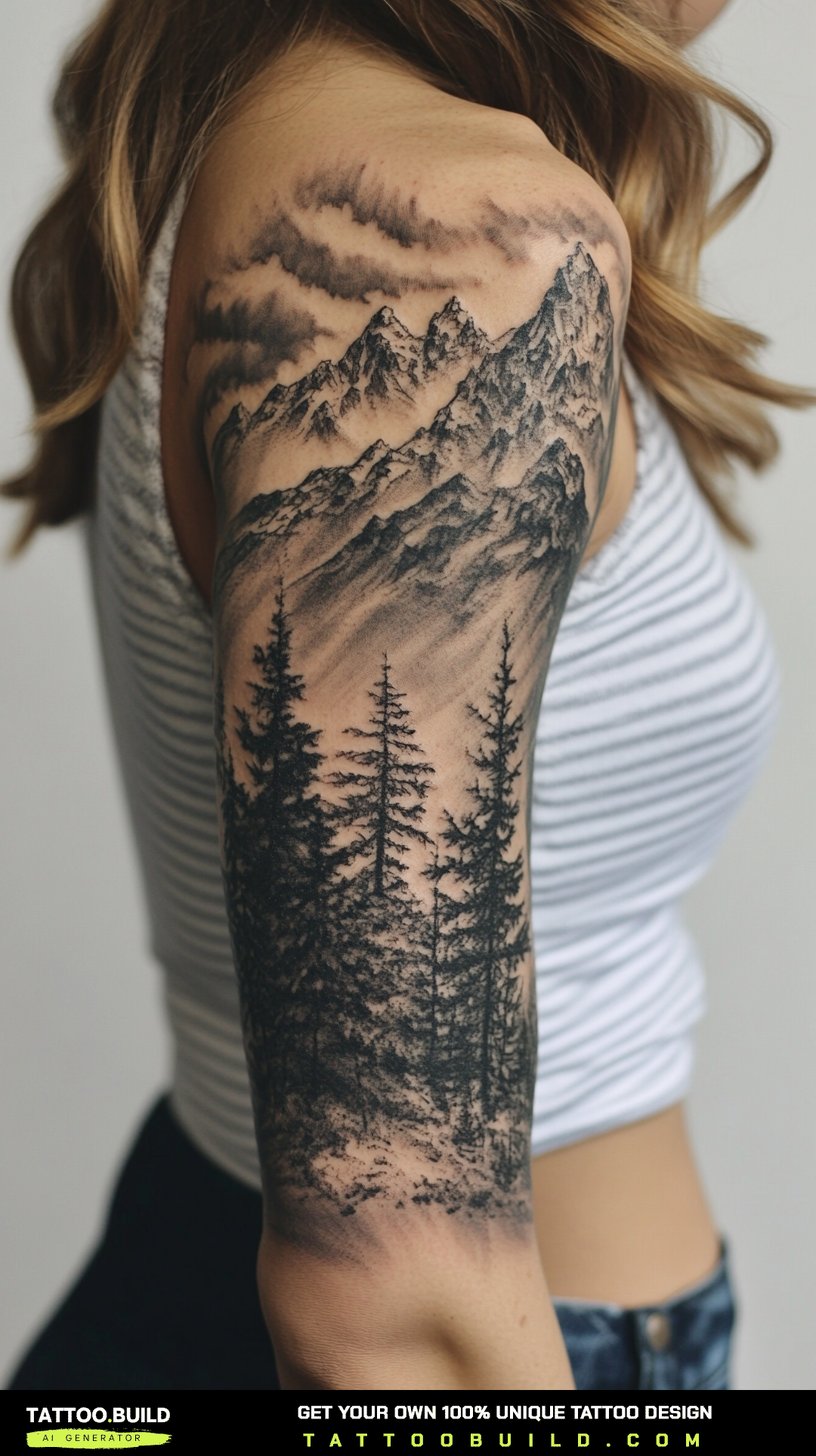
Not every botanical sleeve is a flower sleeve. Ferns, eucalyptus, wheat, pine and wildflowers all work beautifully and read as quieter.
Foliage is especially useful as connective tissue. Leaves can fill the awkward transitions around the elbow ditch, where big focal pieces rarely sit comfortably.
I have noticed these sleeves photograph less dramatically than colour florals but tend to be the ones people are happiest with a few years in.
They also pair naturally with smaller existing tattoos, which matters if you are building around pieces you already have. The wildflower tattoo ideas page covers a lot of these motifs individually.
5. Animal and Symbolic Motifs
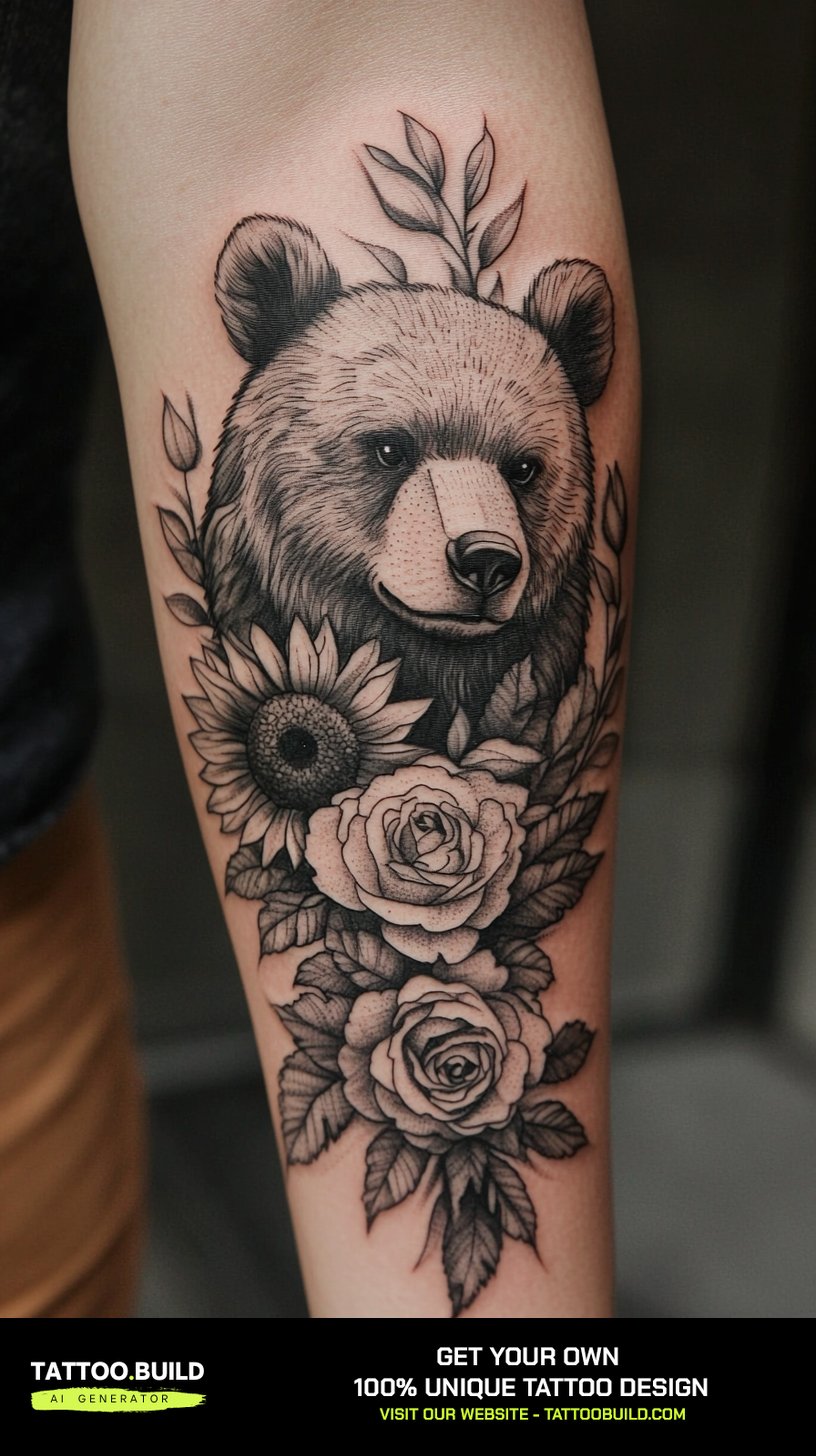
Animals give a sleeve a clear focal point, which is exactly what busy compositions usually lack.
Snakes, moths, birds and big cats dominate here because their shapes are long or wide enough to wrap an arm convincingly rather than sitting flat on one plane.
A snake in particular is a structural gift: it can spiral the arm and become the spine that everything else hangs off.
If a creature is going to anchor your sleeve, look at how it works alone first — the snake tattoo ideas for women collection is a useful sanity check on scale.
One caution: animal faces are the hardest thing on an arm to fix if the artist is not confident with them. Ask for healed examples of that specific animal.
6. Geometric and Mandala Sleeves
Ornamental and mandala sleeves rely on precision, and that precision is unforgiving.
Straight lines on a curved, moving surface are technically difficult, and a mandala that is a few degrees off centre on the shoulder cap will bother you forever.
Dotwork shading is common in this style and takes considerably longer than machine shading, so budget for more chair time than the design’s simplicity suggests.
When it is done well, the symmetry is striking, and it suits people who want structure rather than organic flow. Start with the mandala tattoo ideas for women gallery to see how the geometry is scaled to different arm sizes.
7. Half Sleeves and Forearm-Only Pieces
A half sleeve is not a lesser sleeve. It is often the smarter first move.
Stopping at the elbow gives you a natural, finished edge, keeps the cost and session count roughly half that of a full sleeve, and leaves you the option to extend later.
Upper-arm half sleeves are also the easiest to cover for work, which is still a real consideration in plenty of professions.
Forearm-only sleeves are the opposite choice — permanently visible, and generally less painful than the inner bicep. Both the female half sleeve tattoo and forearm tattoo ideas for females galleries are worth comparing before you decide.
If this is your first large piece, I would start here almost every time.
Alternatives and Variations Worth Considering
A full traditional sleeve is not the only way to cover an arm.
The Patchwork Sleeve
Instead of one master design, you collect individual tattoos over time and let them gradually fill the arm.
It is lower pressure and easier to budget, and it suits people who genuinely cannot commit to a single theme. The risk is a crowded arm with no focal point, so leave more space than feels necessary as you go.
Colour Accents on Black Linework
Rather than a full colour sleeve, black linework carries the structure and small colour touches sit inside it.
This ages better than full colour packing, because when the colour softens the black drawing underneath is still doing the work.
Wrap-Around Versus Panel Designs
A wrap-around sleeve has no blank side and looks intentional from every angle, but costs more chair time.
A panel design covers the outer arm only and leaves the inner arm clear — cheaper, less painful, and perfectly legitimate if you like the look.
Open-Space Sleeves
A deliberately sparse sleeve, where a few well-placed pieces span the arm with a lot of bare skin between them.
This is quietly one of the most flattering options and one of the cheapest, and it borrows heavily from the logic behind sparse floral forearm designs.
Planning, Sessions and Aftercare
Book a consultation before you book a session. A good artist will talk you out of at least one thing, and that conversation is the most valuable part of the process.
Expect the work to be split across multiple appointments with several weeks of healing between them. Skin needs time to recover before the next section, and rushing that is how sleeves end up patchy. General guidance from the American Academy of Dermatology is a sensible baseline for the healing period.
For aftercare, follow the instructions your artist gives you over anything you read online, including this page — they know what they used on your skin. Keep the area clean, use a thin layer of whatever they recommend, and stay out of pools, baths and direct sun while it heals. The Mayo Clinic overview of tattoo risks is a clear summary of what to watch for.
See a doctor, not a tattoo forum, if you get spreading redness, heat, swelling that worsens after the first few days, pus, or a fever. Those are signs of possible infection and they need medical attention. Allergic reactions to pigment are uncommon but real, and the FDA consumer guidance on tattoos explains what is and is not regulated about tattoo inks.
Long term, sunscreen on a healed sleeve is the single highest-return habit. It is the difference between colour that holds and colour that goes muddy.
Common Mistakes and What to Do Instead
Designing the sleeve before choosing the artist. Pick someone whose healed portfolio already looks like what you want, then let them design it. Handing a specialist someone else’s drawing wastes what you are paying for.
Filling every gap. Empty skin is a design element, and the urge to fill it is the most common regret I hear.
Mixing too many styles in one arm. A fine line botanical next to bold traditional colour rarely resolves — pick a visual language and stay inside it.
Booking the whole thing before a single session. Sit for two hours first and find out how your body handles it.
Not sure where to start? The first tattoo ideas for women guide covers the groundwork before you commit to an arm-sized piece.
Frequently Asked Questions
How long does a full sleeve tattoo take?
Most full sleeves take somewhere between 20 and 40 hours of tattooing, split across five to twelve sessions. The exact number depends heavily on style: solid colour packing and dotwork take far longer than fine line work covering the same area. Sessions are usually spaced two to four weeks apart so each section can heal properly. In my experience, people consistently underestimate the calendar time and overestimate what one sitting can cover.
How much does a sleeve tattoo cost?
Cost is driven by your artist’s hourly or day rate and the total hours, so it varies enormously by city and by reputation. Rather than quoting a figure that will be wrong for your area, ask two or three local artists for a range at consultation. Almost all of them will give you an honest estimate. Be wary of a quote that is dramatically cheaper than everyone else’s.
Does a sleeve tattoo hurt more than a small tattoo?
Not more intensely, but for much longer, which is its own kind of hard. The outer arm is generally tolerable for most people; the inner bicep, elbow ditch and the skin near the wrist tend to be sharper. Solid black packing is usually reported as more uncomfortable than linework. Eat beforehand, and tell your artist when you need a break — they would rather stop than have you tense up.
Can I combine my existing tattoos into a sleeve?
Often yes, and a good artist will treat your existing pieces as fixed points to design around. Bring photos to the consultation and be open to the possibility that one piece may need reworking or covering to make the whole arm cohere. This is a normal request and most sleeve specialists handle it regularly.
Will a sleeve tattoo affect my job?
That depends entirely on your industry and region, and attitudes have shifted a lot in the last decade. If you have any doubt, an upper-arm half sleeve stays covered by a short sleeve while a forearm piece does not. It is worth thinking through before the first session rather than after.
Quick Summary
- Composition beats content. Plan the whole arm as one design before choosing individual elements.
- Leave negative space. Bare skin is what keeps a sleeve readable after a decade.
- Match the style to how it ages — blackwork and black and grey hold up best; fine line and full colour need more maintenance.
- Start with a half sleeve or forearm piece if this is your first large tattoo.
- Choose the artist first, then let them design it around your idea.
- Expect multiple sessions weeks apart, and budget calendar time as well as money.
- Follow your artist’s aftercare instructions, and see a doctor for signs of infection.
- Sunscreen on a healed sleeve is the cheapest way to protect the work you paid for.