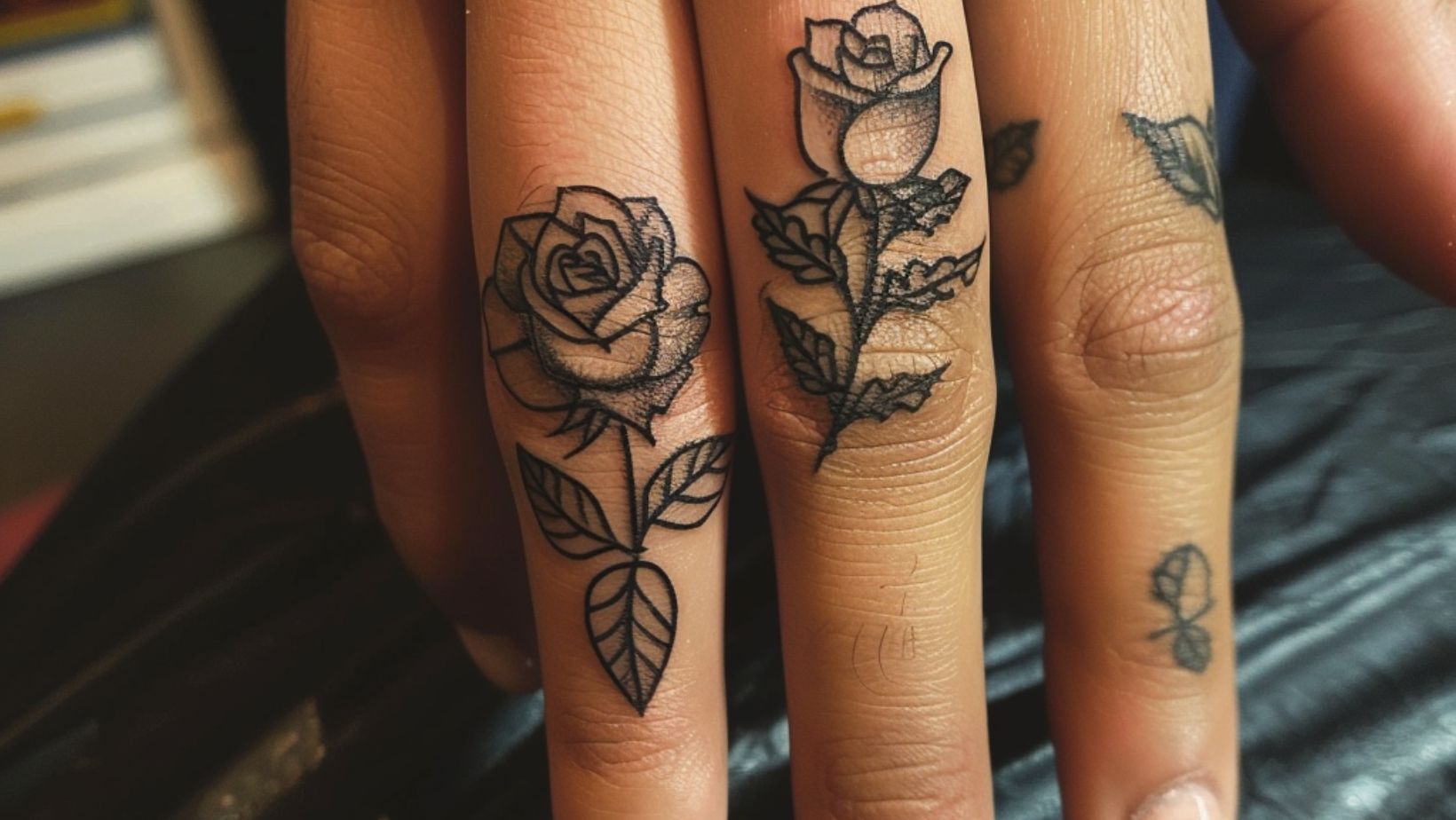
I have watched more people talk themselves into a finger tattoo than almost any other placement, and the rose ring is the design they keep circling back to. A rose ring tattoo is a small rose, band or vine sitting on the ring finger — it reads as jewellery from a distance and as a personal symbol up close.
The appeal is obvious. It never comes off in the shower, it costs a fraction of a band, and it carries meaning that a metal ring only borrows.
The catch is equally obvious once you have seen a few heal badly. Fingers are the hardest place on the body to hold a crisp line, and nobody tells you that until you are already in the chair.
So this guide does both jobs: twelve rose ring designs I would actually recommend, and an honest account of how each one ages. If you are still weighing placements generally, our broader finger tattoo ideas guide covers the ground beyond roses.
Which Rose Ring Style Is Right for You?
Style choice on a finger is less about taste than about how much ink the skin can hold. The bolder the design, the better it survives.
| Style | Typical Session | How It Ages on a Finger | Best For |
|---|---|---|---|
| Fine-line rose | 30–45 min | Softens fastest; expect touch-ups | Subtlety over longevity |
| Wrap-around vine band | 45–75 min | Gaps blur where the finger creases | A true ring silhouette |
| Blackwork silhouette | 45–60 min | Holds best of any style here | Low-maintenance boldness |
| Bold traditional | 60–90 min | Thick outlines stay readable for years | Durability above all |
| Rose plus initial or date | 45–60 min | Small lettering closes up first | Commemorative pieces |
| Negative-space band | 60–75 min | Fine gaps fill in over time | Graphic, jewellery-like looks |
If a row in that table makes you hesitate, that hesitation is useful information. Finger work rewards people who pick the design they can live with at 70% of its original crispness.
Why Finger Tattoos Age Differently
Skin on the fingers is thin, constantly flexing, and replaced faster than skin almost anywhere else on the body. That combination pushes pigment out.
The sides of the finger — the parts that rub against neighbouring fingers all day — fade the most. The top surface, facing up, holds ink noticeably better.
Hand washing compounds it. In my experience, people who wash their hands constantly for work — nurses, chefs, hairdressers — see fading months earlier than office workers with the identical design.
Every artist I have asked about finger work says the same thing in different words: plan for a touch-up rather than being disappointed by one. Many shops build a free or discounted first touch-up into finger pricing precisely because it is so common.
None of this makes a rose ring a bad idea. It just means going in with the right expectation — a tattoo that needs a little maintenance, not one that arrives finished.
12 Rose Ring Tattoo Ideas Worth Saving
1. The Single Fine-Line Rose
One rose, no leaves, no stem — sitting on the top of the ring finger between the knuckle and the base. It is the most requested version and the most misunderstood.
The design works because it is legible at a glance. A viewer sees a flower, not a puzzle of overlapping petals.
The trap is asking for it too small. When I tested reference photos with a few artists, the consistent advice was roughly the width of your fingernail as a minimum — anything under that and the interior petal lines start merging into a dark blob within a couple of years.
Ask for fewer petal lines rather than finer ones. A rose drawn with five confident strokes outlasts the same rose drawn with fifteen whispered ones. The same logic runs through most good fine line tattoo designs.
2. The Wrap-Around Rose Band
A vine circles the finger completely, with one small rose sitting where a gemstone would be. This is the design that most convincingly reads as a ring.
It is also the most technically demanding thing on this list. The artist has to tattoo the underside and both edges, which means rotating your hand repeatedly and working over the finger’s crease.
Expect the underside to fade first and most. Some artists deliberately leave a small gap on the palm side rather than fight a line that will not hold — I would take that trade every time.
Book this one with someone who has healed finger bands before and can show you photos taken a year out, not just fresh work. If a band is really what you want, it is worth comparing against dedicated wedding ring tattoo designs first.
3. Blackwork Rose Silhouette
Instead of outlining petals, the rose is packed solid black with a few slivers of bare skin suggesting the shape. It looks graphic and slightly severe, and it is the most practical choice on this page.
Solid black is simply more pigment in the skin. When some of it inevitably migrates, there is plenty left behind.
The design ages by softening at its edges rather than disintegrating from the inside. A blurred silhouette still reads as a rose; a blurred fine-line rose reads as a smudge.
The honest downside is commitment. Solid black on a finger is harder to cover or lighten later, so choose it because you want it permanently, not because it is convenient. If the heavier look appeals, browse more blackwork tattoo designs before you commit.
4. Rose With Thorns
Adding thorns changes the message entirely. A plain rose reads as love; a thorned rose reads as love that cost something.
Practically, thorns are small triangular shapes, and small triangles close up as they heal. Ask for three or four generous thorns rather than a dozen tiny ones.
The stem gives you somewhere to put them. Running it from the base of the finger up toward the knuckle gives the design a direction and stops it floating.
This is the version I see chosen most often to mark something survived rather than something celebrated. The symbolism is worth reading up on — we covered it in depth in our guide to the rose with thorns tattoo meaning.
5. Bold Traditional Rose
American traditional style exists because of exactly this problem. Thick outlines, simple shapes and heavy black shading were developed to stay readable for decades on working hands.
A traditional rose on the ring finger looks bolder than most people expect in the mirror. It occupies the whole segment rather than sitting daintily in the middle.
If longevity is your top priority, this is the correct answer and the fine-line rose is the compromise.
Colour is possible here, though red on fingers fades unevenly in my experience. A black-and-grey traditional rose with a single red accent tends to hold up better than a fully coloured one.
6. The Closed Rosebud on the Side
A closed bud rather than an open bloom, tucked onto the side of the finger facing the middle finger. It is the most discreet option here.
Buds are structurally simpler — a teardrop with two or three overlapping wraps — which means fewer interior lines to blur.
The placement is the compromise. Side-of-finger tattoos take the most friction and fade fastest of any position on the hand, so this is a design you accept will need refreshing.
I usually suggest this one to people testing whether they like having a finger tattoo at all. It is small, easy to hide, and low stakes.
7. Rose Paired With an Initial or Date
A rose on the ring finger with a letter, a date or a tiny symbol on the neighbouring finger. Splitting the design across two fingers keeps each element large enough to survive.
Small lettering is the weak point. Serifs and thin connecting strokes close up quickly on fingers.
Ask for a simple sans-serif or a single block capital — script initials on a finger rarely stay legible past the first couple of years.
Roman numerals are a common workaround for dates because they are made of straight strokes. They hold up better than numbers with curves.
8. Negative-Space Rose Band
A solid black band around the finger with a rose shape left as bare skin inside it. Graphic, modern, and genuinely striking in person.
The technique demands precision, because the “drawing” is the untattooed skin. Any spread of pigment eats into the rose rather than thickening it.
Keep the negative-space shape simple and chunky — a spiral or a basic bloom outline, not detailed petals. Detail here disappears first.
Be realistic about the band’s width too. A band under about half a centimetre tends to lose its clean edges as it settles.
More Rose Ring Variations to Consider
9. Matching Roses for Couples
Two roses in the same style, one on each partner’s ring finger. The usual approach is identical linework with one small difference — a mirrored stem direction, or a different number of leaves.
Get them tattooed in the same session by the same artist if you can. Two artists drawing “the same” rose produce noticeably different results.
Our wider collection of couple tattoo ideas has more paired designs if a rose is not quite the fit.
10. Rose With a Single Leaf
One leaf instead of a full sprig. It balances the composition and gives the eye somewhere to go without crowding the finger.
Place the leaf toward the knuckle rather than the base. That side of the finger has slightly more room and slightly less friction.
Leaf veins are optional and, honestly, usually a mistake at this scale — a solid or lightly shaded leaf holds its shape far longer.
11. Stacked Roses Across Two Fingers
Small roses on the ring and middle fingers, sized and spaced to read as a set. It fills the hand more than a single piece and photographs well.
Keep the two identical in size. Uneven roses look accidental rather than intentional.
Worth knowing: this is a visible hand tattoo in a way a single ring-finger rose is not, which still matters in some workplaces.
12. The Birth-Flower Swap
Same placement and format, different flower — your birth month’s bloom instead of a rose. June’s birth flower is in fact the rose, which is part of why the ring-finger rose caught on at all.
Some birth flowers translate badly to finger scale. Narcissus and larkspur have thin, spindly forms that struggle; marigold and poppy simplify well.
If that route appeals, our birth flower tattoo ideas guide has the full month-by-month list.
Designing Your Own Rose Ring Before You Book
The single best thing you can do before a finger appointment is arrive with a clear picture of scale, not just style.
Draw the rose on your own finger with a fine-tip pen and leave it there for a day. You will learn more from watching it move with your hand than from a hundred saved reference photos.
Mocking up a few variations first also makes the consultation faster and cheaper, because you are refining rather than starting from scratch. Our own design tool is built for exactly that kind of quick exploration.
Whatever you generate, treat it as a reference for your artist rather than a stencil. A good artist will redraw it to fit your finger’s actual proportions, and that redraw is the part you are paying for.
Aftercare That Actually Matters for Finger Tattoos
Finger aftercare is harder than arm aftercare for one reason: you cannot stop using your hands. Everything below is about reducing friction and keeping the area clean while it closes.
Follow the instructions your artist gives you over anything you read online, including this page — they know what they put in your skin and what products they used. General advice from bodies like the American Academy of Dermatology is a reasonable cross-check, not a substitute.
Wash gently with clean hands and a fragrance-free soap, pat dry, and apply a thin layer of whatever ointment your artist recommended. Thin is the operative word — a thick layer traps moisture and softens the healing skin.
Skip the gym, gardening, dishwashing without gloves and anything that soaks your hands for the first couple of weeks. Swimming pools and hot tubs are worth avoiding until it is fully closed.
One genuine safety point: spreading redness, increasing pain after the first few days, pus, or a fever are not normal healing and warrant a doctor, not a forum thread. Infections on the hands can progress quickly, and an allergic reaction to pigment — uncommon, but real — also needs a medical opinion rather than a home remedy. The NHS guidance on tattoos sets out the same warning signs.
Still Not Sure? Mistakes I See Most Often
Going too small is the mistake I see more than every other one combined. People shrink a design to feel safer and end up with the version most likely to blur.
Booking with an artist who rarely does fingers is the second. Ask directly how often they tattoo fingers and ask to see healed photos — the polite version of this question is “do you have any of these a year out?”
Treating a touch-up as a failure is the third. Finger tattoos are maintained, not finished, and budgeting for that from the start removes most of the disappointment.
If any of that has you reconsidering placement rather than design, a wrist or inner-forearm rose gives you the same imagery with far better longevity — our rose tattoo ideas collection covers those options, and classy finger tattoo designs is worth a look if the finger is non-negotiable.
Frequently Asked Questions
How long does a rose ring tattoo last before it needs a touch-up?
Most finger tattoos need their first touch-up within the first year, and many artists schedule one at around the six-week mark once the initial heal has settled. After that, how long it lasts depends heavily on how much you use your hands and how often you wash them. Bold designs stretch the interval considerably; fine-line work shortens it. Your artist is the right person to judge timing for your specific piece.
Does a rose ring tattoo hurt more than other placements?
Fingers are generally considered one of the sharper placements because the skin is thin and sits close to bone and nerve endings. That said, the sessions are short — usually well under an hour — so the discomfort is brief. Most people I have spoken to describe it as intense but manageable rather than unbearable. Pain tolerance varies a lot between individuals, so treat any ranking as a rough guide.
Can I get a rose ring tattoo instead of a wedding ring?
Plenty of people do, and it is a practical choice if you work with your hands or cannot wear metal safely. The main things to weigh are that it fades faster than other placements and that removal or cover-up is more limited on a finger. Some couples get the tattoo alongside a physical ring rather than instead of one. If you go ahead, plan the design knowing it will need occasional maintenance.
Will a coloured rose work on my ring finger?
Colour is possible but tends to be the first thing to go on fingers, and reds in particular can fade unevenly in my experience. A common compromise is black linework with a single small colour accent, which keeps the structure intact even as the colour softens. Skin tone also affects how colour reads, so this is a conversation to have with your artist rather than a rule. Ask to see their healed colour work on hands specifically.
Are rose ring tattoos hard to remove or cover up?
Fingers are a more difficult area for both. Cover-ups have very little surface area to work with, and laser removal on hands and fingers is often described by practitioners as slower and more variable than on larger areas. That is an argument for choosing a design you are confident about rather than one you expect to change. A licensed laser practitioner can give you a realistic assessment before you commit.
Quick Summary
- A rose ring tattoo sits on the ring finger and reads as jewellery — a rose, a band, or a wrap-around vine.
- Finger skin is thin, flexes constantly and renews quickly, so every design here fades faster than it would on an arm.
- Bolder equals longer-lasting: blackwork and traditional styles hold up best, fine-line work needs the most upkeep.
- Size it to at least your fingernail’s width; going smaller is the most common regret.
- Sides and undersides of fingers fade fastest because of friction — the top surface holds ink best.
- Split designs across two fingers when you want to add an initial or date, so nothing has to be shrunk.
- Plan and budget for a touch-up rather than treating one as a failure; many shops build the first one in.
- Follow your artist’s aftercare, keep the area clean and dry, and see a doctor for spreading redness, worsening pain or fever.