I have sat in on more friendship tattoo appointments than I can count, and the ones that still look good years later almost never come down to the design. The small best friends tattoos that age well are the ones that were drawn simply, placed sensibly, and agreed on by both people before anyone walked into the shop.
That is the honest headline. A tiny paper plane on a forearm and a tiny paper plane on a shoulder blade will heal very differently, and the difference has nothing to do with how much you love each other.
This guide collects more than thirty small friendship designs I have either watched get tattooed or seen healed in person, grouped so you can actually choose between them. If you want bigger, bolder matching pieces instead, my roundup of matching tattoo ideas for best friends covers that end of the scale.
I will also be straight about what small ink cannot do. Fine detail at two centimetres has limits, and knowing them up front is what stops you being disappointed at the eighteen-month mark.
Which Small Best Friends Tattoo Style Is Right for You?
Style matters more than subject at this size. Here is how the four approaches I see most often actually behave once they heal.
| Style | Best For | Typical Size | How It Ages |
|---|---|---|---|
| Fine line / single needle | Paper planes, wine glasses, script initials | 2–4 cm | Softens noticeably; usually wants a touch-up around years three to five |
| Bold minimal linework | Hearts, airplanes, simple symbols | 3–5 cm | The most forgiving option at small scale — thicker line holds shape longest |
| Dotwork / stipple shading | Lotus flowers, wings, wave-and-tree scenes | 4–6 cm | Dots can blur into grey patches if packed too tightly at small size |
| Micro-detail / mini realism | Feathered wings, tin can texture | 5 cm and up | Hardest to keep readable — detail closes up first; needs the most size |
If you cannot decide, bold minimal linework is the safest bet, and it is the one I quietly steer nervous first-timers toward. There is a wider look at that aesthetic in my minimalist tattoo ideas collection.
What Actually Decides Whether a Tiny Friendship Tattoo Lasts
Ink spreads slightly under the skin over the years. That is normal biology, not bad tattooing, and it is the single most important thing to understand before you commit to something small.
At a large scale that spread is invisible. At two centimetres it is the difference between a readable paper plane and a smudge, which is why artists talk so much about leaving gaps between lines.
Placement changes the outcome as much as the drawing does. High-friction areas — fingers, palms, the outer edge of the hand, the tops of the feet — lose crisp edges fastest, in my experience often within the first couple of years.
Sun exposure is the other quiet culprit. Every artist I have asked names unprotected sun as the fastest way to fade a small tattoo, and they are consistent about it in a way they are not about much else.
Budget matters too, and it is worth checking before you fall in love with a design. Small does not automatically mean cheap, because most shops work to a minimum charge — I break the numbers down in how much a small tattoo costs.
30+ Small Best Friends Tattoo Ideas, Grouped by What They Mean
These are the designs I keep seeing chosen, with what actually happens to each one after it heals.
1. Paper Planes and a Dotted Flight Path
Two paper planes, each on a different arm, joined visually by a dotted line that reads as a shared route.
It is a travel symbol, but it works just as well for friends separated by a move or a job. The dotted path is the clever part: it implies distance and connection at the same time.
When I have watched this one tattooed, the planes take minutes and the dots take longer, because even spacing is what makes it read. Ask for the dots slightly larger than feels right — they close up as they heal.
Best at three to four centimetres on the inner forearm. Below about two and a half centimetres the fold lines of the plane start merging.
2. The Wave and Tree Combination
A breaking wave that flows into a tree, blooming on one side and bare on the other.
Of every design in this list, this is the one people give the longest explanation for. It reads as balance, seasons, and the fact that friendships have bad years as well as good ones.
It is also the most technically demanding at small scale. There are three textures competing — water, bark, foliage — and at four centimetres something has to be simplified. A good artist will tell you which.
I would give this one five to six centimetres and a flat placement like the outer forearm or the shoulder blade.
3. Two Wine Glasses
Two slim glasses in outline, sometimes tilted toward each other as a toast.
This is the light-hearted end of the list and I like it for exactly that reason. Not every friendship tattoo needs to be profound, and the ones chosen with a laugh tend to get regretted least.
Technically it is easy. Thin stems, a simple bowl, no shading required — the kind of design that heals cleanly almost anywhere.
Two to three centimetres on the wrist or the back of the arm is plenty. Adding shading inside the bowl at this size usually just fills in over time.
4. Tin Can Telephones
Matching tin cans joined by a taut string, one on each friend.
It is a childhood image, and it carries the idea of staying in contact without needing any words tattooed. That makes it quietly age-proof compared with dates or nicknames.
The detail question is the can texture. Etched ridges look great fresh and are the first thing to blur, so I would ask for a plain can body with one or two suggestion lines rather than full hatching.
Works well on the forearm or the calf at around four centimetres.
5. Dainty Hearts with Interior Detail
A small heart outline with a floral or swirl pattern inside.
The outline is bulletproof. The interior pattern is where this design lives or dies, because packing fine curls inside a two-centimetre shape gives the ink nowhere to settle.
In my experience the healed version looks best when the interior is deliberately sparse — three or four strokes, not twelve. It looks emptier on paper and better on skin at year five.
Popular on the wrist, the ankle and behind the ear. The ankle heals slower than people expect because of sock friction.
6. Minimalist Airplanes
A clean plane silhouette, usually banking slightly, with no interior detail at all.
This is the design I would recommend to two friends who want matching ink and have never been tattooed before. It is a solid shape, it needs no shading, and it survives being small better than almost anything else here.
Placed on opposite hands or opposite inner forearms, the mirroring does the emotional work without any extra decoration.
If you want the wider travel-tattoo family, there is more in my airplane tattoo ideas guide.
7. Feathered Wings
One wing each, so that the pair only completes when you stand together.
The idea is lovely and the execution is the hardest job in this article. Feather detail is dozens of short strokes in close proximity, which is precisely the condition under which small tattoos blur.
Every artist I have asked about this design says the same thing: go bigger than you planned, or ask for a stylised wing with six or seven defined feathers rather than a realistic one.
I would not attempt a detailed wing below about six centimetres. There are more scaled-up options in my wing tattoo ideas roundup.
8. Parted Wings in Grayscale
A softened version of the wing idea, with the two wings drawn slightly apart and shaded in grey wash rather than black line.
Symbolically it lands differently — individuality inside a shared bond rather than two halves of one object. Several people have told me they preferred that reading.
Grey wash is genuinely more forgiving than tight linework at this size, because there are no crisp edges to lose. The trade is that grey fades faster and shows sun damage sooner.
Inner forearms, around five centimetres, and keep it out of direct sun.
9. Fine-Line Lotus Flowers
A lotus in outline with light shading at the petal bases.
The lotus carries strong meaning in Buddhist and Hindu traditions around purity and rising through difficulty, and it has been widely adopted in Western tattooing. Worth knowing the origin before you wear it.
Design-wise it behaves well because the petals are naturally separated. That built-in spacing is exactly what small tattoos need.
More variations, including mandala pairings, are in my lotus flower tattoo designs collection.
Variations Worth Considering Before You Commit
Complementary Rather Than Identical
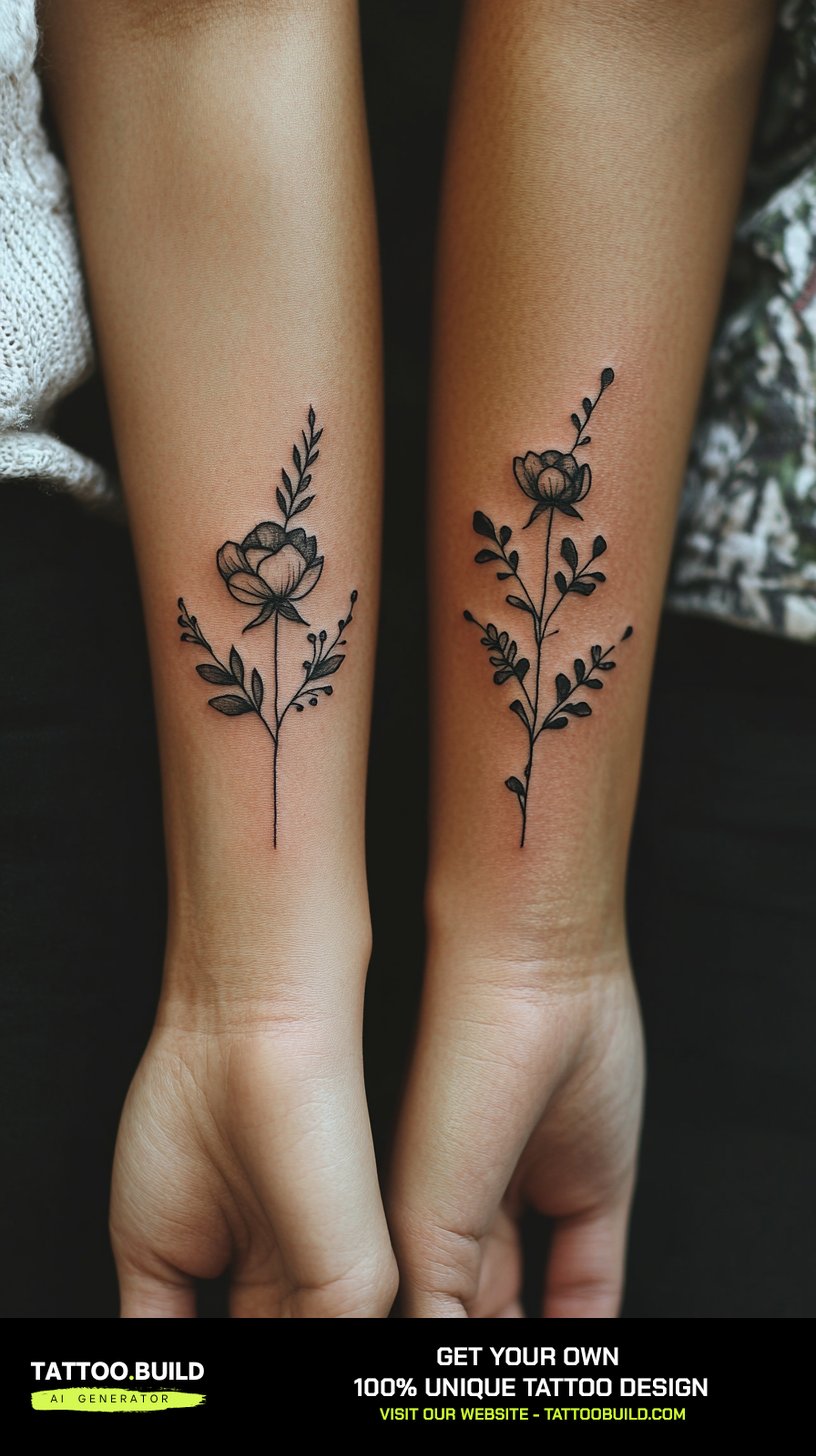
Identical tattoos are the obvious route and not always the best one. Complementary designs — a sun and a moon, a lock and a key, two halves of one landscape — carry the same meaning with more room for personal taste.
They also solve the practical problem of two friends with very different pain thresholds or placement preferences.
Split Symbols
One object divided across two people. Half a heart each is the classic; half a compass or half a wave works better visually because the cut line is less obvious.
The catch is that a split design looks unfinished alone. Be honest with yourself about whether that bothers you.
Custom Combinations
Mixing elements is where the good tattoos come from. A dotted flight path borrowed from the paper planes and attached to two wine glasses reads as a run of shared celebrations across cities.
Or a lotus with a single wing behind it — spiritual and protective at once. Bring both references to your artist and let them resolve the composition.
Groups of Three or More
Friendship groups often want one design across four or five people, which is where identical tattoos start to fail. In my experience a shared motif with individual variation works far better — the same wildflower, a different flower each.
It also removes the awkwardness if one person later wants theirs covered or removed.
Placement, Pain and Getting the Appointment Right
Wrists and inner forearms are the default for a reason: flat, low friction, easy to show and easy to cover. If you want one recommendation, start there. I have a dedicated guide to tiny wrist tattoo ideas if that is the direction you are leaning.
Shoulder blades and ankles suit friends who want the tattoo mostly private. Both heal fine; the ankle simply takes longer because clothing rubs it constantly.
Fingers and hands look wonderful for about a year. I would not choose them for a tattoo that is supposed to represent something permanent, because touch-ups become a recurring cost rather than a one-off.
On pain, ribs, sternum, inner elbow and the tops of the feet consistently rate higher than fleshy areas — my tattoo pain chart maps this out properly. A small piece is over in fifteen to forty minutes either way.
Book together if you can, but book consecutively rather than simultaneously unless the shop has two artists free. Watching your friend go first is genuinely calming for a first-timer.
Aftercare That Keeps Small Ink Readable
Follow the aftercare instructions your artist gives you over anything you read online, including this page. They know what they used and how they worked.
In general terms, a new tattoo is an open wound: keep it clean, keep it lightly moisturised rather than smothered, and leave the flaking alone. Picking at a small tattoo can pull ink out of lines that had very little to spare.
Sunscreen, once fully healed, is the highest-value habit for tiny tattoos specifically. The American Academy of Dermatology has practical guidance on caring for and protecting tattooed skin.
Watch for spreading redness, swelling that increases after day three, heat, pus or fever — those warrant a doctor, not a forum thread. Allergic reactions to certain pigments are uncommon but real, and the US Food and Drug Administration outlines the known risks around tattoo inks. This article is general information, not medical advice.
Common Mistakes, and What to Do If You Are Still Not Sure
The most frequent mistake is choosing a design at a size the design cannot survive. If your artist suggests going a centimetre larger, that is usually the whole conversation.
The second is tattooing the friendship’s current state rather than its substance — a shared in-joke from this year, a nickname, a specific date. Symbols age better than specifics.
The third is one person agreeing to keep the peace. If either of you is hesitating, wait. Nothing about this gets worse with a month of thinking.
Still undecided? Two related guides usually settle it: matching tattoo ideas for sisters for family-adjacent bonds, and fine line tattoo ideas if the style rather than the subject is what you are stuck on.
And if the answer turns out to be no tattoo at all, that is a perfectly good outcome. Matching jewellery has ended more friendships-in-ink debates than anyone admits.
One more practical note: keep a photograph of the healed tattoo. If you ever need a touch-up with a different artist, it is the most useful thing you can hand them.
Frequently Asked Questions
How small can a best friends tattoo actually be?
Most artists I have spoken to set a practical floor around two centimetres for a simple outline shape, and closer to four or five for anything with interior detail. Below that, lines sit too close together and merge as the ink settles. The honest test is whether the design still reads at arm’s length. If it does not, size up rather than simplify further.
Do matching tattoos have to be identical?
No, and identical is often the weaker choice. Complementary designs let each person pick a placement and scale that suits them while still reading as a pair. Split symbols and shared-motif variations both work well for groups of three or more. The connection is legible to anyone who knows the story, which is the only audience that matters.
How much does a small friendship tattoo cost?
Almost every shop works to a minimum charge, so a two-centimetre design and a five-centimetre design frequently cost the same. That minimum varies widely by city and by artist reputation. Ask when you book rather than at the counter afterwards, and budget separately for a possible touch-up down the line.
Which placement hurts the least?
Fleshier, lower-nerve areas — the outer forearm, the outer thigh, the upper arm — are usually reported as the most comfortable. Bony and thin-skinned areas such as ribs, sternum, ankles and the tops of the feet rate higher. Pain is individual, so treat any chart as a rough guide. A small piece is typically finished in under forty minutes regardless.
What if the friendship ends?
It is a fair question and worth asking out loud before the appointment. Symbolic designs — a wave, a lotus, a plane — keep their own meaning independently of the friendship, which is one reason I steer people away from names and dates. Cover-ups and laser removal both exist, but both are slower and more expensive than the original tattoo, so choose as though it stays.
Quick Summary
- Simplicity beats detail at small scale — bold minimal linework ages best.
- Leave visible gaps between lines; ink spreads slightly over the years and small tattoos have no margin.
- Wrists, inner forearms, shoulder blades and ankles are the reliable placements; fingers and hands fade fastest.
- Complementary designs often work better than identical ones, especially for groups of three or more.
- Choose symbols over names, dates and in-jokes — symbols hold their meaning independently.
- Expect a minimum shop charge, so a slightly larger design usually costs the same as a tiny one.
- Follow your artist’s aftercare instructions, do not pick the flaking, and use sunscreen once healed.
- See a doctor for spreading redness, increasing swelling, heat, pus or fever — this guide is not medical advice.