A tiger tattoo is one of the few designs that reads as beautiful and intimidating at the same time, which is exactly why so many women choose it.
I have been collecting and cataloguing tiger tattoos for this site for years, and the pattern is consistent: women rarely want a tiger because it looks fierce. They want it because of what it says about a season they came through.
In my experience the design decision that matters most is not the tiger itself. It is the size, the placement, and whether the stripes have room to breathe.
This guide walks through the styles that actually hold up over years of healing, the placements that suit a tiger’s shape, and the questions worth asking your artist. If you are weighing a tiger against another big cat, the lion tattoo ideas guide is a useful side-by-side.
Which Tiger Tattoo Style Is Right for You?
Style choice drives cost, session length, and how the piece will look a decade from now. Here is how the four main approaches compare.
| Style | Smallest size that works | Typical sitting time | How it ages |
|---|---|---|---|
| Realistic / black and grey | Roughly palm-sized and up | Several sessions for a sleeve or back piece | Fine shading softens; needs size to stay readable |
| Traditional / neo-traditional | Palm-sized | Often one to two sessions | Ages best of the four — bold lines hold |
| Fine-line / minimalist | Two to three inches | Usually under two hours | Thin lines spread over time; may need a touch-up |
| Geometric / abstract | Three to four inches | One session for most designs | Holds well if the linework is not hair-thin |
What a Tiger Tattoo Actually Means
The tiger carries a long symbolic history, and it is worth knowing the version you are wearing.
In Chinese tradition the tiger is a guardian figure rather than simply a predator — an animal associated with driving off harm, which is why it appears on protective imagery. Britannica’s overview of the tiger is a decent starting point on the animal itself.
In Japanese tattooing the tiger sits alongside the dragon and is usually read as courage and protection against bad fortune. That tradition has its own strict rules about composition and flow, which the Japanese tattoo designs guide covers in more depth.
Most women I have spoken to attach a more personal meaning than any of the traditional ones. Survival, a boundary held, a period of anger they refused to apologise for.
That is entirely valid, and worth telling your artist. A tiger meant as protective looks different from one meant as defiant — the first often faces outward or watches over a shoulder, the second usually snarls.
Tiger Tattoo Styles Worth Considering
Realistic Tiger Tattoos
Realism is the style most people picture when they think of a tiger tattoo, and it is also the least forgiving.
A realistic tiger lives on shading — fur direction, the wet highlight on the eye, the way the muzzle catches light. Those details need physical space. When I have seen realism squeezed into a four-inch panel, it reads as a grey blur within a few years.
Ask to see healed work, not fresh photos. Fresh realism looks stunning on every artist’s feed; healed realism separates the specialists from everyone else.
Forearms, outer thighs, and upper backs all give a realistic tiger the room it needs, and all three are flat enough that the face does not distort when you move.
Traditional and Neo-Traditional Tigers
If you want a tiger that still looks sharp in twenty years, this is the safest bet on the list.
Traditional tigers use heavy outlines and a limited palette, so the design survives the natural blurring that happens to every tattoo as skin ages. Neo-traditional keeps those bold lines but adds richer shading and a wider colour range.
The stylised snarling tiger head is the single most requested tiger design I see, and there is a practical reason: it fits almost anywhere and it does not depend on fine detail to work.
Black and grey traditional pieces sit somewhere between the two and suit anyone who wants the boldness without colour. If you like this direction, the tattoos that mean strength and courage collection has related motifs in the same visual language.
Fine-Line and Minimalist Tigers
Minimalist tigers have become the most common first tattoo in this category, and they are a genuinely good entry point.
The design reduces the tiger to a few essential lines — usually the face, sometimes just the stripes suggesting a form. Sessions are short, cost is lower, and the piece is easy to cover for work.
The honest limitation is longevity. Very thin lines spread slightly as they settle into the skin, so a hair-thin minimalist tiger will look softer at ten years than at ten months. Most artists I have asked recommend going one notch thicker than the reference photo.
The fine-line tattoo ideas guide goes deeper on which placements hold thin linework best.
Geometric and Abstract Tigers
Geometric tigers break the animal into planes, triangles, or mandala-style patterning.
The appeal is that the piece works as an abstract composition first and an animal second, which suits anyone who wants the symbolism without a literal tiger staring off their forearm.
Geometric work is where artist skill shows fastest. Wobbling straight lines and imperfect symmetry are impossible to hide, so this is a style worth travelling for rather than settling on locally.
Tiger and Floral Combinations
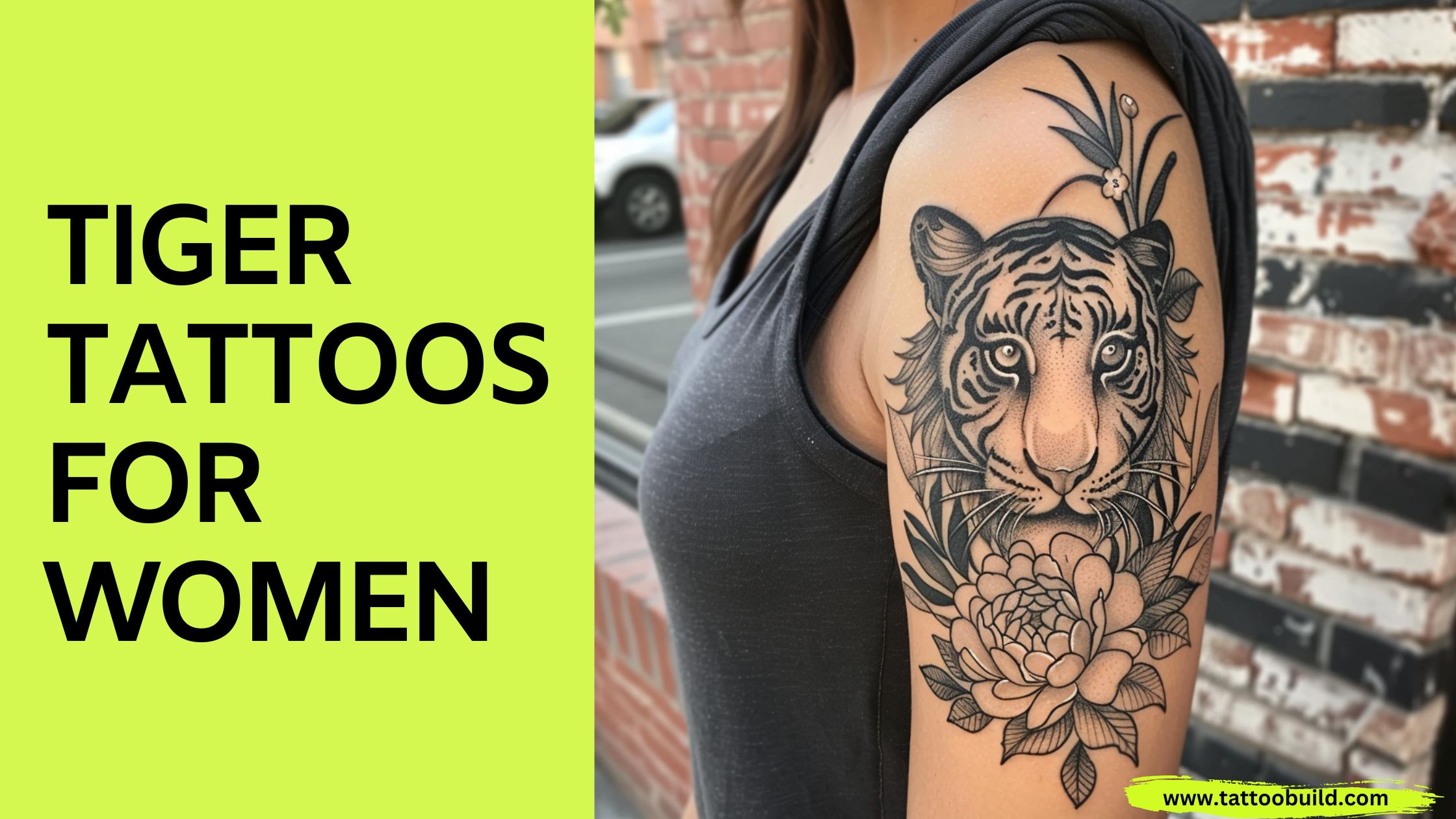
Pairing a tiger with flowers is the most popular way to soften the design without weakening it.
Peonies are the classic partner in Japanese-influenced work; roses and wildflowers show up more in Western neo-traditional. The flowers also solve a practical problem — they fill awkward negative space around the tiger’s shape so the piece sits properly on the limb.
Ask your artist to draw the florals around your specific body shape rather than adapting a flash design. This is the difference between a tattoo that looks placed on you and one that looks made for you.
Placement: Where a Tiger Tattoo Sits Best
Thigh and Hip
The thigh is the placement I recommend most often for a first large tiger.
It offers a wide, relatively flat canvas, it is easy to keep covered while healing, and the outer thigh is generally on the more tolerable end of the pain range. The hip is more sensitive but the curve suits a tiger’s crouching posture beautifully.
For sizing and design references, the thigh tattoos for women gallery is worth browsing before your consultation.
Arm and Forearm
The forearm is the placement you will actually look at every day, which matters more than people expect.
A tiger head works well facing either up the arm or down toward the wrist — decide which orientation you want when you look down at it, since that is the view you get most. The upper arm and outer bicep are more forgiving on pain and easier to hide.
Wrapping a tiger fully around the forearm is harder than it looks and usually requires two sittings just to get the stencil right. More arm options are collected in the forearm tattoo ideas for females guide.
Shoulder and Back
The shoulder and upper back give you the largest uninterrupted canvas on the body.
This is where full-body tigers, prowling poses, and large Japanese-influenced compositions belong. The trade-off is that you will rarely see it yourself, and healing is more awkward — sleeping position becomes a real consideration for the first week.
Ankle and Wrist
Small placements demand small designs, and that is a genuine constraint rather than a compromise.
A minimalist tiger face or a simple outlined silhouette works here. A realistic tiger does not. Both areas sit close to bone, so expect them to be sharper than a thigh — the tattoo pain chart is a reasonable guide to relative sensitivity, though everyone’s tolerance differs.
More Tiger Tattoo Variations to Save
Beyond the main styles, a few variations come up often enough to be worth naming.
Tiger Eyes Only
Cropping to just the eyes and stripe pattern is a striking option for narrow spaces like the inner forearm or spine.
White Tigers and Colour Variations
A white tiger reads as calmer and more ethereal than an orange one, and it relies almost entirely on shading and negative space rather than colour.
White ink highlights are not the same thing as a white tiger — pure white ink fades unpredictably, so most artists will build the effect from untattooed skin instead.
Tigers Paired With Other Motifs
Tigers combine well with snakes, moons, and script, and they anchor a half-sleeve better than most animals because the body gives the composition a spine to follow.
If you are still comparing animals, the wolf tattoo ideas collection covers the closest alternative in terms of symbolism.
Healing and Aftercare for a Large Tiger Piece
Large tigers involve a lot of saturated black, and heavily packed areas take longer to settle than fine linework.
Follow your artist’s specific instructions over anything you read online, including this page — aftercare protocols vary by studio, by bandage type, and by climate. The tattoo aftercare guide covers the general principles, and the American Academy of Dermatology’s advice on caring for tattooed skin is a reliable medical reference.
Sun is the main long-term enemy of a tiger tattoo. Once fully healed, sunscreen on the piece does more to preserve stripe contrast than any lotion or balm will.
If you notice spreading redness, heat, swelling that worsens after the first few days, pus, or a fever, that is a matter for a doctor rather than an internet guide. The FDA’s fact sheet on tattoos outlines the risks worth knowing before you book. Do not attempt to tattoo or remove tattoos at home — both carry real infection and scarring risk and should be handled by licensed professionals.
Common Mistakes — and What to Do If You Are Still Unsure
The mistake I see most is choosing a size that suits the budget rather than the design.
A shrunken realistic tiger is the one regret that comes up repeatedly. If the budget only stretches to a small piece, choose a style built for small — minimalist or traditional — instead of miniaturising realism.
The second mistake is bringing a single reference photo and asking for a copy of it. Bring five or six images that show what you like about each, and let the artist build something original from that.
If a tiger still is not quite landing, browse the rib tattoos for women gallery for placement ideas that might change how you picture the design.
Frequently Asked Questions
How much does a tiger tattoo cost?
Cost depends far more on size, style, and your artist’s rate than on the tiger itself. A small minimalist tiger is usually a shop-minimum or single short session, while a realistic thigh or back piece runs across multiple sittings. Most artists quote by the hour or by the day for larger work. Ask for a full estimate at consultation rather than a per-hour figure alone, since a slower artist charging less can end up costing more.
Do tiger tattoos hurt more than other designs?
The design does not change the pain — the placement and the session length do. Heavily shaded tigers involve more passes over the same skin, which is what makes them feel tougher than an outline of the same size. Bony areas like the ribs, ankle, and spine are generally reported as sharper than fleshy areas like the outer thigh. Everyone’s tolerance is different, so treat any pain chart as a rough guide.
Is a tiger tattoo a masculine design?
Not in any meaningful sense. The tiger has been worn by women in traditional Japanese and Chinese-influenced tattooing for a very long time, and the style choice matters far more than the subject. A fine-line tiger and a heavily shaded traditional tiger read completely differently even when the pose is identical. Pick the treatment that matches how you want the piece to feel.
How small can a tiger tattoo be and still look good?
Roughly two to three inches is the practical floor for a simplified tiger face, and that assumes a minimalist or traditional treatment. Below that the stripes start competing with each other and the design turns into a dark blob as it settles. If you want something smaller, consider cropping to eyes, a paw print, or a single stripe motif instead of shrinking the whole animal.
Will a tiger tattoo cover an old tattoo?
Tigers are one of the better cover-up subjects because the stripes provide natural dark areas to hide old ink. That said, a successful cover-up usually needs to be larger and darker than the original piece, so expect to size up. Take clear photos of the existing tattoo to your consultation and let a cover-up specialist assess it. Some faded tattoos need a session or two of laser lightening first.
Quick Summary
- Traditional and neo-traditional tigers age best; bold outlines survive decades of skin change.
- Realistic tigers need size — roughly palm-sized and up — or the shading blurs.
- Fine-line tigers are cheap, quick, and cover-friendly, but thin lines soften over the years.
- Geometric tigers expose weak linework, so choose an artist who specialises in them.
- Thigh and outer arm are the most forgiving placements for a first large tiger.
- Ankle, wrist, and rib sit closer to bone and generally feel sharper.
- Pairing the tiger with florals fills negative space and helps the piece fit your body.
- Sunscreen after healing does more for long-term stripe contrast than any aftercare balm.