The triangle is the only shape that cannot be deformed without changing the length of one of its sides. That single structural fact is why the triangle carries more symbolic weight per square inch than almost any other tattoo shape — it has meant stability, trinity, fire, water, change and ascent across cultures that never met each other.
I have watched this design get requested for completely opposite reasons in the same week. One person wants three sides for three siblings. The next wants a delta because they are in the middle of leaving a career.
What I like about it, after years of looking at geometric tattoo designs, is that a triangle is honest about its difficulty. There is nowhere for a shaky line to hide inside three straight strokes, and every artist I have asked says the same thing: a clean small triangle is harder than it looks.
Below are 17 directions, from a bare outline you could get in twenty minutes to compositions that need multiple sittings. I have flagged which ones age well and which ones do not.
Which Triangle Style Is Right for You?
This is the comparison I end up drawing on paper for people who arrive knowing they want a triangle and nothing else.
| Style | Typical size | Rough sitting time | How it ages | Best for |
|---|---|---|---|---|
| Fine line outline | 1–5 cm | 20–45 min | Softens; may need a touch-up in 5–10 years | First tattoos, discreet placements |
| Solid blackwork | 3–10 cm | 45–90 min | Best of the group; edges hold for decades | People who want it readable at arm’s length |
| Dotwork / stipple | 5–15 cm | 2–4 hours | Dots merge slightly; gradient stays legible | Texture without heavy black |
| Sacred geometry | 8–20 cm | 3–6 hours, sometimes two sessions | Dense linework can close up if placed too small | Back, chest, outer thigh |
| Watercolour fill | 5–12 cm | 1–3 hours | Fades fastest; plan on maintenance | Covered placements, colour lovers |
| Geometric portrait | 10–25 cm | 4–8 hours | Holds well if facets are not microscopic | Forearm, calf, upper arm |
What a Triangle Tattoo Actually Means
There is no single answer here, and anyone who tells you there is, is selling something.
In alchemical notation the four classical elements are all triangles: fire points up, water points down, air points up with a bar through it, earth points down with a bar. That system is genuinely old and genuinely documented, which is why it is the meaning I trust most when someone asks.
In Christian iconography, three points read as the Trinity. In Greek mathematics, the capital delta became shorthand for change or difference, and it still is on every physics whiteboard I have seen.
Then there is the modern layer — the triangle as a symbol of strength, of three people, of a personal three-word rule. None of those newer meanings are less valid, they are just newer.
My honest advice: pick the meaning before you pick the design, and be comfortable that a stranger may read a different one into it. That happens more with triangles than with almost anything else.
17 Triangle Tattoo Ideas
1. Single Fine Line Triangle
One equilateral triangle, thinnest needle grouping the artist has, no fill and no shading. The version pictured at the top of this article is exactly this.
It is the most requested triangle design I encounter and the one people most often underestimate. Three straight lines with sharp corners leave no margin for wobble, and the corners are where cheap work shows first.
Behind the ear, inner wrist and collarbone are the classic spots. Keep it above roughly 2 cm per side — smaller than that and the corners tend to fill in slightly as the ink settles over the first few years.
When I have asked artists which of these they would choose for themselves, this one comes up constantly. It is the least likely to look dated in fifteen years.
2. Sacred Geometry Triangle
The triangle as a structural unit inside a larger composition — the Sri Yantra, a Merkaba, or a Flower of Life grid built from intersecting triangular forms.
The Sri Yantra in particular is nine interlocking triangles, and it is a genuinely demanding piece of linework. You can read the background on the yantra tradition at Britannica before you commit to it.
This is where placement decides everything. Dense intersecting lines need room; I would not put a full Sri Yantra under about 10 cm, because the points where lines cross are the first thing to blur.
If you want the look at a smaller scale, ask for a simplified version with fewer intersections rather than a shrunken full one.
3. Mountain Triangle
A triangle that resolves into a peak: a snow line near the top, sometimes a horizontal rule beneath it for the horizon.
This is the gateway triangle. People who are not sure they want something abstract find it easy to live with because it reads as an object first and a shape second.
It pairs naturally with treeline and forest work — see the mountain and tree tattoo directions if you want to build it out later.
Practical note from watching these heal: the thin snow-line detail is usually the first element to soften, so ask for it a touch heavier than looks right on the stencil.
4. Eye of Providence
An eye inside a triangle, usually with rays radiating outward. The most historically loaded option on this list.
It has been used in Christian art, on the Great Seal of the United States, and by groups it was never associated with originally. Expect people to read meanings into it that you did not intend.
Design-wise it is a good candidate for dotwork shading, because the eye needs soft gradient while the triangle needs hard edges — the contrast is the whole appeal.
I would place this one where you can cover it easily if you work somewhere conservative. Inner bicep and upper back both work.
5. Delta Symbol
The bare capital delta: mathematical shorthand for change or difference.
This is the cleanest way to get “change” onto skin without a quote. No fill, no decoration, just the character.
It is also the smallest viable idea in this article — I have seen these done well at around 1 cm on a finger side, though finger ink fades faster than anywhere else on the body and usually needs touching up.
People often get this one at a genuine hinge point in their life, which is also why it ages emotionally well. The meaning does not depend on the circumstances still being true.
6. Upward and Downward Triangle Pair
Two triangles, one pointing up and one pointing down, placed side by side or stacked.
In alchemical terms that is fire and water — opposites held together. It is the design I most often see chosen by couples and siblings who want something matching but not identical.
Spacing is the whole game. Too close and they read as a single blob after a decade; I would leave at least the width of one triangle between them.
A variation worth asking about: one solid black, one outline only. It keeps the pair legible at a glance.
7. Alchemical Fire Triangle
A single upward triangle, usually filled solid, standing for fire in classical alchemical notation.
Solid black is the right call here. Of every style in this article, solid blackwork is the one that holds its shape longest, and a small filled triangle is about as durable as tattooing gets.
Ask for the packing to be done in at least two passes rather than one heavy one — patchy black in a small shape is the most common touch-up I hear artists complain about.
Size range that tends to work: 2 to 5 cm. Larger solid triangles start needing a border to stop the edges reading soft.
8. Trinity Knot (Triquetra)
Three interlaced arcs forming a triangular silhouette — a triangle made of curves rather than straight lines.
Because it is continuous linework, it forgives slight unevenness in a way the bare outline does not. That makes it a softer entry point if you are nervous about hard geometry.
It sits inside a much larger tradition of interlace; the wider Celtic knot tattoo ideas are worth scanning before you settle on a version.
Check the over-under weave on your stencil carefully. An incorrectly woven triquetra is surprisingly common and impossible to unsee afterwards.
9. Geometric Landscape in Triangle
The triangle used as a window: mountains, trees, a sun or a wave contained inside the outline.
This is the most forgiving idea on the list for someone who wants detail without a long sitting, because the frame does the compositional work.
The mistake I see is cramming too much inside. Two elements — a ridgeline and a sun, say — read far better at a distance than five.
Negative space matters more than the linework here. Ask your artist to leave more empty area inside the triangle than feels comfortable on the drawing.
10. Dotwork Triangle
Shading built entirely from individual dots, typically dense at one corner and fading out toward the opposite edge.
It is slow work. A palm-sized dotwork triangle can easily take two to four hours, because the gradient is built point by point.
The payoff is how it ages — dots merge very slightly and the gradient stays readable rather than turning into a flat grey patch. If the texture appeals, the broader dotwork tattoo ideas show what the technique can do at scale.
Bring reference of a dotwork gradient you actually like. “Dotwork” means very different densities to different artists.
11. Interlocking Triangles
Two or more triangles overlapping, often drawn as an impossible object in the Penrose style.
The illusion only works from a reasonable viewing distance, so this is a design that wants a flat, visible plane — outer forearm, calf, shoulder blade.
Avoid curved placements. Wrapping an impossible triangle around a bicep breaks the perspective trick that makes it worth getting.
When I have seen these go wrong, it is almost always because the piece was placed somewhere the eye never sees straight-on.
12. Fibonacci Triangle
A triangle constructed on golden-ratio proportions, sometimes with the spiral drawn inside it.
Honestly, the proportion is doing quiet work that most viewers will not consciously notice — they will just say it looks balanced.
It suits people who want a mathematical reference that is not as on-the-nose as a written formula. Fine line is the natural register.
If you want the maths to be explicit, coordinates or a short equation beneath the shape reads better than trying to label the ratio inside it.
13. Animal Geometric Portrait in Triangle
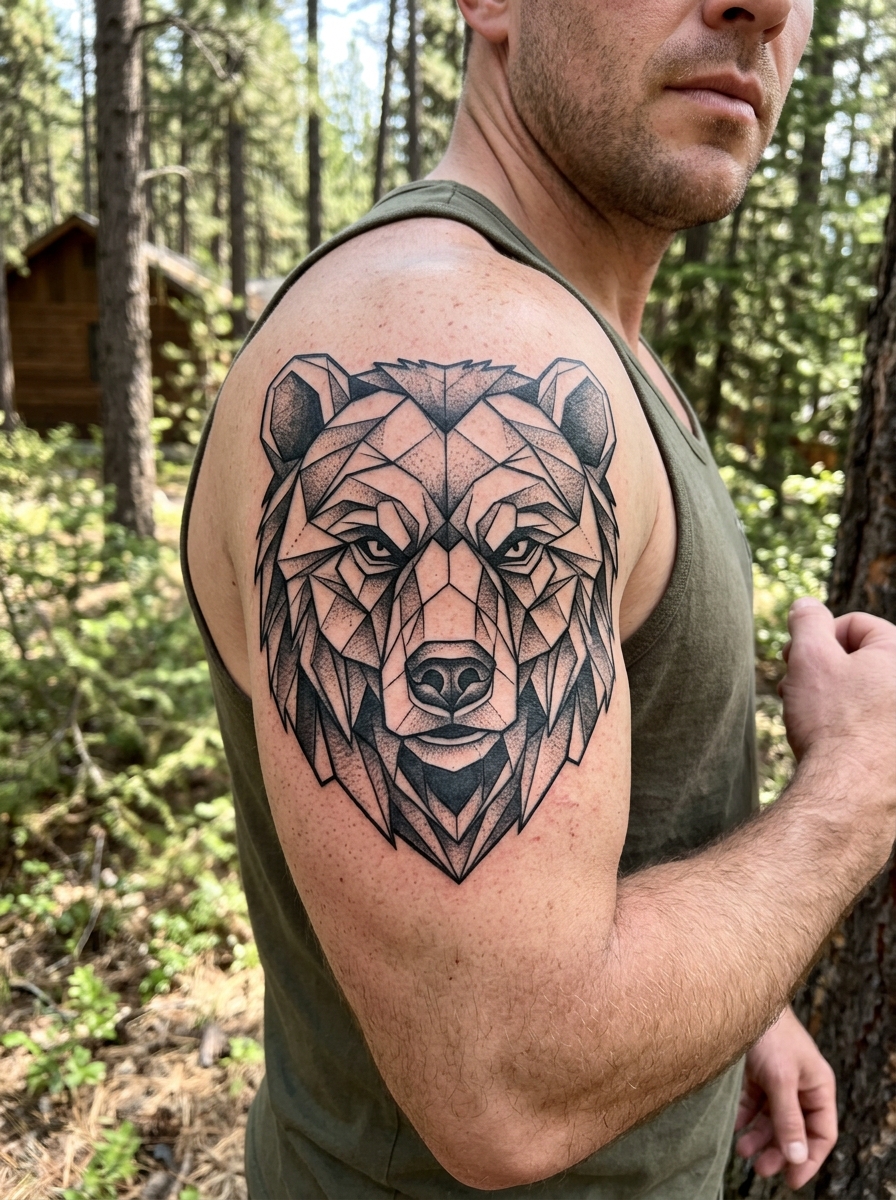
An animal face broken into triangular facets and framed by a triangle outline — bears, wolves and foxes are the usual choices.
This is the longest sitting in this article. Four to eight hours is realistic for a forearm-sized piece with clean facets.
Facet size is the thing to negotiate. Very small facets look stunning fresh and merge into noise over time; larger, fewer planes hold up far better.
The geometric bear tattoo ideas collection is the best reference point I know for how the faceting should be weighted.
14. Three Dots (Ellipsis Triangle)
Three dots arranged in a triangle formation. No outline at all — the shape exists only in the space between them.
It is the most discreet option here and takes minutes. It is also the one I would think about hardest before getting, because three dots in a triangle carries specific prison and gang associations in some regions and reads as an ellipsis or a minimalist design in others.
Context and placement change how it is read. Inner arm and ankle are usually fine; face and hand placements are where the other reading is most likely.
If that ambiguity bothers you, a bare outline triangle at the same size says the same thing with none of the baggage.
15. Triangle with Coordinates or Text
A triangle outline paired with GPS coordinates, a date, or a short word set beneath or inside it.
Lettering is the risk. Small text blurs faster than linework, so I would not go below roughly 3 mm cap height for the numerals.
Check the coordinates twice, then have someone else check them. I have heard more than one artist describe a correction session on exactly this.
Sans-serif reads better long term than a thin serif at this scale, and negative-space spacing between the shape and the text matters more than the font choice.
16. Mandala Built on Triangle Grid
A radial mandala whose underlying construction grid is triangular rather than circular, producing six- or twelve-fold symmetry.
This is the densest design in the article and needs the most skin. Back, chest and outer thigh are where it works; forearm versions almost always lose detail.
If the radial approach is what draws you rather than the triangle itself, the wider mandala tattoo ideas are a better starting point.
Expect two sessions. Nobody I have spoken to finishes a full triangle-grid mandala in one sitting comfortably.
17. Watercolour Fill Triangle
A hard black triangle outline with soft washes of pigment behind or inside it.
It is the most fragile style in this article. Watercolour pigment, especially in the pastel range, fades noticeably faster than black, and sun exposure accelerates it.
If you want this, plan for maintenance rather than hoping it holds. Keep it somewhere clothing usually covers, and be realistic that a refresh every several years is part of the deal.
Asking for a slightly heavier outline than the drawing suggests is worth it — the black is what will still be holding the shape together in a decade.
Variations Worth Considering
If none of the seventeen is quite right, these adjustments usually get people the rest of the way there.
Open or broken outline
One side left incomplete, or a gap at a corner. It softens the geometry and gives the eye somewhere to rest, and it dates less obviously than a perfect outline.
Negative space triangle
Instead of inking the triangle, ink a solid black field and leave the triangle bare. It is a blackwork approach and it is genuinely striking, but it commits far more skin than the outline version.
Stacked or repeated triangles
Three to five triangles of decreasing size stacked vertically. Works well on the spine and forearm, and lets you add to it later without redesigning anything.
Triangle as a frame for something else
A botanical, a moon phase, a small animal, framed by the shape. This is how most people who are unsure about pure geometry end up getting a triangle anyway.
Placement, Pain and Getting It Right
Straight lines are unforgiving on curved anatomy. A triangle on the ribs or the side of a bicep will appear to bow when viewed from an angle, and no amount of skill fixes that — it is geometry, not technique.
The flattest, most reliable spots are the outer forearm, the shoulder blade, the calf and the sternum. If your design depends on perfect symmetry, choose one of those.
On pain, the honest answer is that the shape does not change much — the placement does. Ribs, sternum and inner bicep sting; outer forearm and calf are gentler. The tattoo pain chart gives you a usable map before you book.
One thing I would push anyone on: ask to see the stencil on your skin and then walk to a mirror and look at it from a few feet away, not two inches. Triangles that look perfect up close often sit crooked relative to the limb.
Common Mistakes and Still Not Sure?
The mistake I see most often is going too small. A triangle under about 2 cm per side gives the ink nowhere to settle, and the corners are the first casualty.
The second is treating a triangle as an easy piece and choosing the artist on price. Fine line geometry is a specialism; look specifically for healed photos in a portfolio, not fresh ones.
The third is skipping aftercare on something small. Size has nothing to do with healing — a 2 cm triangle is a wound like any other, and the tattoo aftercare basics apply identically.
If you are still deciding, look at how fine linework actually settles on the body over time — the fine line spine tattoo examples are a fair, unflattering test of the style.
And on safety: tattooing carries real risks including infection and allergic reaction, and red and some coloured pigments are the most common culprits for delayed reactions. The Mayo Clinic overview of tattoo risks is a sober summary. If a healing tattoo is hot, spreading, weeping or painful beyond the first few days, see a doctor rather than asking the internet — and never attempt DIY tattooing or at-home removal.
Frequently Asked Questions
What does a triangle tattoo mean?
There is no single meaning. In alchemy the four elements are all triangles, with fire pointing up and water pointing down. In Christian symbolism three points read as the Trinity, and in mathematics a capital delta means change or difference. Most people I have spoken to attach a personal meaning — three family members, a turning point — rather than adopting a historical one. Decide what it means to you before you book, because strangers will read their own meaning into it either way.
How small can a triangle tattoo be?
Around 2 cm per side is a sensible floor for an outline design. Below that, the three corners tend to soften as ink spreads slightly over the years, and a small triangle with rounded corners stops reading as a triangle. Three dots in a triangle formation can go much smaller because there are no corners to lose. Fingers and the side of the hand fade faster than anywhere else regardless of size.
Do triangle tattoos age well?
Solid blackwork ages best, then dotwork, then fine line, with watercolour fill last. The variable is not really the shape, it is line weight, placement and sun exposure. Hard geometric edges make any softening more visible than it would be on an organic design, which is the one genuine downside of the style. Sun protection once healed makes more difference than almost anything else you can control.
Where is the best place for a triangle tattoo?
Flat areas are best, because straight lines visibly distort on curved anatomy. The outer forearm, shoulder blade, calf and sternum are the most reliable. Inner wrist, behind the ear and the collarbone all work for small designs and are easy to conceal. Avoid the side of the bicep and the ribs if your design depends on looking symmetrical from every angle.
How long does a triangle tattoo take?
A simple fine line outline is often twenty to forty-five minutes including the stencil. A dotwork triangle runs two to four hours because the shading is built dot by dot. Sacred geometry compositions and geometric animal portraits can take four to eight hours and are sometimes split across two sessions. Ask for a time estimate when you book, since shop minimums usually apply to the very small designs anyway.
Quick Summary
- The triangle has no single meaning — alchemical elements, the Trinity and the mathematical delta are all legitimate readings.
- Keep outline designs at roughly 2 cm per side or larger so the corners stay sharp as the ink settles.
- Solid blackwork ages best; watercolour fill ages fastest and needs planned maintenance.
- Flat placements — outer forearm, shoulder blade, calf, sternum — keep straight lines looking straight.
- Dotwork takes two to four hours; geometric animal portraits can take four to eight.
- Choose your artist on healed portfolio photos, not fresh ones, and not on price.
- Three dots in a triangle carries specific regional associations — know them before you choose that version.
- Aftercare applies identically to small tattoos; see a doctor, not a forum, if healing goes wrong.