If you are searching for ghost tattoo ideas, here is the thing nobody tells you up front: the ghost is one of the few tattoo subjects that works equally well as a two-inch joke and as a full back piece, and the design decision that matters most is which of those two you actually want.
I have sat with this subject a lot. Ghosts come up every October, but the requests I find most interesting arrive in February and June — people who want the shape for what it means, not because a holiday is close.
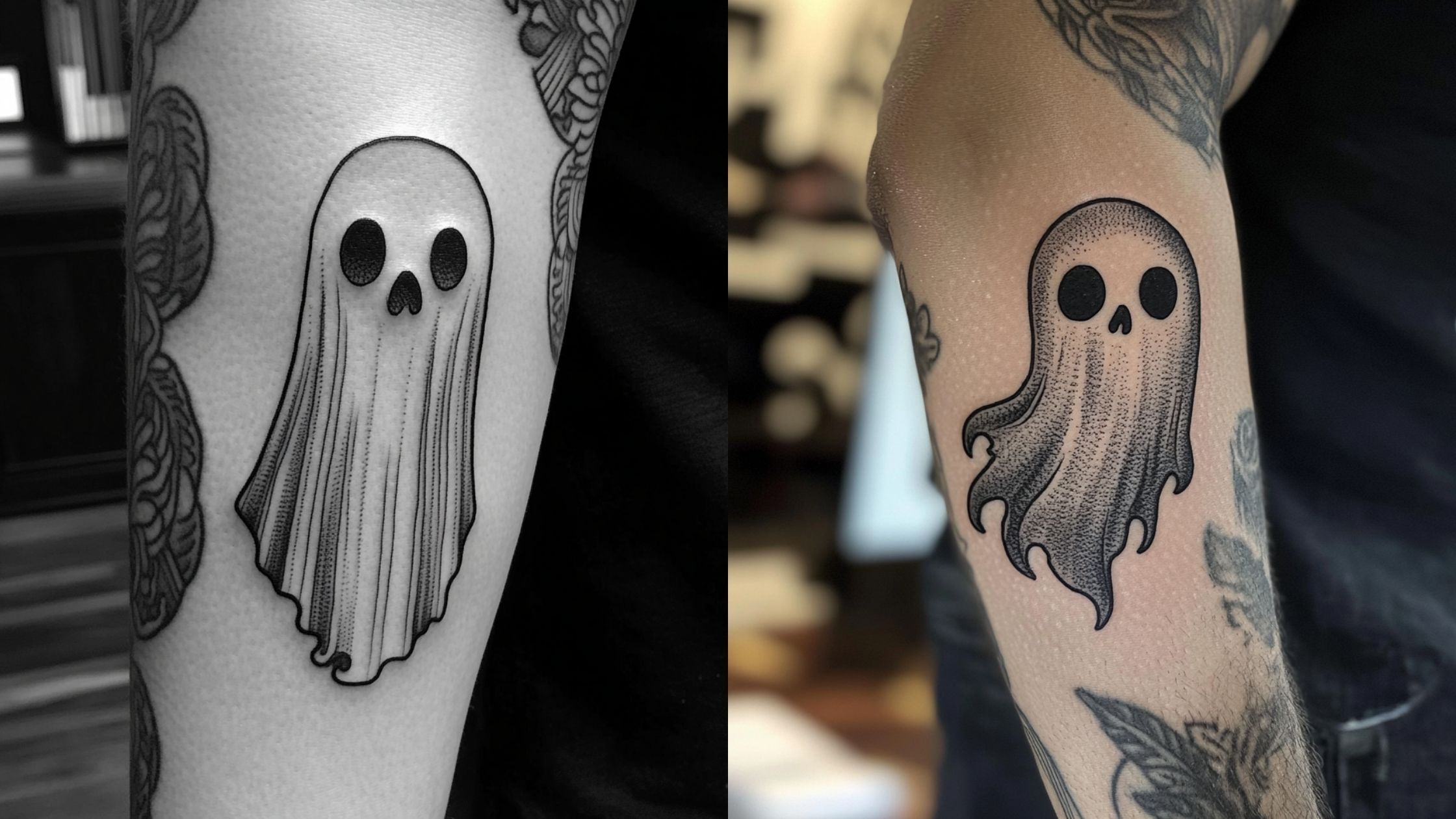
The classic sheet ghost is a genuinely brilliant piece of design. It is a single closed outline with two dots, which means it survives being shrunk, stretched, blurred by time and placed almost anywhere on the body.
That flexibility is why ghost designs sit comfortably next to minimalist tattoo ideas on one end and full horror sleeves on the other. Below I have broken the whole category into the styles, variations and placements that actually hold up.
Which Ghost Tattoo Style Is Right for You?
Before the gallery, a quick way to narrow things down. This is roughly how I talk through the decision with someone who knows they want a ghost but not which one.
| Style | Best Size | Typical Sitting | Ages Well? | Best For |
|---|---|---|---|---|
| Traditional / old-school | 3–6 in | 2–4 hours | Excellent | A first tattoo you want readable in 20 years |
| Cute / kawaii | 1.5–3 in | 45 min–1.5 hours | Good | Small, playful, low-commitment placement |
| Fine line / minimalist | 2–4 in | 1–2 hours | Needs touch-ups | Subtle pieces on forearm or ribs |
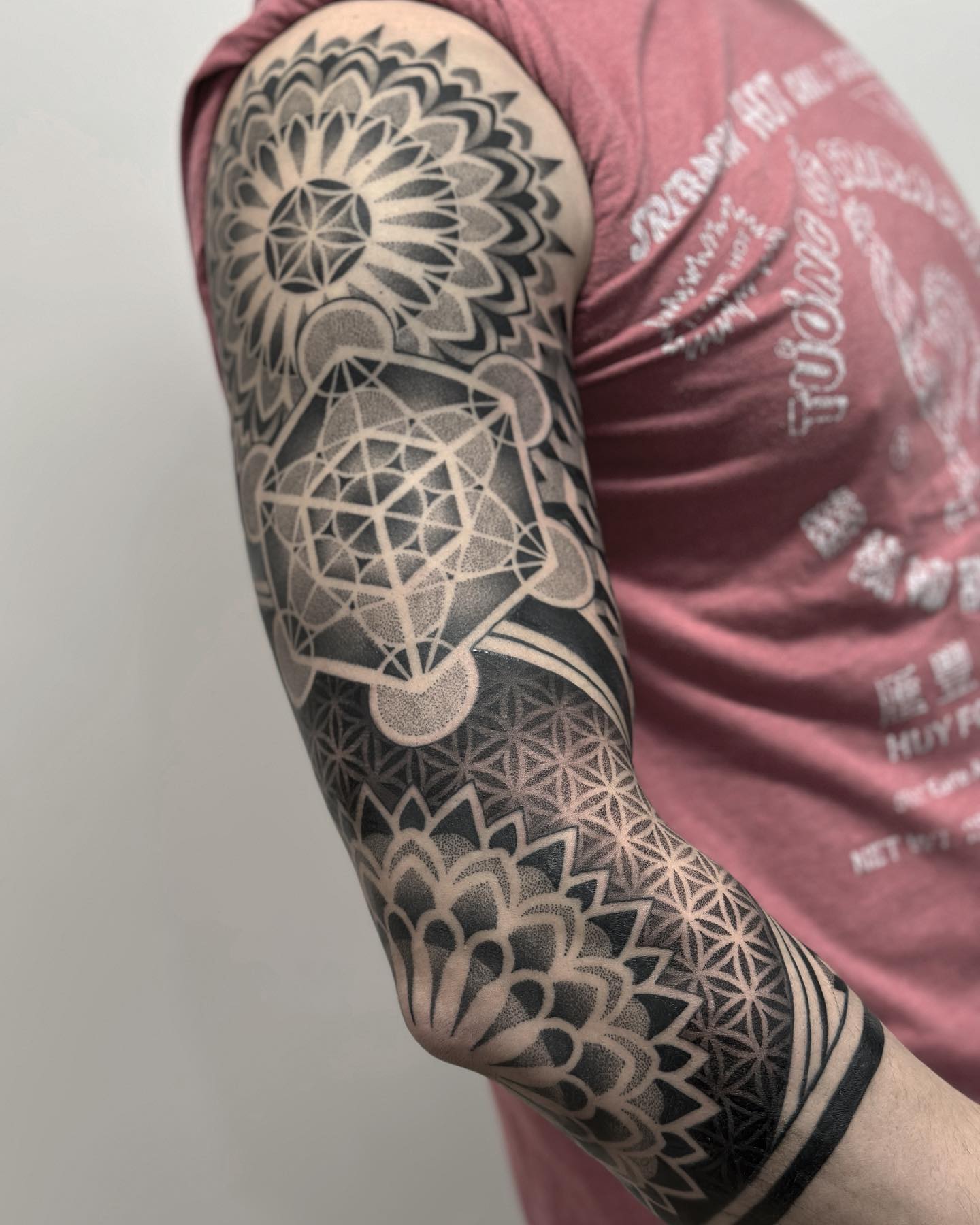
| Blackwork / dotwork | 4–8 in | 3–6 hours | Excellent | High contrast that stays punchy |
| Black & grey realism | 5–10 in | 4–8 hours | Good with care | Atmospheric, painterly ghost scenes |
| Anime / cartoon | 3–6 in | 2–4 hours | Good | Character-driven pieces with flat colour |
| Scene work (ship, graveyard) | 8 in+ | Multiple sessions | Depends on detail density | Half sleeves, backs, thighs |
The column I would pay the most attention to is size. Most ghost tattoos that disappoint people were simply drawn too small for the amount of detail crammed into them.
What Ghost Tattoos Actually Mean
Ghosts carry a wide spread of meaning, and that range is the reason the design has stayed popular rather than cycling in and out like a trend.
The most common reading is memory. A ghost is a person who is gone but still present, which makes it a quieter alternative to a portrait or a name.
For a lot of people the piece is functionally a memorial. If that is your reason, it is worth reading through memorial tattoo ideas before you commit to a shape, because the symbolism options are wider than most people expect.
A second reading is protection or watchfulness — the idea of someone still looking out for you. This is where you see ghosts paired with hands, candles, or a house.
The third reading is simply affection for horror. That is a completely valid reason, and honestly it produces some of the best-executed work, because the reference material is so strong.
None of these meanings are fixed. A ghost tattoo means what you decide it means, and no artist is going to argue with you about it.
Ghost Tattoo Ideas by Style
These are the eight style directions I see most often, roughly ordered from the safest bet to the most ambitious.
1. Traditional and Old-School Ghost Tattoos
Bold outlines, limited shading, flat colour if any. This is the style that has been proven over roughly a century of tattooing.
The heavy line is doing the work. When the piece softens over 15 or 20 years, a thick outline still holds the silhouette while thin lines have blurred together.
In my experience this is the direction I recommend most often to people getting their first tattoo, purely because the failure mode is so gentle — a traditional ghost that has aged badly still reads as a ghost.
Expect a smaller flash-style piece to land in the two-to-four hour range depending on size and how much solid black is in it.
2. Cute and Kawaii Ghost Tattoos
Big eyes, blush marks, a little wave. These are the ghosts that make people smile rather than flinch.
The technical advantage here is that the design is intentionally simple, so it survives being placed somewhere small — behind the ear, on a finger, on the inside of an ankle.
The trap is the face. Tiny eyes and a tiny mouth placed close together will merge into one dark smudge as the tattoo settles.
Every artist I have asked about this says the same thing: give the features more separation than looks right on paper, because healed ink spreads slightly in every direction.
3. Minimalist and Fine Line Ghost Tattoos
A single continuous outline, no fill, no shading. Elegant, and by far the most requested modern interpretation.
Fine line work is beautiful and it is also the least forgiving style on this list. If this is the direction you want, look through fine line tattoo ideas first so you can judge an artist’s healed work rather than their fresh photos.
Ask specifically to see healed fine line pieces at one year or older. Fresh photos of thin lines look incredible on everyone; healed photos separate the artists who plan for spread from the ones who do not.
Plan on a touch-up. Many fine line pieces benefit from one at the six-to-twelve month mark, and most reputable shops price that reasonably or include it.
4. Blackwork and Dotwork Ghost Tattoos
Solid black fill, negative space used as the light source, no grey wash at all.
This is my favourite technical answer to the ghost problem, because a ghost is fundamentally a shape rather than a face — and blackwork tattoo technique is all about shape.
Dotwork is the softer cousin. Instead of a hard black edge you get graduated stippling, which suits the idea of something fading in and out. There is a lot of range in dotwork tattoo ideas if you want texture without colour.
Solid black takes longer to heal than line work and tends to feel hotter for the first few days. Budget more downtime than you would for an outline-only piece.
5. Ghosts with Flowers
Pairing a ghost with roses, poppies or wildflowers is the single most common combination I see requested.
It works for a compositional reason: a ghost is a soft, curved, closed shape, and flowers give the artist a way to break up that outline so it does not read as a blob.
It also shifts the mood. The same ghost that reads as spooky on its own reads as tender once there are flowers around it.
If you want the memorial reading without it being obvious, this is how to get there. Flowers with personal significance carry the meaning quietly.
6. Haunted House and Graveyard Scenes
Full scene work — a house on a hill, a fence, a moon, a small ghost drifting through it.
These need real estate. A scene squeezed into three inches is the most common way people end up disappointed with an otherwise skilled tattoo.
As a rough rule, if the design has more than about four distinct elements, you are looking at a forearm panel, a calf, or a thigh rather than a wrist.
Scene work almost always spans multiple sessions once you get past palm-size, so ask about session structure and pricing before you book.
7. Anime and Cartoon Ghost Tattoos
Character ghosts from film and animation, rendered with flat colour and clean line to match the source material.
The important question here is licensing and taste rather than technique — many artists will happily tattoo a character but prefer to reinterpret it rather than copy a frame exactly.
I have found that the pieces people are happiest with long-term are the ones where the artist was allowed to redraw the character in their own hand.
Flat colour ages reasonably well as long as the outline underneath is solid. Ask about outline weight, not just the colour palette.
8. Ghosts Paired with Skulls
The ghost-and-skull pairing gives you the softest possible shape against the hardest, and that contrast is the whole appeal.
If you want the skull to carry the piece, it is worth browsing skull tattoo ideas separately, because skull anatomy is where a mediocre artist gets exposed fastest.
A skull that is even slightly off in proportion looks wrong to everyone, even people who cannot say why. A ghost, by contrast, is forgiving.
For this combination I would prioritise the artist’s skull portfolio over their ghost portfolio, every time.
Variations Worth Considering
If none of the eight above is quite it, these five variations cover most of what is left.
Ghost Ship Tattoos
Tattered sails, heavy rigging, a hull half-lost in fog. The most ambitious design in this guide.
Rigging is the difficulty. Dozens of thin parallel lines in a small area will merge over time, so this piece needs scale — realistically a half sleeve, a back panel or a full thigh.
Ghost and Lantern
A ghost carrying a lantern solves a problem that most ghost tattoos have: there is no light source, so the shading is arbitrary.
Add a lantern and suddenly the artist has a reason for every highlight and shadow in the piece. It is a small addition that makes the whole design more coherent.
Victorian and Mourning-Portrait Ghosts
Ornate frames, drapery, high collars — visual language borrowed from nineteenth-century mourning portraiture and spirit photography.
This suits people who want something that reads as antique rather than as horror. It sits well alongside other ornamental work if you are building a themed sleeve.
Ghost Pets
A cat, a dog or a rabbit drawn as a small floating spirit. This is the memorial variation I get asked about most.
It works because it sidesteps the difficulty of pet portraiture. A stylised ghost version of your animal only needs to capture the silhouette and one or two identifying features.
Celestial Ghosts
Ghosts with a crescent moon, stars or moon phases behind them. If this is your direction, moon tattoo ideas will give you a better sense of how the celestial half should be weighted.
A moon behind a ghost does the same job flowers do — it frames the shape and stops it floating in empty skin.
Where Ghost Tattoos Sit Best
Placement changes a ghost tattoo more than style does, because size and skin behaviour vary so much across the body.
Forearm, Bicep and Calf
The default answer, and usually the right one. Flat, stable skin, easy to see, easy to keep clean while healing.
These areas also tolerate detail better than most, so a mid-size scene will still be readable in a decade.
Wrist, Ankle, Finger and Behind the Ear
Great for the cute and minimalist end of the range, with two honest caveats.
These spots fade faster. Hands, fingers and feet see constant friction and sun, and touch-ups are a normal part of owning a tattoo there rather than a sign something went wrong.
They also tend to be sharper to sit through than the forearm. The most painful tattoo spots guide is worth a read if this is your first piece.
Back, Chest and Thigh
Where scene work belongs. Large flat areas let a ghost tattoo carry atmosphere — fog, gradients, background depth — instead of just an outline.
The trade-off is sessions. Anything at this scale is usually booked as multiple appointments with healing time in between.
Colour, Ink and Aftercare
A few practical points that come up on almost every ghost tattoo consultation.
On colour: black and grey is the safer long-term bet for this subject, mostly because the ghost concept relies on contrast rather than hue. Colour absolutely can work, but ask your artist how specific pigments have healed on skin similar to yours.
When I have compared colour ghost pieces fresh against the same pieces healed, the ones that held up best had a solid black outline underneath the colour rather than colour alone.
On glow-in-the-dark and UV ink: I would be cautious. These pigments are not approved for injection into skin, the long-term data is thin, and the FDA notes that tattoo inks generally are not reviewed for safety before they reach the market. If you want that effect, talk it through with your artist and understand you are accepting an unknown.
On healing: follow whatever your artist tells you, because they know what they put in your skin. The American Academy of Dermatology has straightforward general guidance, and our tattoo aftercare guide covers the day-to-day routine.
If something looks wrong, see a doctor rather than the internet. Spreading redness, swelling that increases after the first few days, pus, fever, or a rash that appears weeks later are all reasons to get it looked at by a medical professional — not reasons to ask a forum. Allergic reactions to pigment can show up long after healing, and they are treatable.
Also worth knowing: the Mayo Clinic lists the main risks as infection, allergic reaction and scarring. Choosing a licensed shop that uses single-use needles handles most of that.
And to state the obvious: never attempt a tattoo or a removal on yourself at home. Both carry real infection and scarring risk, and neither is a DIY project.
Common Mistakes and What to Do Instead
Five things I see go wrong repeatedly, in rough order of how often.
Going too small for the detail. This is the big one. If your reference has a face, a background and text, it is not a two-inch tattoo.
Booking on a holiday deadline. October is the busiest month for this subject at most shops, and rushing an artist is how you get a design that was not properly drawn.
Copying a reference photo exactly. Bring three or four references and let the artist build something for your body and their hand.
Picking a style the artist does not actually specialise in. If you want dotwork, go to someone whose portfolio is dotwork — a great grim reaper realism artist is not automatically the right choice for stipple work.
Ignoring how the piece will sit next to future tattoos. Even if this is your first, think about which direction the arm or leg would grow.
Frequently Asked Questions
What does a ghost tattoo symbolise?
Most commonly it symbolises memory, the presence of someone who has died, or a connection to the past. It can also represent protection, transition, or simply an affection for horror and the supernatural. The meaning is not fixed by tradition the way it is for some symbols. In practice, the person wearing it decides what it means, and that is a perfectly normal answer to give when someone asks.
How much does a ghost tattoo cost?
It depends almost entirely on size, detail and your artist’s rate, which varies enormously by city and by reputation. A small simple sheet ghost is usually a shop-minimum or near-minimum piece. A detailed scene across a forearm or thigh will be priced by the hour or by the session. The only reliable way to find out is to send your reference and rough size to two or three local shops and compare quotes.
Do ghost tattoos hurt more than other tattoos?
No — the subject matter has nothing to do with pain. What matters is placement, session length and your own sensitivity on the day. Fleshy areas like the outer forearm, thigh and calf are generally more comfortable than ribs, sternum, feet and hands. If it is your first tattoo, choosing a forgiving placement makes the whole experience easier.
Will a small fine line ghost tattoo blur over time?
Some softening is normal for any tattoo, and thin lines show it sooner than thick ones. How quickly depends on line weight, placement, sun exposure and your skin. A fine line ghost on a shoulder will usually hold up better than the same design on a finger. A touch-up somewhere in the first year or two is common and not a sign of poor work.
Can a ghost tattoo be covered up or reworked later?
Usually yes, and more easily than most subjects. Because a classic ghost is a light-value shape with lots of open skin inside the outline, there is room for an artist to work into it rather than having to blast over solid black. If the original is heavy blackwork, coverage gets harder and laser lightening sessions may be suggested first. Take it to a cover-up specialist for an honest assessment.
Quick Summary
- Decide size first — most disappointing ghost tattoos are detailed designs drawn too small.
- Traditional and blackwork age the best; fine line looks the best fresh but needs touch-ups.
- The classic sheet ghost is the most versatile shape, working from finger-size to back-piece.
- Pair with flowers, a moon or a lantern to break up the outline and give shading a purpose.
- Scene work (ships, graveyards, haunted houses) needs a forearm panel or larger, and multiple sessions.
- Ghost pets are the most requested memorial variation and are far easier than pet portraiture.
- Choose the artist by the hardest element in your design — usually the skull or the realism, not the ghost.
- Follow your artist’s aftercare, and see a doctor rather than a forum if healing looks wrong.
If you are still weighing it up, my honest advice is to start with a mid-size traditional or blackwork ghost on the forearm. It is the version with the widest margin for error, and it leaves every other option open.