I have watched key and lock tattoos move from a quiet couples trend into one of the most requested symbolic designs on the flash walls I browse. A key and lock tattoo works because it carries two ideas at once — something guarded, and the thing that opens it.
That double meaning is why the motif survives so many style shifts. It reads clearly at two inches and still holds up as a full forearm piece.
In my experience, the people who love these designs a decade later are the ones who picked a meaning first and a style second. The ones who regret them usually chose a fussy antique key that was far too small to hold its detail.
Below I have pulled together the design directions I keep seeing work, the placements that age well, and the honest trade-offs nobody mentions before you sit down. If you are weighing this against other paired designs, our guide to matching tattoos covers the wider category.
Which Key and Lock Design Is Right for You?
Style choice affects cost, healing and how the piece looks in ten years far more than subject matter does. Here is how the main directions compare.
| Style | Smallest size that holds up | Typical sitting | Best for |
|---|---|---|---|
| Fine line | 2 in / 5 cm | 1–2 hours | Wrist, ankle, behind-ear placements |
| American traditional | 3 in / 7.5 cm | 2–3 hours | Longevity and bold readability |
| Blackwork / ornamental | 4 in / 10 cm | 3–5 hours | Forearm, thigh, sternum statement pieces |
| Black and grey realism | 5 in / 12.5 cm | 4–6 hours | Antique keys with texture and depth |
| Micro / minimalist | 1 in / 2.5 cm | 30–60 minutes | Discreet placement, first tattoos |
Those sitting times are what I have seen quoted by artists for a single clean piece, not for a session that includes a second person’s matching half. Budget separately if you are going in as a pair.
What Key and Lock Tattoos Actually Mean
The honest answer is that the meaning is whatever the two objects mean to you — but there are four readings that come up again and again when I ask people why they chose it.
The first is connection: one person carries the key, the other the lock. It is the reading behind most couple and best-friend versions.
The second is access and secrecy — a lock that stays shut, guarding something private. Worn alone, without a partner piece, that reading is usually about self-protection rather than romance.
The third is freedom. A key on its own suggests an obstacle cleared, a door opened, a period of life closed behind you.
The fourth is inheritance. Old keys have a genuine history — the padlock and warded key are among the oldest security objects still recognisable today, which is why a heirloom key traced from a family original carries weight a stock design does not.
One caution I give people: if the meaning is tied to a specific relationship, be sure you would still like the image if that relationship ended. Most people I have asked say they would — the objects themselves are neutral enough to re-read later.
Key and Lock Tattoo Ideas by Style
Every design below is the same two objects. What changes is line weight, contrast and how much detail the skin is asked to hold.
American Traditional Key and Lock
Heavy black outlines, a limited palette, and almost no internal shading. This is the style that ages best, and it is not close.
A traditional key and lock usually simplifies the key bow into a heart or a clover and gives the padlock a flat face with a single keyhole. The detail that would blur out over twenty years is removed on purpose.
When I tested this against my own older pieces, the traditional work was the only thing that still looked deliberate rather than faded. If you want one tattoo you will never need to touch up, start here.
Add a banner with a date or a short word if you want it personalised without adding fragile detail.
Fine Line and Single-Needle Designs
Fine line work turns the key into a drawing rather than an emblem — thin, even strokes with no fill.
It photographs beautifully, which is most of why it exploded. The honest trade-off is that very thin lines spread slightly as they settle, so a fine line key at one inch can lose its teeth within a few years.
Every artist I have asked about this gives the same advice: go a size up from what you first sketched. Two to three inches is where fine line detail stays legible.
If this is the direction you like, our fine line tattoo ideas collection shows how the technique behaves across other subjects.
Blackwork and Heavy Shading
Blackwork goes the opposite way: solid saturated black, negative space doing the drawing.
Contrast is what makes a blackwork key read, not detail. The keyhole is usually left as bare skin, which is why these pieces stay sharp long after a shaded design has softened.
Expect a longer sitting and a slightly rougher heal. Large solid black areas are more work for the skin than outline-and-light-shade pieces, and in my experience they scab a little heavier in the first week.
Best on the outer forearm, calf or upper arm, where the skin is flat enough to take an even fill.
Heart Padlock and Keyhole Designs
Swapping the square padlock for a heart-shaped one is the single most popular variation I see requested.
It reads instantly as romantic, which is either the point or the problem depending on what you want. A plain padlock keeps the design ambiguous; a heart padlock commits it.
A middle path that works well: keep the padlock square but shape the keyhole into a heart. The meaning is there for anyone who looks closely and invisible from across a room.
Our guide to heart tattoos has more on how the shape behaves at small sizes.
Matching Pairs for Couples and Friends
Splitting the design across two people is the classic use, and it is worth planning more carefully than most people do.
Get both pieces done by the same artist in the same session where you can. Line weight and shading style vary enough between artists that two halves done months apart rarely look like a set.
Mirror the placement too — both left inner forearms, or both right ankles. When the pieces sit on opposite sides they only line up in photographs taken from one specific angle.
Friends often go a different route: both people get the full key and lock, with a small personal element changed in each. See our couple tattoo ideas for more paired layouts.
Ornamental and Filigree Keys
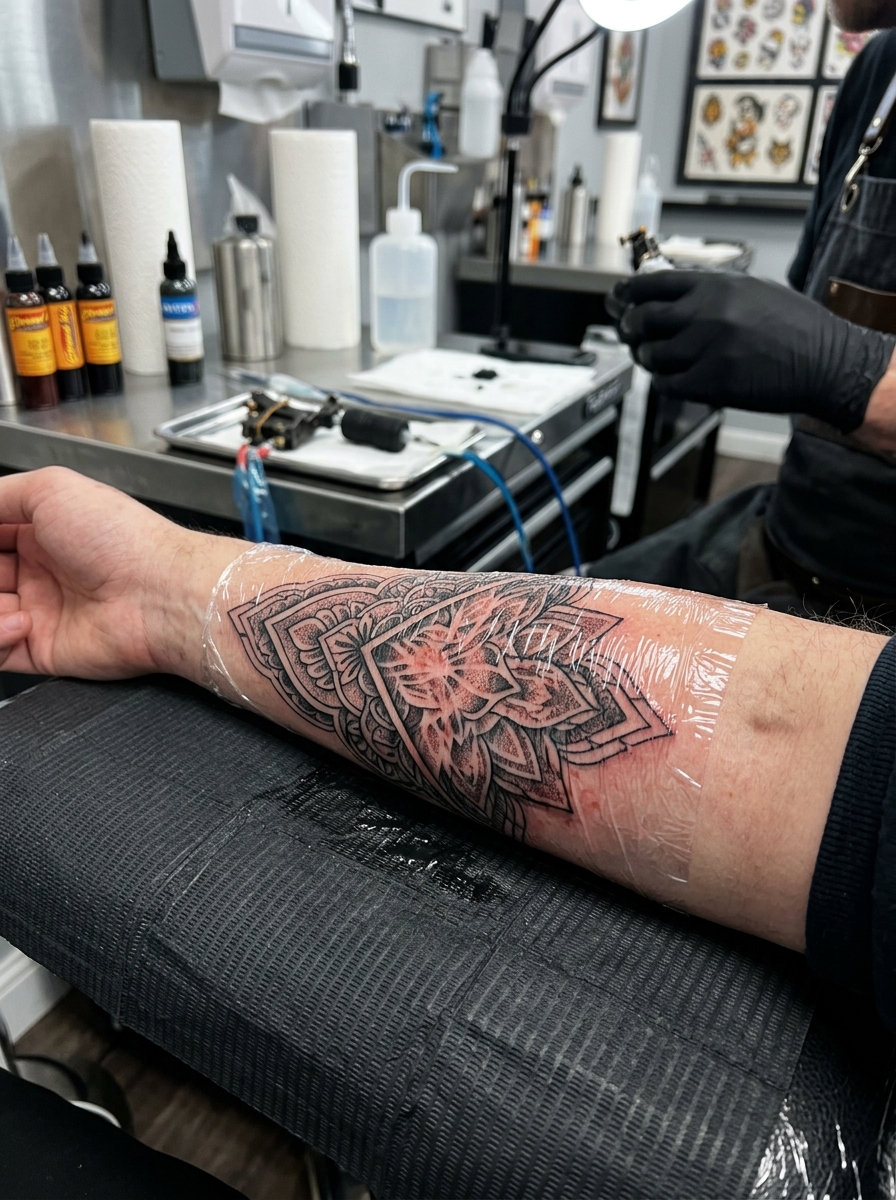
This is where the key bow becomes the whole point — scrollwork, lace patterns, dotwork stippling filling the head of the key.
Ornamental work suits the sternum, spine and outer thigh, where there is length to run a decorative shaft down.
The honest limit: filigree needs space. Below about four inches the scrollwork closes up as it heals and turns into a grey blur. I have seen this happen more than once on small ornamental pieces.
Ask your artist to show you a healed photo of their ornamental work, not a fresh one. Fresh dotwork always looks crisper than it will at six months.
Black and Grey Realism
Realism treats the key as a real object with weight, tarnish and reflected light rather than as a symbol.
It is the most impressive version in person and the most demanding. Smooth grey gradients are the hardest thing to keep looking clean over time, and a realism piece will usually want a touch-up somewhere around the ten-year mark.
Bring a photograph of an actual key if you go this route. Working from a real object gives an artist the reference they need for believable highlights.
Five inches is a sensible floor. Below that there is not enough room for the gradient work that makes realism convincing.
Variations Worth Considering
If the standard key-and-padlock pairing feels too literal, these are the directions I would look at next.
Key and Clock
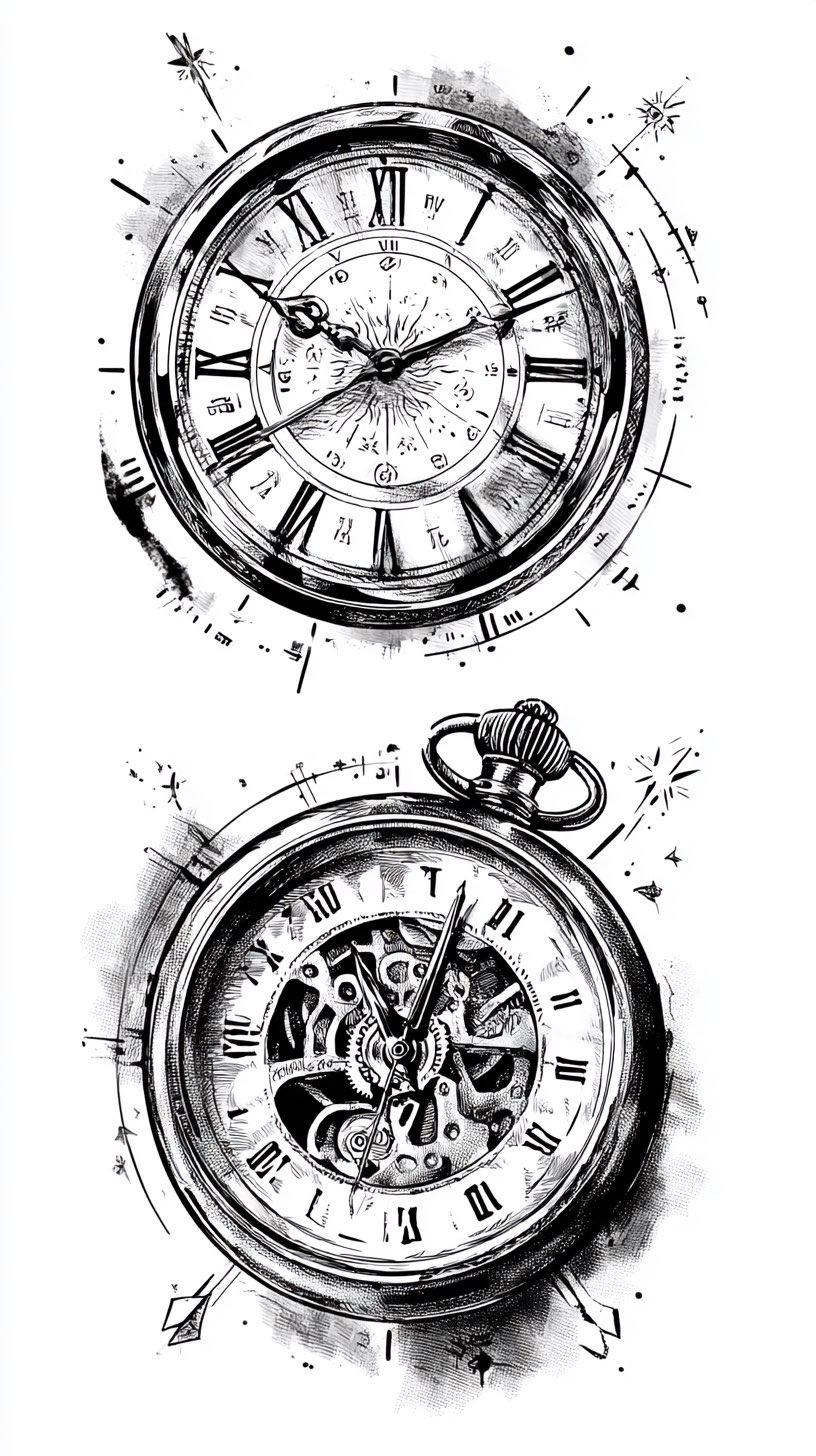
Replacing the lock with a pocket watch shifts the meaning from connection to time — a date unlocked rather than a person. It pairs well with the compositions in our clock tattoo drawings guide.
Keyhole Only
A single keyhole, no key, no lock body. Quietly the most interesting version, because it leaves the question open rather than answering it.
Floral Key
Roses or wildflowers growing through the bow of the key. This softens a hard metal object and gives the artist somewhere to put colour if you want it.
Micro Key
A one-inch key on the inner wrist or behind the ear, no lock at all. If this is your instinct, our minimalist tattoo ideas cover what survives at that scale and what does not.
Placement, Sizing and Aftercare
Placement decides how a key design is composed. A key is a long, narrow object, so it wants a long, narrow area — inner forearm, outer calf, spine, the side of the ribs. Our forearm tattoo ideas and wrist tattoo ideas both show how that vertical run works in practice.
Avoid hands, fingers and feet for anything with fine detail. These areas rub constantly and lose ink faster than anywhere else, and most artists will tell you a finger piece needs re-working within a couple of years.
On healing, follow the aftercare your artist gives you rather than advice from the internet — they know their ink, their needles and their local climate. In general that means keeping it clean, keeping it moisturised without smothering it, and staying out of pools and direct sun until it has settled. The American Academy of Dermatology publishes general guidance on caring for tattooed skin.
If you see spreading redness, swelling that worsens after the first few days, pus, or a fever, see a doctor rather than waiting it out — that is a medical question, not a tattoo one. The FDA also publishes information on tattoo inks and possible reactions. Nothing in this article is medical advice.
Common Mistakes — and Still Not Sure?
The mistake I see most often is scaling down. People fall for a detailed antique key on a screen, then ask for it at half the size it was drawn.
The second is treating the lock as an afterthought. A beautifully drawn key next to a generic padlock looks unbalanced — both objects need the same level of care.
The third is booking a couples piece with an artist chosen for availability rather than for portfolio. In my experience that is the decision people most often regret.
Still weighing it up? Compare against a rose design if you want something less literal, or look at what small pieces actually hold up before committing to size.
Frequently Asked Questions
What does a key and lock tattoo mean?
Most often it represents connection — one person holds the key to another’s lock. Worn alone it usually reads as freedom, a new beginning, or something private being guarded. There is no fixed meaning, which is part of the appeal. The interpretation you give it at the time is the one that counts.
How small can a key and lock tattoo be?
A simple two-object design holds up from around two inches in fine line and three inches in a bolder style. Below that the keyhole and the key teeth start to close up as the tattoo heals. Ornamental and realistic versions need four to five inches minimum. If you want something genuinely tiny, drop the lock and keep only the key.
Should couples get the key and lock separately?
Splitting them is the traditional approach and it works well when both pieces are done by the same artist, ideally in one session. Mirror the placement so the halves line up naturally. Some couples prefer both people getting the complete design with a small personal variation instead. That version survives better if circumstances change.
Do key and lock tattoos hurt more in certain places?
Pain depends on placement far more than on the design. Ribs, sternum, spine and the inner arm are generally reported as the more uncomfortable spots, while the outer forearm, thigh and calf tend to be easier. Larger blackwork pieces mean longer sittings, which is its own kind of difficulty. Everyone’s experience differs, so talk to your artist about breaking a long session in two.
How long does a key and lock tattoo take to heal?
The surface usually looks settled within two to three weeks, while the deeper layers keep repairing for a couple of months. Heavier blackwork often scabs more in the first week than fine line work does. Follow your artist’s specific aftercare instructions rather than general advice. If anything looks infected, see a doctor promptly.
Quick Summary
- Decide the meaning first — connection, freedom, or something guarded — then pick the style that carries it.
- American traditional ages best; black and grey realism looks most impressive but needs the most maintenance.
- Do not go below two inches in fine line or four inches in ornamental work.
- A key is long and narrow, so choose a long, narrow placement: forearm, calf, spine or ribs.
- For matching pairs, use one artist, one session and mirrored placement.
- A heart-shaped keyhole is a subtler alternative to a heart-shaped padlock.
- Ask to see healed photos, not fresh ones, before booking detailed work.
- Follow your artist’s aftercare, and treat signs of infection as a matter for a doctor.