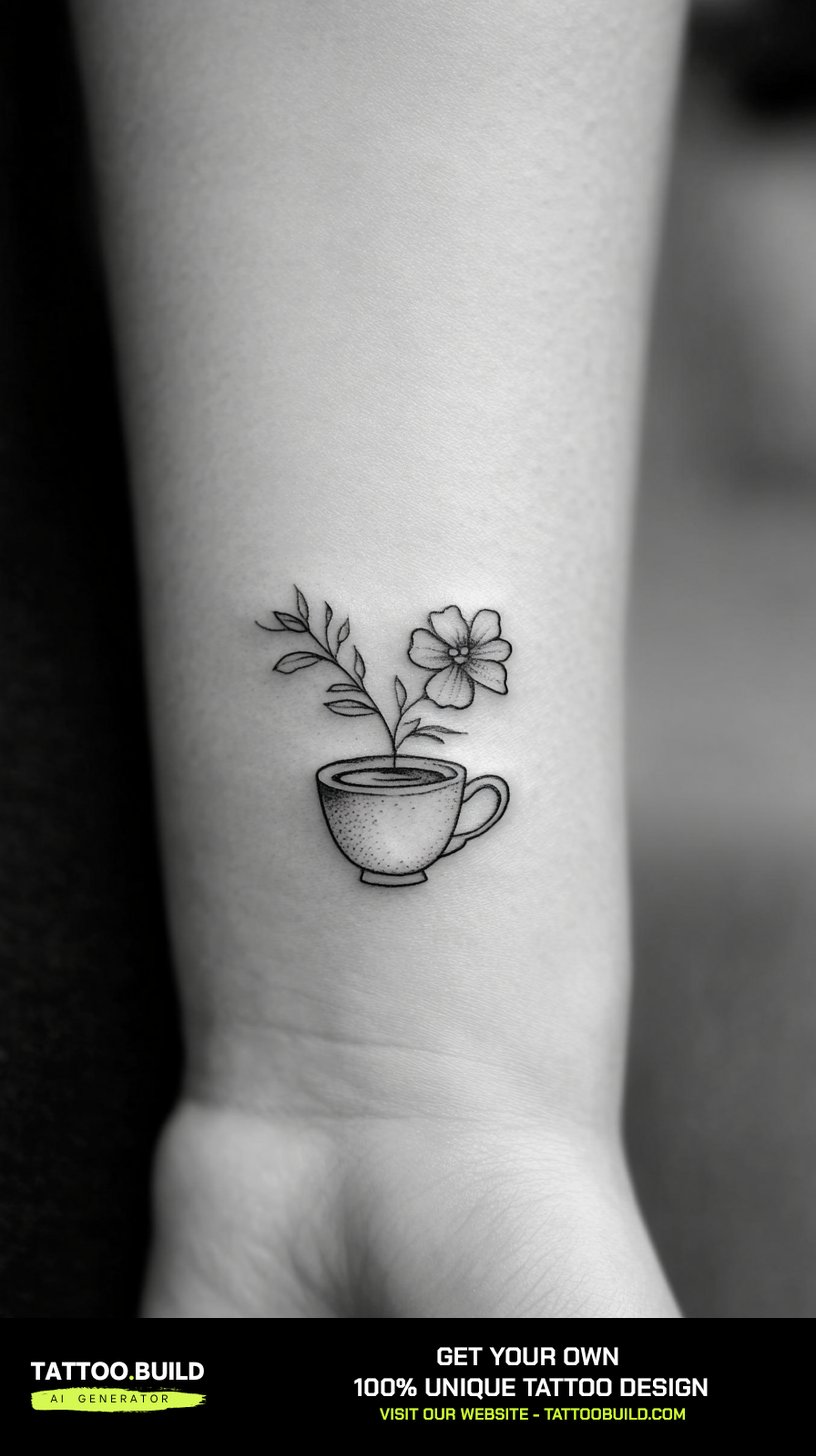
A small tattoo earns its meaning from what it stands for, not from how much skin it covers. I have watched people agonise over size when the thing that actually mattered was the symbol.
Most of the pieces in this guide would fit inside a credit card. Several are smaller than a coin.
I have sat in on enough consultations to notice a pattern: women rarely arrive asking for something small because they want less tattoo. They ask because they want something private, something they can cover for work, or something they can look at on a hard day. If you are still narrowing things down, the wider collection of tiny tattoo ideas for women is a good place to browse before you commit.
What follows is organised by meaning rather than by style — flowers that stand for people, animals that stand for traits, objects that stand for a chapter of your life. Every design shown here is a real tattoo at a real scale, so what you see is roughly what you would get.
Which Small Tattoo Style Is Right for You?
| Style | Best for | How it tends to age | Typical sitting |
|---|---|---|---|
| Fine line / single needle | Delicate botanicals, script, tiny symbols | Lines soften and can spread slightly over the years; many artists suggest a touch-up eventually | 30–90 minutes |
| Micro-realism | Portraits, animals, objects with texture | Fine detail can blur first, so scale matters more than usual | 1–3 hours |
| Bold blackwork | Graphic shapes, silhouettes, symbols | Usually the most durable option at small sizes | 45–90 minutes |
| Dotwork / stippling | Moons, mandalas, soft shading without solid black | Dots can merge as skin changes, which softens the piece | 1–2 hours |
| Soft colour | Florals where the colour is the point | Generally fades faster than black and grey, especially on sun-exposed skin | 1–2 hours |
If you are choosing between these for the first time, my honest advice is to go one step bolder than feels necessary. A design with a little more line weight has a much easier life over ten years, and it is a lesson most people learn on their second tattoo rather than their first. There is more on this in the guide to minimalist tattoo ideas.
What Makes a Small Tattoo Actually Meaningful
Meaning is not something an artist can add for you. It comes from the connection between the image and something that already happened in your life.
The pieces that hold up over time are usually the ones with a specific reference behind them — a grandmother’s birth flower, a date, a place, an animal that a person in your family always talked about.
In my experience the tattoos people regret are rarely the ones that were too personal. They are the ones chosen because a shape looked good on a screen and the reason never quite arrived.
That does not mean a design has to carry grief or ceremony. A small teacup because you and your mother have talked every morning over one for twenty years is a perfectly good reason.
It also helps to accept that meaning can be layered on afterwards. Every artist I have asked has a story about a client who chose a piece for one reason and, five years later, reads it a completely different way.
Small Meaningful Tattoos for Women: 8 Directions Worth Exploring
1. Sunflowers and the People They Stand For
Sunflowers are the design I see requested most often as a memorial piece, usually for a mother or a grandmother.
The whole flower with a stem needs roughly four to six centimetres of height to keep the petals separated. Below that, the centre tends to fill in and lose its texture.
If you want something smaller, ask for the flower head alone. It reads as a sunflower at almost any size because the seeded centre is so recognisable.
When I tested placements for this shape, the inner forearm gave the cleanest result — flat skin, easy to show, easy to cover. The stem version works best when it can follow the length of a limb rather than sitting across it.
2. Birth Flowers and Botanical Portraits
A birth flower is the most reliable way I know to put a person on your body without a name or a portrait.
Dahlia for August, peony for late spring, lily for May — the associations vary a little by source, so it is worth checking a couple before you book.
These flowers carry more petal detail than a daisy or a sunflower, which means they need a bit more room. Most artists I have spoken to want at least six centimetres for a layered dahlia.
The shoulder and upper arm suit them well because the skin there is broad and relatively flat, so the artist is not fighting a curve. Our full list of birth flower tattoo ideas covers all twelve months if you are matching a family birthday.
3. Delicate Blooms Along the Shoulder and Collarbone
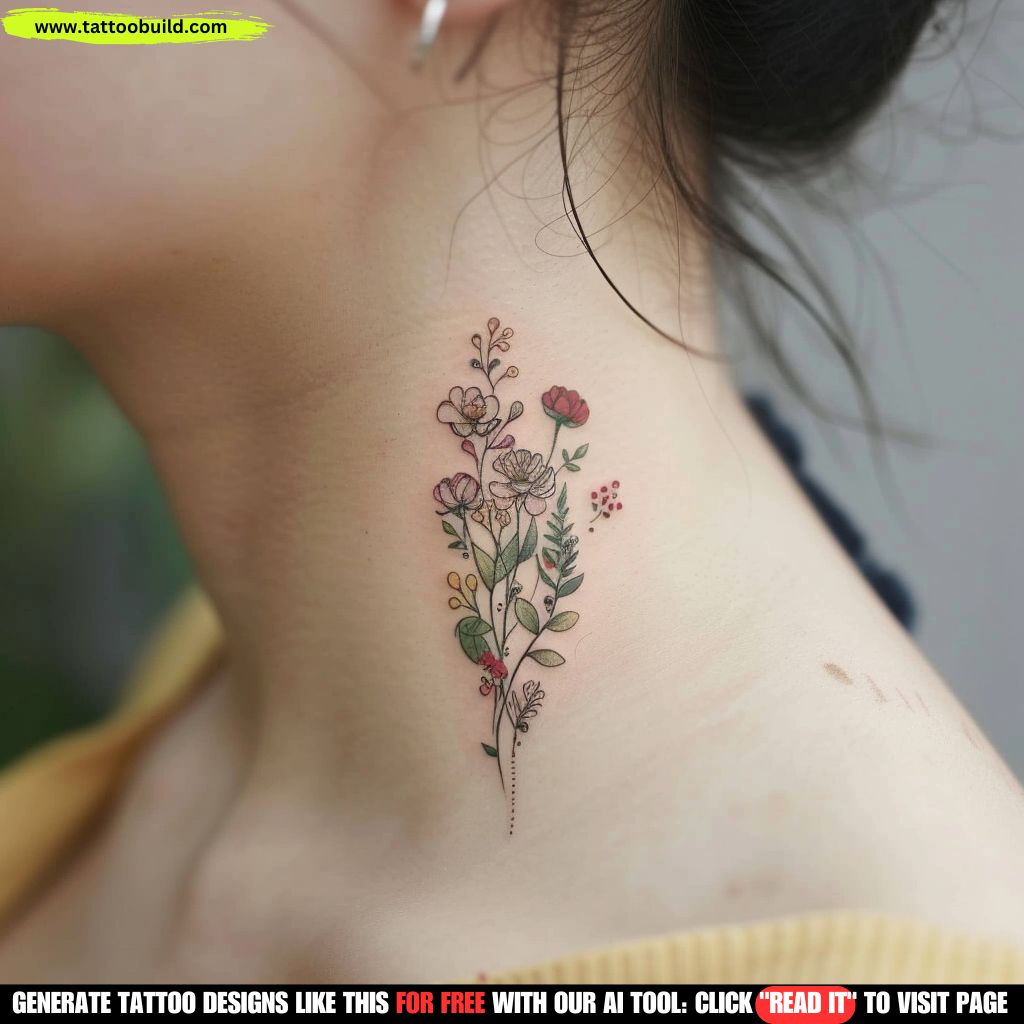
There is a whole category of small floral work designed to follow the body’s own lines rather than sit as a standalone shape.
A blossom cluster laid along the top of the shoulder, a single daisy tucked under the collarbone, a stem curving down the shoulder blade — all three read as jewellery more than as tattoo.
Placement is doing half the work in these pieces. The same daisy that looks unremarkable on a forearm looks intentional under a collarbone.
The trade-off is visibility. The collarbone is not a discreet spot, and it is a bonier area than the arm, which many people find sharper to sit through. If you are weighing it up, the notes on collarbone tattoo ideas go into the practical side.
4. Animals as Personal Symbols
Animals give you a way to tattoo a trait rather than an event.
Elephants come up constantly for family, memory and protection, and they miniaturise unusually well because the silhouette does the work — the ears and trunk are recognisable in outline alone.
An octopus is the outlier here. It is a genuinely difficult small tattoo because eight limbs at two centimetres each is a lot of line in a little space, and it needs an artist who is confident with line weight.
In my experience, the animal pieces that fail are the ones where the client asked for photographic detail at a size that could never hold it. Ask your artist what the design will look like in ten years, and take the answer seriously.
5. Small Creatures with Larger Meanings
Some of the most effective tiny tattoos are the ones that lean into being sparse.
A spider at two centimetres is mostly negative space, and that is precisely why the legs stay crisp. A bird on a branch works the same way.
Snakes are worth mentioning separately because their meaning genuinely divides people — renewal and shedding for some, something darker for others. It is one of the few designs I would recommend explaining to yourself in a sentence before you book.
Behind the ear and along the neck is a placement that suits a long, narrow subject like a snake. It is also one of the more sensitive areas, which is worth knowing before you sit down.
6. Faith, Protection and Remembrance
Remembrance pieces are the most common reason women book their first small tattoo, at least among the consultations I have watched.
Wings with a cross is the default request, and there is nothing wrong with a design being common when the reason behind it is yours.
If you want something less literal, flowers wrapped around a cross soften the shape considerably, and a lotus carries ideas of renewal without any specific religious framing.
One thing I would push back on: adding a date in tiny script under a small piece. Numbers at that scale are the first thing to blur, and an artist will usually tell you the same.
7. Time, Books and the Objects You Carry
Objects are underrated as meaningful tattoos. They tend to be more specific than symbols and less obvious than script.
A pocket watch set to a birth time, an open book for a person who read to you, a koi for a period you swam upstream through — each is legible to you and quietly opaque to everyone else.
Watches come with a warning. Roman numerals and a legible face need real estate, and shrinking a pocket watch below about five centimetres usually means giving up the numbers entirely.
The koi shown here runs from the wrist onto the hand, which uses the body’s shape as part of the composition. Hand placements fade faster than most spots because of constant washing and sun, so factor a touch-up into the plan.
8. Nature Beyond Flowers
Ferns, waves and mountain ridges are the three landscape subjects that consistently work at a small scale.
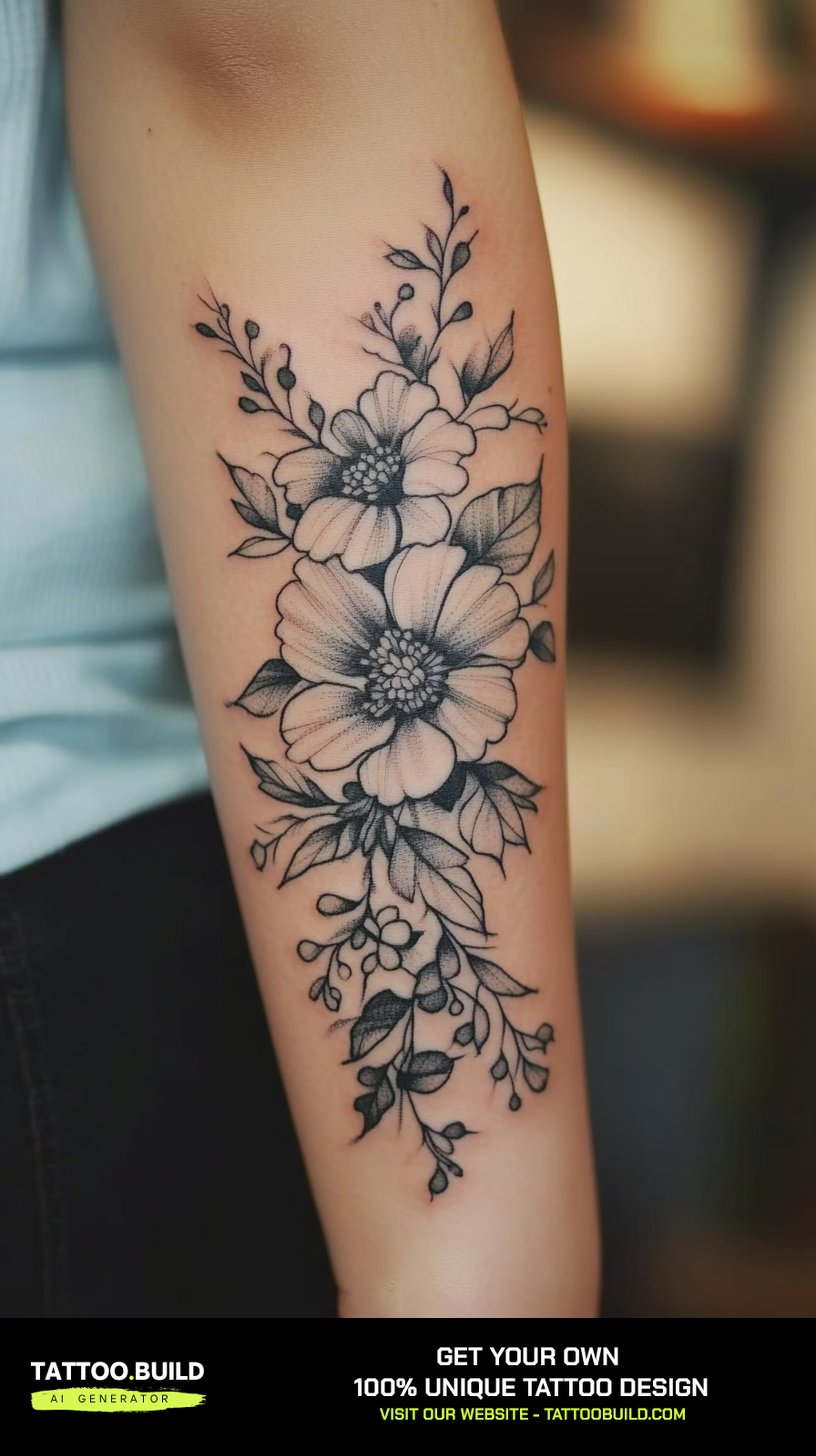
A fern frond is probably the most forgiving small botanical there is. The shape is repetitive, so a little softening over the years reads as texture rather than damage.
A wave banded around the ankle sits almost entirely out of sight under trousers, which makes it a practical option for anyone with a strict workplace.
Mountains work because a ridge line is a single continuous shape. When I tested this at wrist scale, keeping it to one ridge instead of three was the difference between crisp and muddy.
Variations Worth Considering Before You Book
Take Part of a Design Instead of the Whole Thing
A single butterfly wing instead of a full butterfly. Half a moon instead of a moon phase set. One flower from a bouquet.
Cropping a design is the simplest way to shrink it without shrinking the line work, and it usually looks more considered than a miniature of the full image.
Swap the Symbol for the Season It Came From
Holly with berries is a December piece rather than a Christmas one, if that distinction matters to you.
Seasonal botanicals give you the same personal anchor as a birth flower with a bit less of the greeting-card association.
Consider Where It Will Live Day to Day
The same design behaves very differently on a wrist, a rib and an ankle — in visibility, in how it stretches, and in how much it hurts.
If a piece needs to be hidden at work, the inner bicep, the ribs and the ankle are the three spots I hear recommended most. Our roundup of tiny wrist tattoo ideas covers the most visible end of that spectrum.
Aftercare That Keeps Small Tattoos Crisp
Small tattoos heal faster than large ones, and that is exactly why people get careless with them.
The first two weeks decide how a fine line piece looks for the next decade. Follow the aftercare instructions your artist gives you — they know their ink, their machine and their local climate better than any article does.
The general guidance from dermatologists is straightforward: keep it clean, keep it moisturised without smothering it, do not pick at flaking skin, and stay out of pools and direct sun while it heals. The American Academy of Dermatology sets this out in its guide to caring for tattooed skin.
Sunscreen after healing is the single biggest factor in how a small tattoo looks at year five. Fine lines and soft colour both fade under UV, and a wrist or ankle piece gets far more sun than people assume.
Take reactions seriously rather than waiting them out. Spreading redness, swelling that increases after day three, pus, fever or a rash can indicate infection or an allergic reaction, and those need a doctor rather than a forum thread — the AAD lists the common skin reactions to tattoos worth watching for. The FDA also publishes a plain-language fact sheet on tattoos and permanent makeup covering ink safety and what is and is not regulated. Nothing here is medical advice, and a licensed artist or a doctor should always be your first call.
Still Not Sure Where to Start?
The most common mistake I see is choosing the image before choosing the placement. Design and location interact, and reversing that order saves a lot of redrawing.
The second is underestimating cost. A small tattoo is usually priced at a shop minimum rather than by the centimetre, so a tiny piece often costs more per square centimetre than a large one — the breakdown in how much a small tattoo costs explains why.
The third is picking a spot for looks alone. Ribs, sternum, ankle bone and the back of the knee are consistently reported as sharper than fleshy areas, and the tattoo pain chart is worth a look before you decide.
If this would be your very first piece, it is worth reading the practical run-through of first tattoo ideas for women and browsing fine line tattoo ideas to see how thin an artist can realistically go on your skin.
Frequently Asked Questions
How small can a meaningful tattoo actually be?
Most artists will work down to roughly two centimetres for a simple shape like a crescent moon, a small leaf or a single line drawing. Below that, lines placed close together tend to merge as the ink settles under the skin. The limit depends on the design as much as the size — a spider with four thin legs survives at a smaller scale than a portrait with shading. Ask your artist for the smallest size they are willing to do the specific design at, and trust their answer over an internet reference.
Do small tattoos fade faster than large ones?
The tattoo itself does not fade faster, but blurring is more noticeable when the design is small, because there is less space between the lines to absorb any spreading. Fine line and single needle work is the most affected, and soft colour generally fades sooner than black and grey. Sun exposure and placement matter more than size — hands, wrists and feet fade quickest. Daily sunscreen after healing is the most effective thing you can do about it.
Where do small tattoos hurt the least?
The outer arm, the outer thigh and the upper back tend to be described as the most tolerable areas, because there is more muscle and fat between the needle and bone. Ribs, sternum, ankle, collarbone and the inside of the elbow are commonly reported as sharper. Pain is genuinely individual, though, and a small piece is usually over within an hour either way. If you are anxious about it, tell your artist beforehand rather than during.
How much does a small meaningful tattoo cost?
Almost every studio has a shop minimum, and a small piece will usually be priced at that minimum rather than by size. That figure varies widely by city, studio and artist demand, so the only accurate answer is the one your chosen studio gives you. Booking two or three small designs in one session is often better value than spreading them across separate appointments. Be wary of prices well below the local norm, as they can signal corners being cut on hygiene.
Can a small tattoo be removed or covered up later?
Small tattoos are generally easier to cover than large ones, and a skilled artist can often work an existing piece into a bigger design. Laser removal is possible but takes multiple sessions spread over months, costs considerably more than the original tattoo, and does not always clear the skin completely. Results depend on ink colour, depth, your skin tone and how old the tattoo is. Removal should be handled by a qualified medical provider, never attempted at home with creams or abrasion.
Quick Summary
- Choose the meaning first and the image second — the reference behind a design is what keeps it from feeling arbitrary.
- Go one step bolder in line weight than feels necessary; small fine line work softens over the years.
- Give layered flowers like dahlias and peonies at least five to six centimetres so the petals stay separated.
- Let placement do half the work — collarbone, shoulder line and ankle bands read as jewellery.
- Skip tiny dates and script under small pieces; numbers blur before anything else does.
- Expect a shop minimum rather than a per-centimetre price, and book several small designs together if you can.
- Sunscreen after healing is the single biggest factor in how the tattoo looks five years on.
- Treat spreading redness, worsening swelling or a rash as a reason to see a doctor, not something to wait out.