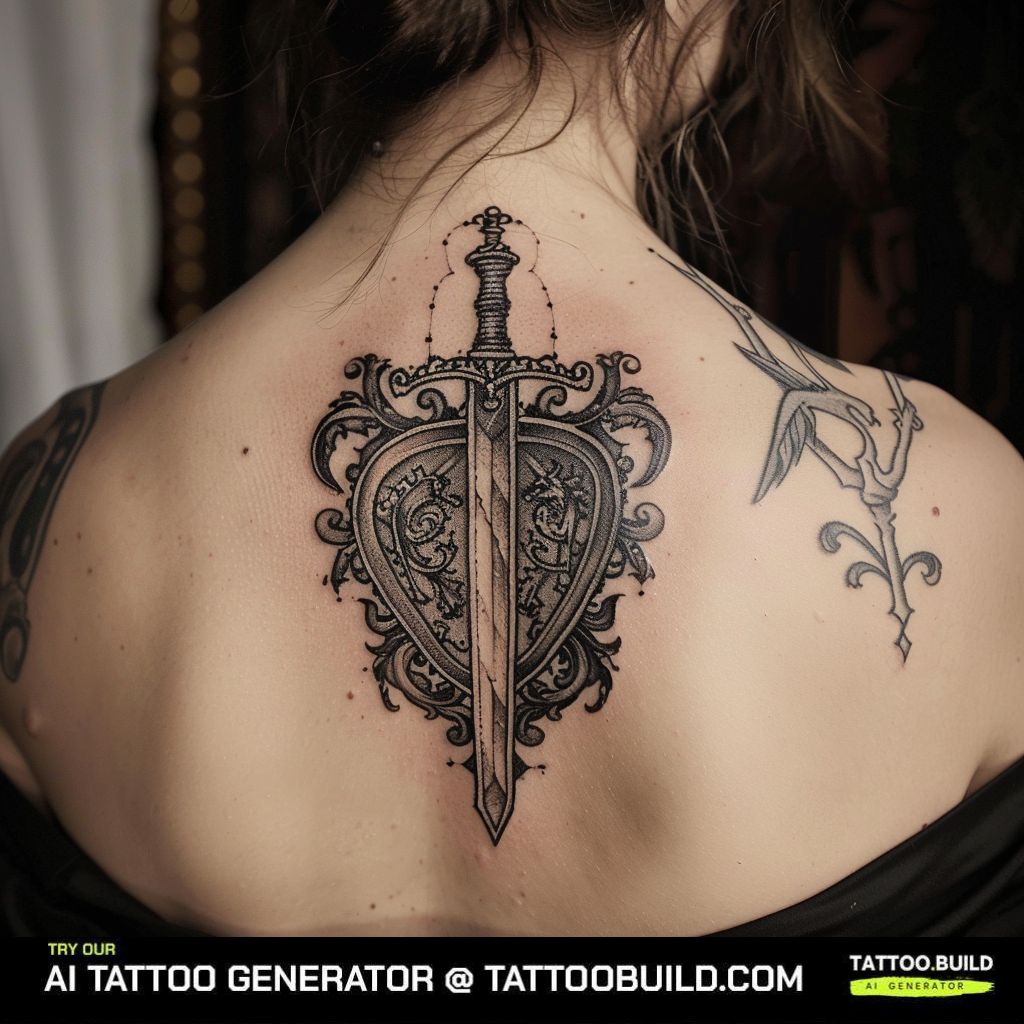
A sword and shield tattoo works because it says two opposite things at once: I will fight, and I will protect. Most single-object tattoos only manage one of those.
I have been sketching and researching this design for years, and it is one of the few military-adjacent motifs that never looks dated. The shapes are architectural. They hold up at any size.
What surprised me when I started asking artists about it was how much the shield does the heavy lifting. The sword grabs attention, but the shield is what makes the tattoo readable from across a room, because it gives the composition a solid anchor of black.
Below I have laid out what the design actually means, which styles suit which body parts, and the mistakes I see people make. If you are still deciding on your broader theme, our guide to warrior tattoo ideas covers the wider category.
Which Sword and Shield Style Is Right for You?
Style choice matters more than design detail here, because it determines how the tattoo ages. Here is how the main approaches compare.
| Style | Best Size | Ages Well? | Best For |
|---|---|---|---|
| Bold blackwork | 4 in and up | Excellent | Forearm, calf, first tattoo |
| Fine line | 2–4 in | Needs touch-ups | Inner arm, ribs, subtle placement |
| Black and grey realism | 6 in and up | Good with contrast | Chest, back, upper arm |
| Neo-traditional | 5 in and up | Very good | Shoulder, thigh, colour lovers |
| Celtic / Norse knotwork | 5 in and up | Good if spaced | Heritage pieces, back, calf |
| Heraldic crest | 6 in and up | Excellent | Chest, back, family symbolism |
What the Sword and Shield Actually Symbolize
The pairing is genuinely ancient. Swords and shields appear together across Greek hoplite equipment, Roman legionary kit, Norse and Anglo-Saxon burials, and medieval European heraldry, and museum arms-and-armour collections such as the Metropolitan Museum of Art’s Arms and Armor department hold examples spanning all of it.
That long history is why the symbol reads clearly to almost everyone. You do not have to explain it.
The core meaning is balance — the capacity to act and the discipline to defend. In practice, most people I have spoken to choose it for one of three reasons.
Some wear it for a fight they survived: illness, addiction, a legal battle, a period of grief. The shield is the part that got them through; the sword is what they picked up afterwards.
Others wear it for someone else. Parents, in particular, tend to lean on the shield side of the design, and often ask for the sword to be sheathed or lowered rather than raised.
And a third group wear it for heritage — a Scottish clan crest, a Norse round shield, a Greek aspis. If that is your angle, look into what your specific lineage actually used before committing to a shape.
Sword and Shield Tattoo Ideas by Style
1. Bold Blackwork and Traditional
If you want one recommendation that is hard to get wrong, this is it. Heavy outlines, solid black fill in the shield, minimal internal detail on the blade.
Bold blackwork survives the decades better than anything else because ink spreads slightly under the skin over time, and thick lines have room to spread without closing up. Thin ones do not.
In my experience this style also photographs best, which matters more than people admit. A blackwork sword and shield at four or five inches still reads at arm’s length after fifteen years.
Ask your artist to keep at least a couple of millimetres of clear skin between the blade and the shield edge. That gap is what stops the two shapes merging into one dark mass later on.
2. Fine Line and Minimal
Fine line versions strip the design to outline only — a simple blade, a plain shield outline, maybe a single decorative element.
They are elegant, and they suit inner forearms and ribs. They are also the style most likely to need a touch-up, usually somewhere in the three to seven year range depending on sun exposure and placement.
I would not put a fine line sword and shield on a hand, foot, or the outside of a finger. Those areas turn over skin fast and fine work fades unevenly there.
If you want small but durable, ask for a fine line design with one small area of solid black — the shield boss, or the grip wrap. That one dark spot does a surprising amount of work.
3. Viking and Norse Round Shield
The Norse version swaps the pointed heater shield for a round wooden shield with a central iron boss, usually paired with a straight double-edged blade rather than a curved one.
It is the most requested variant I come across, and it slots naturally into a larger Norse mythology sleeve with runes, ravens, or a longship.
A caution worth stating plainly: certain runes and rune combinations have been appropriated by extremist groups, and a few now carry associations most people would not want on their skin. Ask your artist, and check the specific symbol before you commit.
The round shield’s biggest practical advantage is that it fills a calf or outer arm beautifully, because the circle matches the natural curve of those limbs. Our wider guide to Viking tattoo ideas for men has more layout options.
4. Celtic and Knotwork Variations
Celtic treatments band the shield rim with interlace and often run knotwork down the fuller of the blade.
Knotwork is unforgiving of crowding. Every strand needs visible skin either side of it, which means a Celtic sword and shield needs to be bigger than you first think — realistically five inches minimum.
Every artist I have asked about this says the same thing: the piece either gets the size it needs, or the interlace turns into a grey smear within a decade. There is no middle option.
If the knotwork itself is the draw rather than the weaponry, our Celtic knot tattoo ideas guide covers standalone options that carry the same heritage without the scale requirement.
5. Black and Grey Realism
Realism renders actual metal: brushed steel, rivets, leather strapping, nicks along the blade edge.
Done well it is stunning. Done at the wrong size it is mud. Realism relies on subtle mid-tones, and mid-tones are the first thing to go as a tattoo settles.
Six inches is roughly the floor for realistic metal rendering, and I would push for eight on a chest or back. Ask to see healed work from your artist, not fresh photos — fresh realism always looks better than it will in a year.
Reference matters here too. Sending your artist a photo of a genuine historical piece from a collection like the Royal Armouries gets you a far better result than a fantasy game render.
6. Heraldic Crests and Family Arms
A heraldic version puts a charge on the shield face — a lion, an eagle, a cross, initials — with the sword behind or beneath it.
This is the most personal route, and the one I would suggest to anyone getting the tattoo for family reasons rather than aesthetic ones.
It is also the most likely to age badly if overloaded. Real heraldry uses a small number of bold elements for exactly this reason: it had to be identifiable on a battlefield at distance. Follow that logic.
Chest placement suits crests particularly well because the design sits symmetrically over the sternum. Our chest piece tattoo ideas for men guide covers how to lay one out across the pectorals.
7. Neo-Traditional and Colour
Neo-traditional keeps the bold outlines of traditional tattooing but adds a richer palette and more dimensional shading.
Deep reds, muted golds, and desaturated blues suit armour well. I would avoid bright yellows and pale pastels here, which tend to look thin against black linework.
It ages nearly as well as blackwork because the outlines do the structural work and the colour just fills. That combination is why the style has stayed popular.
Colour does fade faster than black, particularly on areas that get sun. Expect a colour refresh at some point if the piece lives on a forearm or calf.
Placement: Where a Sword and Shield Sits Best
Forearm
The most popular choice, and a sensible one. The forearm’s long vertical shape matches a sword naturally, with the shield sitting at the elbow end or the wrist end.
Inner forearm hurts less and fades slower; outer forearm shows better and takes more sun. Our forearm tattoo ideas collection has more layout examples for this area.
Ribs and Side Body
A vertical sword down the ribs with the shield at the top is a striking composition, and it hides easily under clothing.
It is also, by broad consensus among people I have talked to, one of the more painful spots — thin skin directly over bone, and the area moves with every breath. Budget for a longer session or split it across two.
Back
The back gives you the most room and the fewest compromises. A full sword can run the length of the spine with the shield across the upper back.
The trade-off is that you will rarely see it yourself, and it usually takes multiple sessions. Worth it if you want scale and detail together.
Chest, Calf and Thigh
Chest suits symmetrical heraldic layouts. Calf suits round Norse shields. Thigh is the quietly underrated option — a large, flat, low-pain canvas that stays covered most of the year.
Thigh also fades slowly, since it rarely sees direct sun. If you want a large detailed piece and do not need it visible, it is the placement I would point you to first.
Alternatives and Variations Worth Considering
Sword Alone
Dropping the shield gives you a cleaner, more graphic tattoo that fits narrow spaces like the spine, the inner bicep, or a finger-to-wrist run.
You lose the protective half of the meaning, though. A sword alone reads as pure resolve.
Shield Alone
The reverse works too, and is often the better choice for a tattoo about guarding family or recovery. A shield with a name, a date, or a small charge on the face says plenty on its own.
Sword and Rose, or Sword and Serpent
Swapping the shield for a rose adds a softness-and-strength contrast. Swapping it for a serpent coiled round the blade adds a wisdom or transformation reading.
If blades in general are the draw more than the armour, our dagger tattoo ideas guide covers the smaller-scale cousins of this design.
Cultural Variants
A katana with a tsuba-focused composition gives you a Japanese reading — see our samurai tattoo ideas for that route. A xiphos and aspis pairing gives you a Greek one, which our Greek mythology tattoo ideas guide expands on.
Do a little homework on whichever tradition you borrow from. Artists appreciate it, and the result is better.
Practical Tips and Aftercare
Bring reference, but bring it as a mood board rather than a single image to copy. Three or four photos showing the qualities you want — this shield shape, that line weight, this level of shading — gives your artist room to design something that fits your body.
Ask to see the stencil placed on your skin and walk to a mirror before the first line goes in. Angles that look right on paper often sit wrong on a curved limb, and this is the free, five-second moment to fix it.
For aftercare, follow the instructions your artist gives you over anything you read online, including this page — they know their inks, their needles, and their local climate. Broadly: keep it clean, keep it lightly moisturised, do not pick, and keep it out of pools, hot tubs, and direct sun until it has fully settled.
Tattooing does carry real risks, including infection and allergic reaction, and the US Food and Drug Administration publishes a plain-language overview worth reading before your appointment. If a healing tattoo becomes hot, increasingly painful after the first few days, swollen, or starts weeping pus, see a doctor rather than waiting it out. Nothing in this article is medical advice, and no reputable artist will be offended by you getting a professional opinion.
Common Mistakes I See With Sword and Shield Tattoos
Going too small is the mistake that costs people the most. A design with two distinct objects, overlapping edges, and internal detail needs room. Shrinking it does not simplify it — it just guarantees the detail closes up.
The second is chasing a fantasy render. Game and film weapon art uses lighting tricks and impossible geometry that do not translate to skin. Historical reference translates far better.
The third is picking a symbol from a culture without checking what it means there now. This applies especially to runes and to some heraldic charges.
And the fourth is booking with the first artist who will take the job. Look specifically for healed blackwork or healed realism in their portfolio, depending on your style. If you are still weighing the theme itself, our guide to tattoos that mean strength and courage is a good place to keep browsing.
Frequently Asked Questions
What does a sword and shield tattoo mean?
It represents the balance between action and protection — the willingness to fight for something alongside the discipline to defend it. Because both objects appear together across Greek, Roman, Norse and medieval European traditions, the symbol reads clearly to almost anyone who sees it. Many people choose it after coming through a difficult period, where the shield represents what protected them and the sword what they did next. Others wear it for family, heritage, or military service. The specific meaning is genuinely personal, which is part of why the design has stayed popular.
How big does a sword and shield tattoo need to be?
As a rough guide, four inches is a sensible minimum for bold blackwork, five for Celtic knotwork or neo-traditional, and six or more for black and grey realism. The design contains two overlapping objects, so it needs enough space for the eye to separate them. Anything smaller than about three inches usually means dropping the shield detail entirely. Your artist will tell you honestly whether your idea fits the space you have in mind, and it is worth listening if they push back.
Where does a sword and shield tattoo hurt the least?
Outer thigh, outer forearm, and the calf are generally reported as the more comfortable placements, since they have more muscle and fat between the needle and the bone. Ribs, sternum, spine, and the inside of the upper arm tend to be described as considerably tougher. Pain varies a lot between individuals, though, so treat any pain chart as a rough guide rather than a rule. If you are worried, book a shorter first session and see how you handle it.
Is a sword and shield tattoo a military symbol?
It can be, but it is not exclusively one. Plenty of serving and former military personnel choose it, sometimes with unit insignia worked into the shield face. Just as many people wear it with no military connection at all, for reasons tied to recovery, family, faith, or heritage. If you want it to read as specifically military, adding a unit crest, dog tags, or a date makes that explicit. Without those, most viewers will read it as a general symbol of strength and protection.
How long does a sword and shield tattoo take?
A simple blackwork forearm piece is often a single session of roughly three to five hours. A detailed realistic chest or back piece commonly runs across two to four sessions, with healing time in between. Celtic knotwork sits somewhere in the middle, since the interlace takes patience to line cleanly. Your artist can give you a realistic estimate once they have seen your reference and the placement, and most will book the sessions a few weeks apart.
Quick Summary
- The meaning is balance — the sword is action, the shield is protection, and together they say more than either alone.
- Bold blackwork is the safest style for a first sword and shield tattoo, because thick lines age well as ink spreads.
- Size honestly. Four inches minimum for blackwork, six or more if you want realistic metal rendering.
- Forearm, calf and thigh are the friendliest placements; ribs and sternum are the most demanding.
- Use historical reference from museum collections rather than fantasy game art — it translates to skin far better.
- Check any runes or heraldic charges before committing, since some carry associations you may not intend.
- Review the stencil in a mirror before the first line, and follow your artist’s aftercare instructions over anything online.
- See a doctor if a healing tattoo becomes hot, increasingly painful, or starts weeping — do not wait it out.
Let Tattoo Build AI Design Your Next Tattoo
Stuck finding a cool tattoo design? Look no further! Tattoobuild’s AI tool helps you create unique tattoos in just 3 steps:
- Open the Studio: Visit our website, try a design, and pick a plan that fits you.
- Describe Your Dream Tattoo: Tell us everything! Colors, styles, themes, or any images you like.
- Get Awesome Designs: Our AI tool uses your info to create unique tattoo designs, just for you!
Skip the boring searches and endless sketching. Tattoobuild helps you get the perfect tattoo you’ve always wanted. Let’s turn your dream into art!