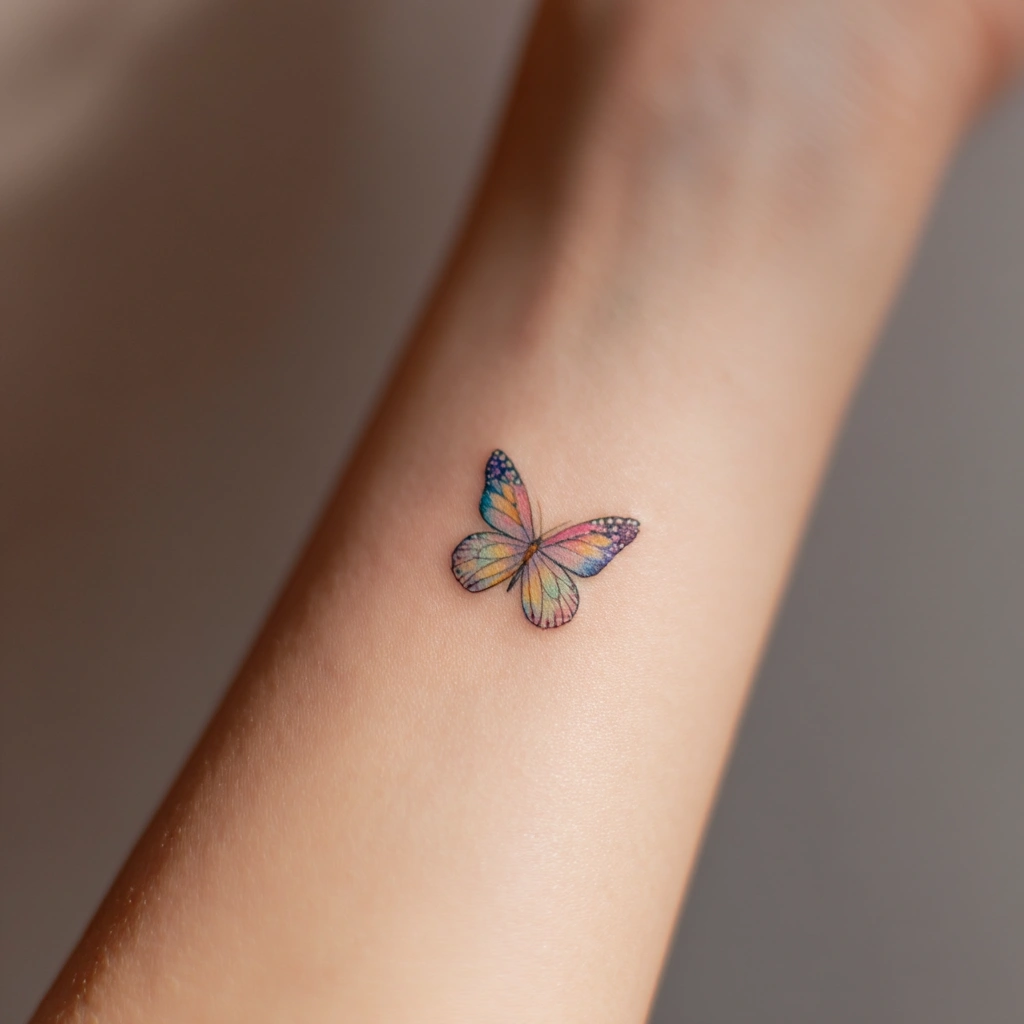
I have spent a lot of time in tattoo studios watching people talk themselves out of a big first piece and into something the size of a postage stamp. A small tattoo is not a compromise — done well, it is the hardest kind of tattoo to pull off, because there is nowhere for a shaky line to hide.
This guide is the version of the conversation I wish more people had before they sat in the chair.
I have collected design ideas here that actually hold up over years, not just the ones that photograph beautifully on day one. If you are still deciding on scale, our roundup of tiny tattoo ideas for women is a useful companion piece.
Everything below assumes you want something pretty, feminine and quiet — a piece you notice, not one that announces itself.
Which Small Tattoo Style Is Right for You?
Style matters more than subject when the piece is under two inches, because style decides how the tattoo will look in a decade.
Here is how I compare the five approaches I see most often on small feminine work.
| Style | Best For | How It Ages | Touch-Up Outlook |
|---|---|---|---|
| Fine-line botanical | Stems, sprigs, single blooms | Lines soften gradually; shape stays readable | Often none for years |
| Single-needle script | Words, dates, initials | Thin strokes can blur if crowded | Likely once, eventually |
| Dotwork geometric | Mandala fragments, moons | Very well; dots spread slowly | Rarely needed |
| Watercolor | Butterflies, petals, washes | Colour fades faster, especially pastels | Plan for refreshes |
| Micro-realism | Portraits, tiny objects | Hardest to keep crisp at small scale | Most demanding of the five |
If you want the lowest-maintenance option on that list, dotwork and simple fine-line work are the safe bets.
Why Detail Is the Enemy of a Small Tattoo
Tattoo ink does not sit still. It is deposited in the dermis, and over years the body slowly nudges those particles outward, which is why every line in a tattoo thickens a little with age.
On a large piece that spread is invisible; on a design the width of a coin, it can close the gap between two lines and turn a delicate flower into a dark smudge.
Every artist I have asked about this says the same thing in different words: leave more negative space than feels comfortable.
When I have watched artists redraw a client’s reference on the spot, the change is almost always subtractive — fewer petals, fewer leaves, wider gaps between strokes.
Placement compounds the effect. Hands, fingers and feet see constant friction and sun, and small work there tends to need attention sooner than the same design on an inner forearm.
Small Tattoo Ideas That Actually Hold Up
These are the categories I keep coming back to, and the specific choices within each that make them work at a small scale.
Lavender, Wildflower and Single-Stem Botanicals
A single stem is the most forgiving small tattoo subject there is, because the design is mostly empty space with a clear silhouette running through it.
Lavender in particular works because the buds can be simplified into small separated marks rather than a solid mass — the eye fills in the rest.
In my experience the version that ages best is a stem of about two to three inches with individual buds spaced clearly apart, not clustered tight against the stalk.
Wildflowers, olive branches, single sprigs of rosemary and simple fern fronds all follow the same logic. If lavender specifically appeals to you, we have a fuller collection of lavender tattoo ideas for women with more placement options.
Keep the stem gently curved rather than dead straight — a slight arc reads as botanical, a straight line reads as a stick.
Single-Line Roses and Continuous-Line Florals
Continuous-line work — one unbroken stroke that describes the whole flower — is genuinely one of the best small-tattoo formats I know.
Because there is only ever one line, there is nothing for that line to bleed into, so the design stays legible far longer than a shaded equivalent of the same size.
The catch is that single-line work is unforgiving of the artist. A wobble in a shaded piece disappears; a wobble in a continuous line is the whole tattoo.
Ask to see healed photos of single-line work specifically, not fresh ones — fresh linework flatters everybody.
Behind the ear is a lovely home for these, though it is a spot that sees sun and hairline friction, so factor that in.
Butterflies, in Fine Line or Watercolour
Butterflies are the most requested small design I have come across, and they are requested so often that a lot of them end up looking identical.
The way out of that is usually the treatment rather than the subject — a loose watercolour wash, an open outline with no fill, or wings drawn from a real species instead of a generic template.
Be honest with yourself about colour: soft pastel washes are the first thing to fade, particularly on skin that gets regular sun.
When I have compared healed watercolour work against healed blackwork of the same age, the difference is consistent enough that I now suggest colour only to people happy to book refreshes.
Geometric Fragments and Partial Mandalas
A full mandala does not shrink well, but a fragment of one does — a half-arc over the shoulder, a quarter over the spine, a small ornamental crest.
Dotwork is the natural technique here, and it is also the most durable small-scale technique I know of, because individual dots spread outward far more gracefully than parallel thin lines do.
Symmetry is the make-or-break factor, so this is not the design to get from an artist who mostly does lettering.
If ornamental work appeals to you more broadly, our page of mandala tattoo ideas for women covers how these scale up if you later want to expand the piece.
Constellations, Moons and Celestial Marks
Constellations have an advantage almost nothing else does: the design is literally dots and connecting lines, so it is already as simple as a tattoo can get.
They also carry personal meaning easily — a birth sign, a date rendered as a star map, a shape that matters only to you.
Crescent moons, small suns and simple star clusters belong in the same family and share the same durability.
One caution I would give: check the constellation’s actual star arrangement rather than trusting a stock illustration, since a lot of the ones circulating online are simply wrong.
Tiny Script, Initials and Dates
Lettering is where I have seen the most regret, and almost never because of the words — it is the size.
Very small script written in a fine cursive can lose the gaps inside its own loops as it ages, turning letters into shapes.
If you want words, keep them short, keep the font simple, and accept a slightly larger tattoo than you first pictured.
Roman numerals and single initials are the safest lettering choices, because each character stands alone with space around it.
Simple Symbols That Carry Weight
Some of the best small tattoos I have seen were the least ornamental: a plain wave, a mountain outline, a small arrow, a single bird.
The appeal is that meaning does not depend on detail, so the design can be pared back to almost nothing and still say what it needs to.
These also sit well as a first tattoo, which is why they turn up so often in our first tattoo ideas for women collection.
A symbol you chose for a reason usually survives changing taste better than a design you chose because it was trending.
Placement Ideas for Small Pretty Tattoos
Placement decides three things at once: how visible the tattoo is, how much it will hurt, and how well it will keep.
Wrist and Inner Forearm
The inner forearm is, in my opinion, the single best home for a small piece — flat, easy to work on, rarely sun-exposed, and comfortable to sit through.
The inner wrist is prettier but bonier, and the tendon side can be genuinely sharp for a few minutes at a time.
Our guide to women’s wrist tattoo ideas goes deeper on how designs sit around the wrist bone.
Collarbone, Nape and Behind the Ear
These are the placements people choose when they want control over who sees the tattoo, since hair and a collar hide all three.
The collarbone is bony and can be uncomfortable, but the line of the bone gives a botanical design a natural path to follow — see our collarbone tattoo ideas for how artists work with that curve.
The nape is the most comfortable of the three by a wide margin, and it stays out of the sun almost permanently.
If you are drawn to the area more generally, our small neck tattoo ideas for women covers what does and does not work there.
Ankle, Ribs and Fingers
The ankle is elegant and easy to cover, though the bone makes it one of the sharper small-tattoo spots.
Ribs are beautiful for delicate script but are widely agreed to be among the more painful placements, and healing there is slower for most people.
Fingers I would treat as a category of their own, because finger tattoos fade and patch faster than anywhere else on the body — our finger tattoo ideas for women page is honest about that trade-off.
Variations Worth Considering Instead
If none of the above is quite right, these adjacent directions solve some of the same problems.
A Small Set Instead of One Piece
Three or four tiny marks spread across a forearm often read as more intentional than a single small tattoo floating alone.
It also lets you start with one and add over time without committing to a composition on day one.
Going One Size Up
The most common advice I have heard artists give, and the most commonly ignored, is to make the piece slightly larger than the client wants.
An extra half-inch buys a surprising amount of longevity, and it almost never makes a piece feel loud.
Full Minimalism
If what you actually want is subtlety rather than prettiness, stripped-back linework may suit you better than a detailed floral.
Our minimalist tattoo ideas collection is built entirely around that approach.
Aftercare and Practical Advice
Small tattoos heal quickly, which is exactly why people get careless with them.
Follow the aftercare instructions your artist gives you rather than anything you read online, including this page — they know what ink and technique they used and how your skin responded in the chair.
Sun protection is the single biggest factor in how a small tattoo looks in ten years. Once healed, keeping it covered or under sunscreen makes a visible difference, and the American Academy of Dermatology publishes straightforward guidance on caring for tattooed skin.
If you notice spreading redness, swelling that increases after the first few days, discharge, or a rash in the tattooed area, that is a doctor’s question rather than an internet one — see a medical professional promptly. The US Food and Drug Administration outlines the reactions and ink-related risks worth knowing about beforehand.
Never attempt to tattoo or remove a tattoo yourself. Both carry real infection and scarring risk, and removal in particular belongs with a licensed practitioner.
Common Mistakes — and What to Do If You Are Still Not Sure
The mistake I see most is bringing a reference photo of a two-inch design and asking for it at one inch, unchanged.
The second is choosing the artist by price rather than portfolio, when fine-line work is precisely where skill differences show.
The third is deciding on a placement before deciding on a design, which usually forces the design to compromise. If cost is what is holding you back, our breakdown of how much a small tattoo costs explains what shop minimums actually cover.
If you are undecided, print the design at true size and wear it as a temporary transfer for a week — a fortnight of living with it tells you more than a month of scrolling.
Frequently Asked Questions
How much do small pretty tattoos typically cost?
Most studios charge a shop minimum rather than an hourly rate for very small work, and that minimum covers the setup, sterile equipment and the artist’s time regardless of how quick the piece is. The figure varies a lot by city and by artist demand, so the only reliable answer comes from asking the specific shop. Highly sought-after fine-line specialists often price well above a local average. Expect to pay more for colour than for simple blackwork of the same size.
Do small tattoos hurt less than large ones?
They usually hurt for less time, which is not quite the same thing as hurting less. The sensation in any given moment depends far more on placement than on size — a small piece over the ribs or ankle bone can feel sharper than a much larger piece on an outer thigh. Most people find a small forearm tattoo very manageable. If pain is your main worry, choose a fleshy placement rather than a smaller design.
How well do small detailed tattoos age?
Ink migrates slowly outward over years, so every line thickens a little with time. On a small design that spread can close the gaps between closely spaced lines, which is why simplified pieces with generous negative space age so much better than dense ones. Dotwork and open linework are the most durable at small scale. A touch-up somewhere down the line is normal, not a sign anything went wrong.
What should I consider when choosing my first small tattoo?
Pick the artist before the design, because a good artist will improve whatever you bring them. Choose a placement you are comfortable seeing every day, and be realistic about your workplace if visibility matters. Give yourself a few weeks between deciding and booking — anything that still appeals after a month usually keeps appealing. And go slightly larger than your instinct says.
Can small tattoos be covered up or removed later?
Small tattoos are generally easier to cover than large ones, though a cover-up almost always needs to be bigger and darker than the original. Laser removal is possible but typically takes multiple sessions spread over months, and results vary with ink colour, depth and your skin. Black ink usually responds better than bright colours. Removal should only ever be done by a qualified practitioner — never attempt it at home with creams or abrasion.
Quick Summary
- Simplify the design before you shrink it — remove detail rather than scaling it down.
- Negative space is what keeps a small tattoo readable as it ages.
- Dotwork and open fine linework are the most durable small-scale techniques.
- Watercolour and pastel colour will fade sooner than blackwork; budget for refreshes.
- Inner forearm and nape are the most forgiving placements; fingers are the least.
- Keep lettering short, simple and slightly larger than you first pictured.
- Choose the artist on healed portfolio work, not on fresh photos or on price.
- Follow your artist’s aftercare, protect it from sun, and see a doctor for anything that looks like infection.