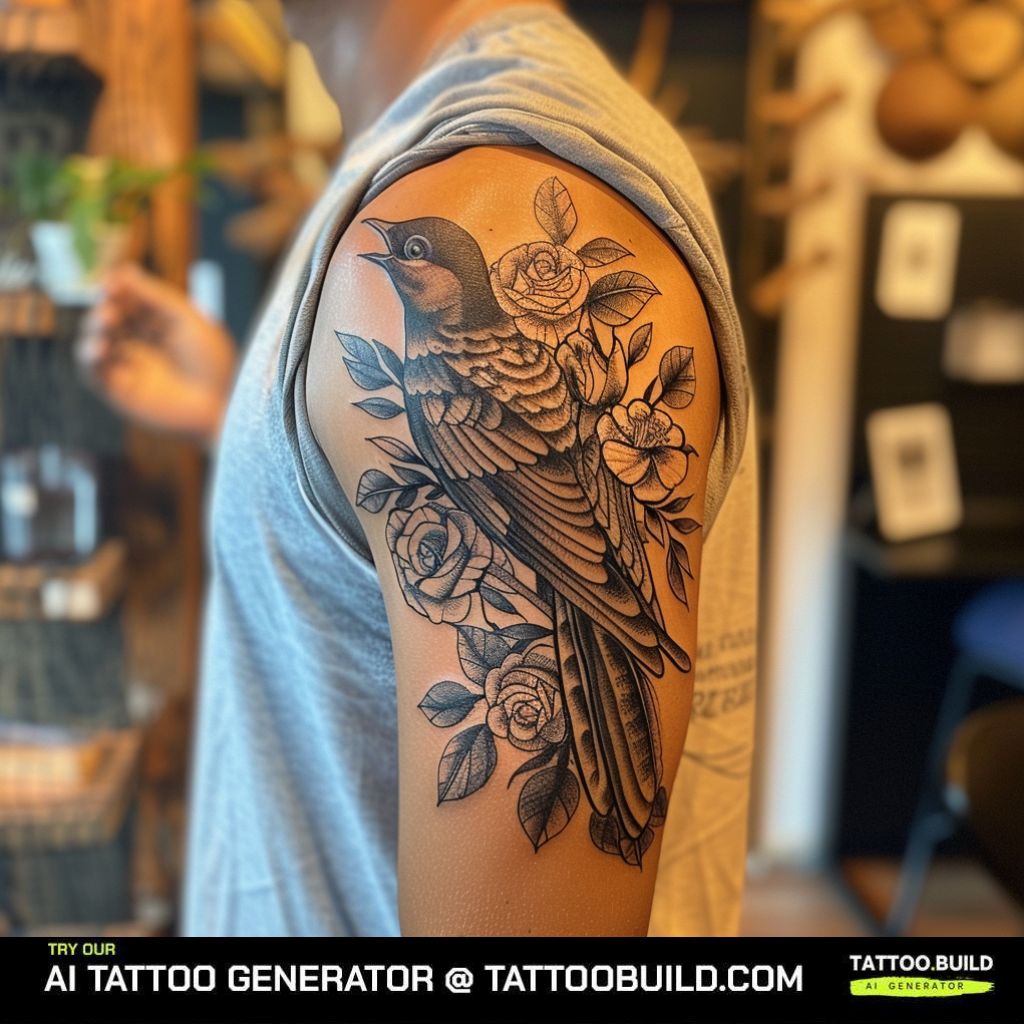
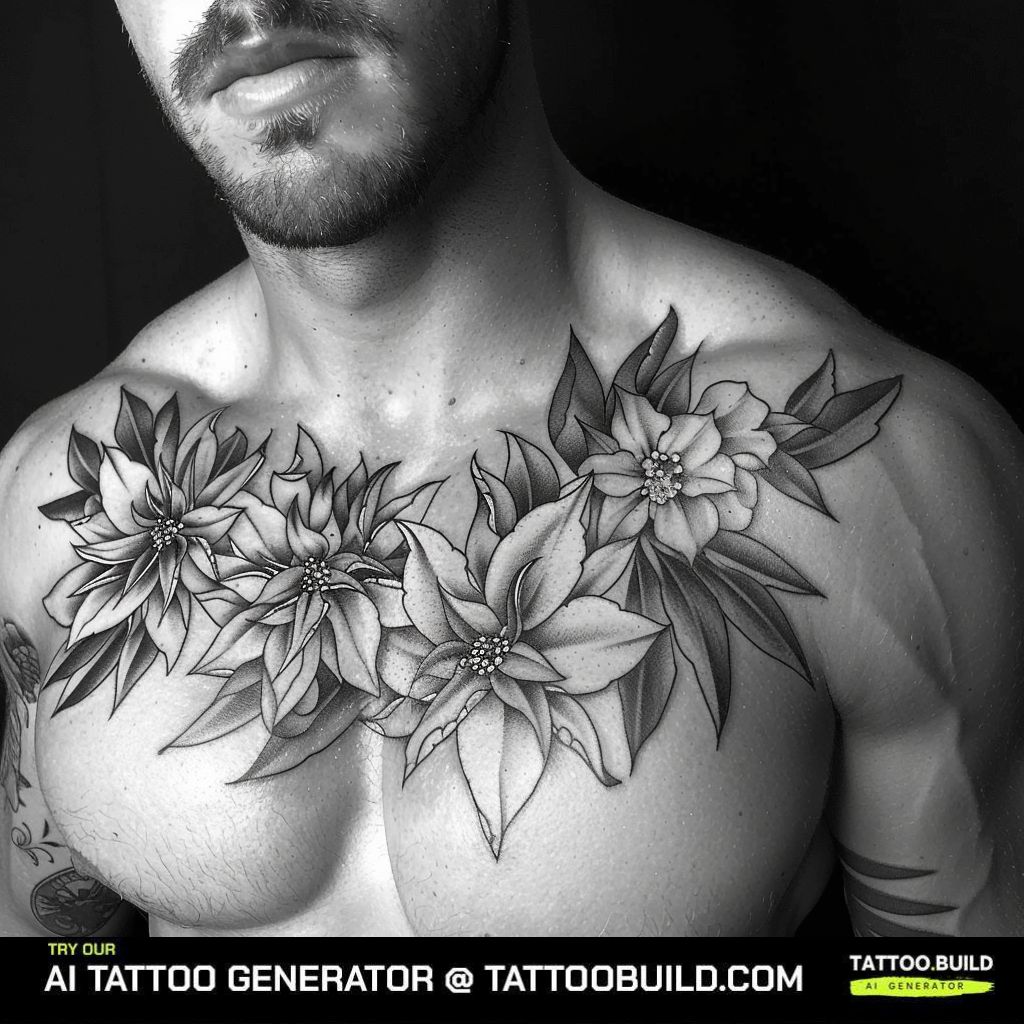
There are twelve months in the year and, depending on which list you follow, somewhere between twelve and twenty-four flowers attached to them. A birth flower tattoo turns a birthday into a design instead of a number, which is why it has quietly become one of the most requested floral concepts in the shops I have spent time in.
I have watched this go from a niche request to something artists now keep flash sheets for. The appeal is obvious once you see a good one: it is personal without being literal, and it does not date the way a numeral or a year does.
What follows is the full twelve-month calendar with real design notes for each flower — which ones tattoo well, which ones need more space than you think, and which ones I would steer a first-timer away from. If you would rather build a piece around shape than around a date, our guide to wildflower tattoo ideas covers the looser approach.
One thing to settle before you read on: the birth flower lists are folk tradition, not an official register. Different sources assign different flowers to the same month, and you are allowed to pick the one you like better.
Which Birth Flowers Actually Tattoo Well?
Not every flower on the calendar behaves the same way under a needle. This is my rough working guide after seeing these designs healed rather than fresh.
| Month & Flower | Best Size | Ages Well? | Good First Tattoo? |
|---|---|---|---|
| January — Carnation | Medium to large | Yes — dense petals hold up | Yes |
| January — Snowdrop | Small | Riskier — very thin stems | Only with a fine-line specialist |
| February — Violet | Small to medium | Yes | Yes |
| March — Daffodil | Any | Yes — strong silhouette | Yes |
| April — Daisy | Any | Yes | The easiest on the list |
| May — Lily of the Valley | Small to medium | Depends heavily on spacing | Harder than it looks |
| June — Rose | Any | Yes | Yes |
| July — Larkspur | Long and narrow | Yes | Yes |
| August — Gladiolus | Large, vertical | Yes | Committing, but forgiving |
| September — Aster | Medium | Only if petals are spaced | Ask about petal count |
| October — Marigold | Medium to large | Yes at size | Not at small sizes |
| November — Chrysanthemum | Large | Very well | Yes, if you want scale |
| December — Holly | Any | Yes — bold outline | Yes |
Why the Birth Flower Lists Disagree With Each Other
This trips up more people than anything else about the concept, so it is worth addressing before you start collecting reference images.
Birth flowers are a Victorian-era folk tradition rather than a codified system. The lists that circulate today grew out of the language of flowers, and they were never standardised the way birthstones eventually were.
The practical consequence is that published birth flower lists differ. British lists and American lists diverge on several months, and modern florists’ charts have added flowers that no historical source mentions.
None of this means one list is correct and the others are wrong. If two flowers are both attributed to your month, the one that makes a better tattoo is the right answer.
I have also had clients pick the flower that was actually blooming when they were born, or the one their grandmother grew, and ignore the chart entirely. That is a better reason than tradition, honestly.
Birth Flower Tattoo Ideas for Every Month
Here is the full calendar, with what each flower actually asks of you as a tattoo rather than just what it symbolises.
January — Carnation and Snowdrop
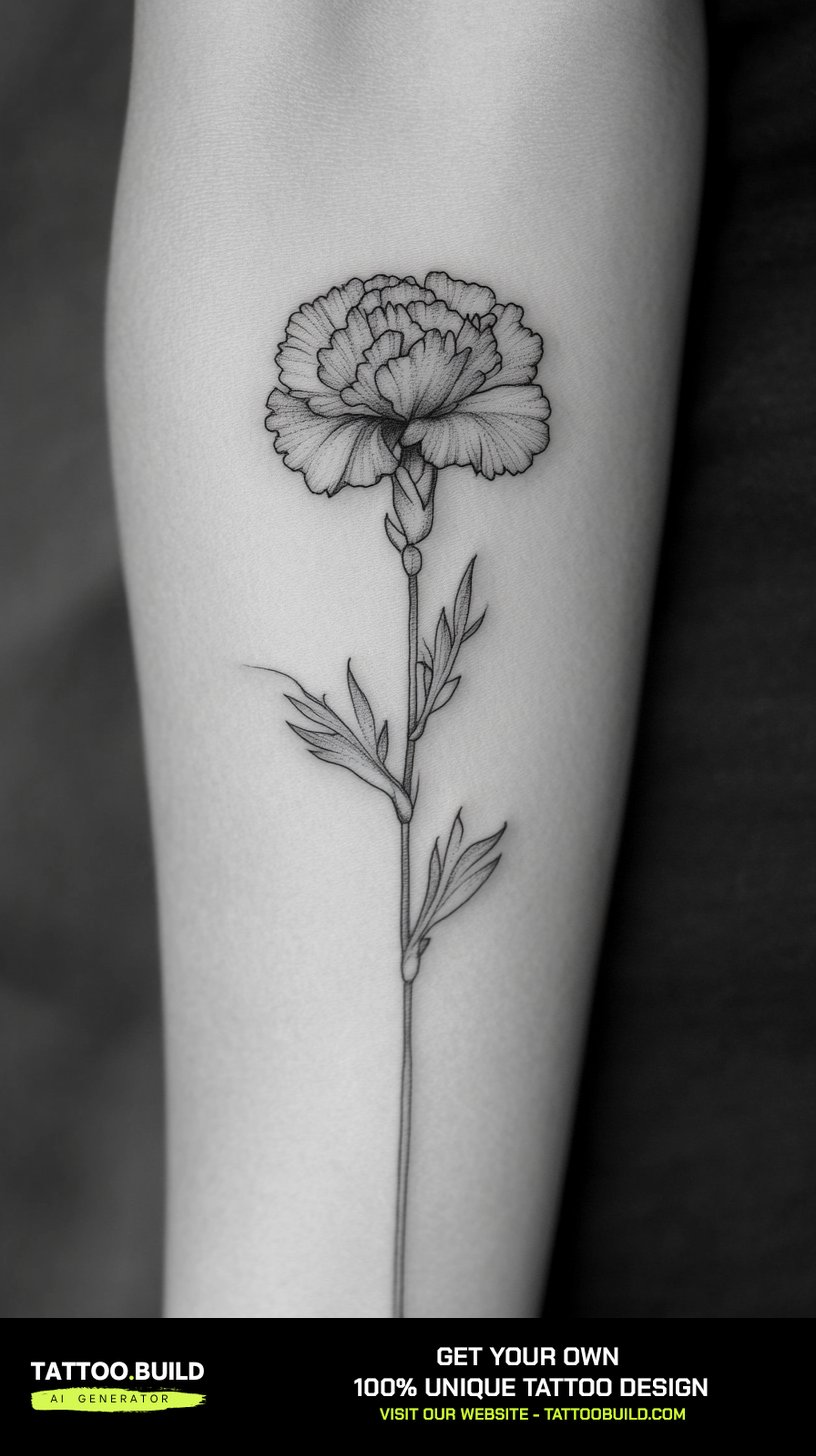
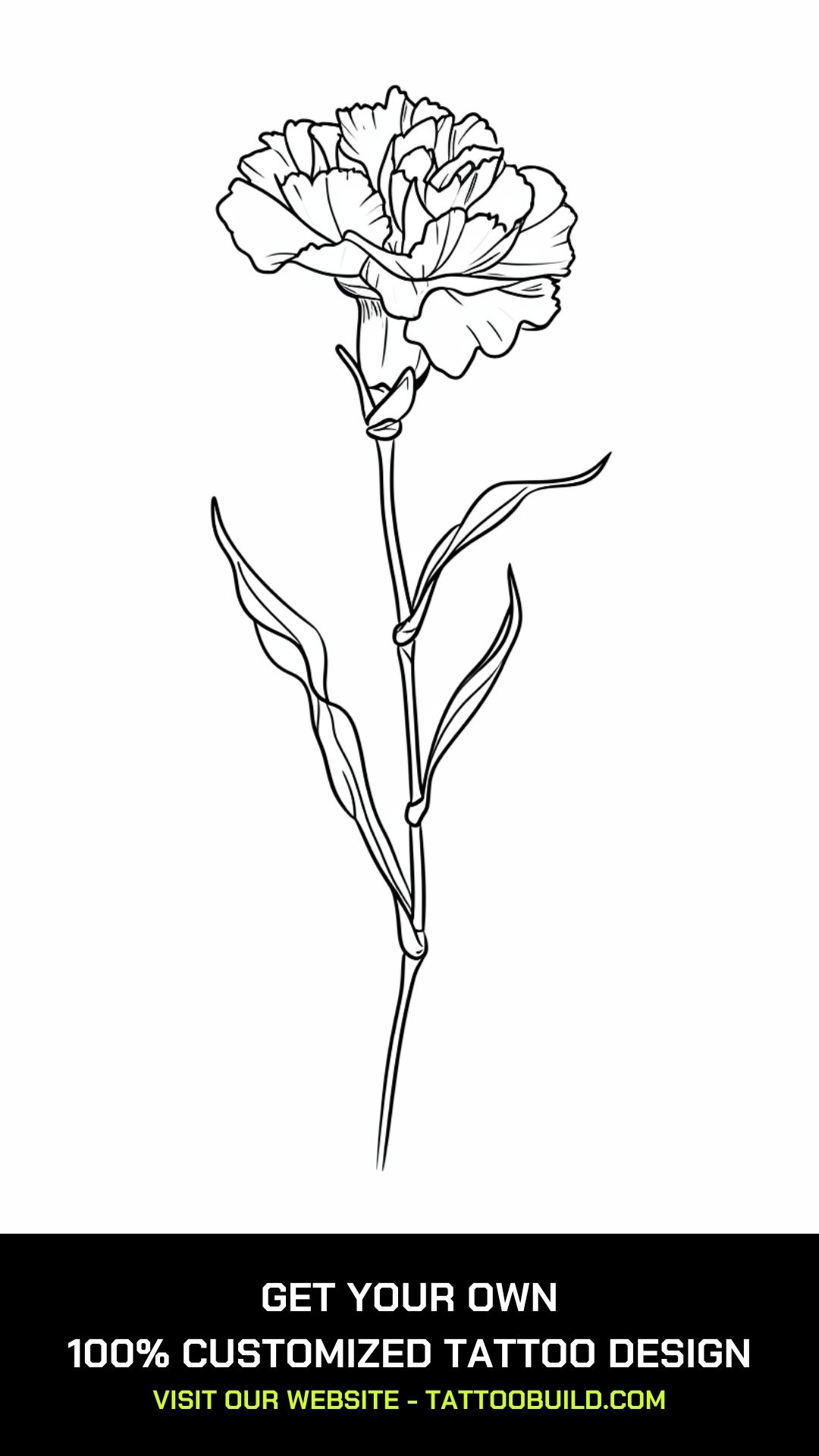
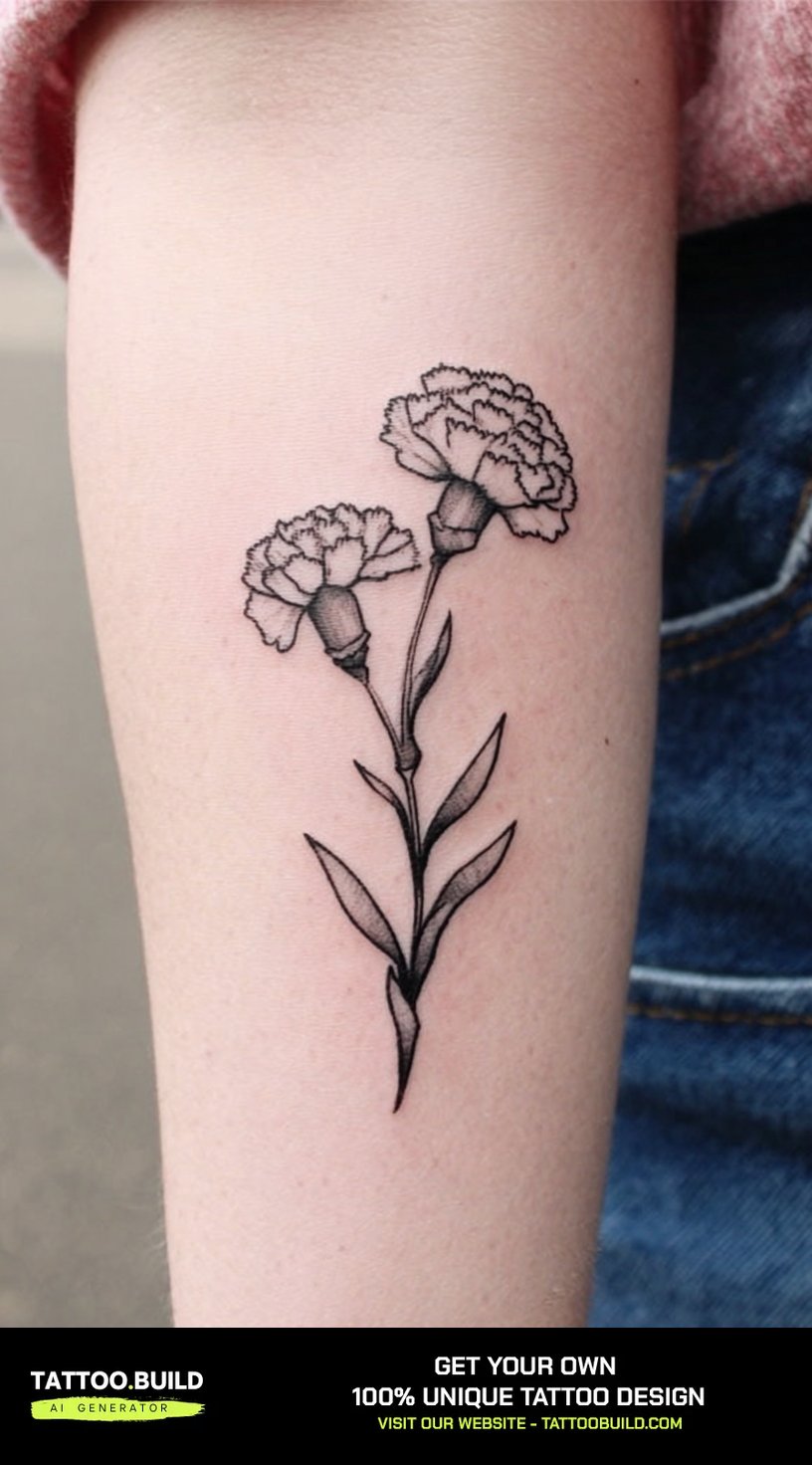
January gets two flowers that could not be more different in feel. The carnation is dense, ruffled and forgiving, while the snowdrop is a single drooping bell on a thin green stem.
That contrast is useful. If you want something with visual weight on a forearm or calf, the carnation carries shading well and still reads clearly from across a room.
The snowdrop is the opposite — it is the one I recommend when someone wants a birth flower tattoo that almost nobody will notice unless they are looking. It sits beautifully on a wrist, an ankle, or behind the ear.
In my experience the snowdrop is also the design most likely to blur over the years, because it lives or dies on two or three very thin lines. If you are set on it, ask your artist to keep the stem slightly thicker than the reference photo. I have watched hairline stems on healed work soften noticeably by year five.
Carnations traditionally signal love and fascination; snowdrops are read as hope and renewal, which is a fitting pair for the first month of the year.
February — Violet, Primrose and Iris
February is where the birth flower lists start to disagree with each other. Most traditional charts give February the violet, often paired with the primrose, while a number of modern florists’ lists assign the iris instead.
I mention this because clients regularly arrive with two different reference images and assume one of them is wrong. Neither is. The lists are folk tradition, not a standard, and they vary by country and by century.
Practically, the violet is the easier tattoo. Its five rounded petals hold their shape at small sizes and it clusters well, so three or four violets can fill a space without looking crowded.
The iris is the more dramatic option — tall, with falls that hang downward and standards that rise up. It suits a vertical space: the outside of a forearm, the back of a calf, or alongside the spine.
When someone wants both parents’ months in one piece, violets are usually the flower I suggest as the connective tissue, because they tuck into gaps that a larger bloom cannot.
March — Daffodil and Jonquil
The daffodil is one of the most recognisable flowers in the entire birth flower calendar, and that is its real advantage. Even reduced to a simple outline, a daffodil still reads as a daffodil.
The trumpet at the centre is the whole design. Every artist I have asked about daffodils says the same thing: get the depth of the cup right and the rest of the flower falls into place.
Jonquils are a type of narcissus closely related to the daffodil, with smaller blooms carried several to a stem. If you want a March tattoo with more movement, jonquils give you a cluster rather than a single face.
Daffodils suit both fine-line and bolder illustrative styles. I have seen them work in American traditional with a heavy black outline and a flat yellow fill, and they hold up unusually well over time in that style.
The traditional reading is rebirth and new beginnings, which is why March birth flower tattoos show up so often as a marker for a fresh start rather than a birthday.
April — Daisy and Sweet Pea
April is the month I recommend most often to people getting their first tattoo. The daisy is simple, symmetrical and almost impossible to make ugly.
It is also flexible in size. A daisy works at two centimetres on a finger and at twenty on a thigh, which is not true of most of the flowers on this list. If you like the shape, our wider guide to daisy tattoo ideas has more placement options.
The sweet pea is the more interesting half of the pair. Its ruffled petals and curling tendrils give you something to wrap around an arm or a wrist without needing a full band.
Those tendrils are the detail worth protecting. They are thin, they curl, and if the artist crowds them too close together they merge into a blob within a few years. Ask for more breathing room between curls than the reference image shows.
Daisies read as innocence and loyalty; sweet peas are associated with blissful pleasure and, slightly oddly, with goodbyes.
May — Lily of the Valley and Hawthorn
Lily of the valley is, without much competition, the most requested birth flower I see for May. The arched stem hung with small white bells is elegant and instantly recognisable.
It is also a genuinely difficult tattoo. Each bell is a small closed shape, and the whole design depends on even spacing along a curve. A rushed lily of the valley looks like a row of commas.
I would budget more time and more money for this one than the size suggests. It is a small tattoo that takes a careful artist longer than a bigger, simpler flower would.
Hawthorn is the forgotten half of May. Its blossom is a flat five-petalled flower carried in bunches, often drawn with the thorns and berries included, which gives it a rougher, more folkloric feel.
If you like the shape but want something larger, our guide to lily tattoo ideas covers the bigger lily varieties that share the same family name but almost none of the same design problems.
June — Rose and Honeysuckle
June has the rose, which is both a gift and a problem. It is the most tattooed flower in the world, so a June birth flower tattoo needs a reason to look like yours and not like everyone else’s.
The usual solutions are style and context. A rose in black and grey with heavy shading, a rose in fine line with no fill at all, and a rose in bold traditional colour are three completely different tattoos.
The one advantage of the rose is that every artist has drawn hundreds of them. Whatever style you walk in asking for, someone in the shop can do it well.
Honeysuckle is June’s second flower and it is badly underused. Its long tubular blooms and trailing vine suit wrapping placements — around a bicep, along a collarbone — far better than a rose does.
If the rose is where you are leaning, our collection of rose tattoo ideas is worth a look before you book, mostly to narrow down which style of rose you actually want.
July — Larkspur, Delphinium and Water Lily
July’s flower is the larkspur, which belongs to the delphinium family — which is why you will see both names used for the same month, and both on the artwork below.
Larkspur is a spike: many small flowers stacked up a tall stem. That shape is genuinely useful, because it fills a long narrow space without needing to be wide.
It is the best birth flower on this list for a spine tattoo or the outside of a forearm. In my experience it is also one of the easiest to combine with a second month’s flower, because the spike gives the composition a backbone to build around.
The water lily is July’s alternate in several lists, and it is the opposite shape — flat, wide, symmetrical, and best suited to a shoulder blade or the top of a thigh.
Larkspur carries associations with an open heart and strong attachment; the water lily is read as purity and rebirth in several traditions.
August — Gladiolus and Poppy
The gladiolus is the tallest flower in the birth flower calendar and it commits you to a vertical placement. There is no comfortable way to make a gladiolus small and round.
That said, a full gladiolus spike running from the wrist to the inner elbow is one of the more striking single-flower tattoos I have seen, and it needs no filler around it.
The poppy is August’s alternative and it is a much easier ask. A poppy is essentially a bowl of crumpled petals around a dark centre, which means it looks good in black and grey, in bold red, and in fine line.
The seed pod is worth including. It gives the design a second shape to balance against the bloom and it is one of the few botanical details that stays legible when a tattoo softens with age.
Our guide to poppy flower tattoo ideas goes further into the remembrance associations, which are worth knowing about before you commit to one.
September — Aster and Morning Glory
The aster is a daisy-like flower with far more petals — thin, numerous, radiating out from a dense centre. It photographs beautifully and tattoos less easily.
The risk with an aster is petal count. Drawn too tightly, the petals merge into a solid disc within a few years. A good artist will draw fewer petals than the real flower has, and leave visible gaps between them.
Morning glory is September’s second flower and it is one of my favourites on this whole list. It is a simple trumpet shape on a twining vine, which means it can travel.
That twining habit makes morning glory the natural choice for anyone who wants a birth flower tattoo that wraps — around a forearm, up a calf, or along the outside of a thigh.
Asters are associated with wisdom and patience; morning glories, which open at dawn and close by afternoon, are usually read as affection and the shortness of a moment.
October — Marigold and Cosmos
The marigold is dense — layer on layer of short petals packed into a tight head. It is the most texturally interesting flower in the calendar and the one that rewards a skilled shader the most.
It is also the flower where I would most strongly advise against going small. Under about five centimetres a marigold stops reading as a marigold and starts reading as a pom-pom.
The cosmos is October’s counterweight: eight broad petals on a very thin stem, with feathery foliage. Simple, airy, and easy to place almost anywhere.
Marigolds carry heavy cultural weight, particularly in Mexican Día de los Muertos tradition and in South Asian ceremony. That is worth knowing and worth being thoughtful about, especially if the design borrows visual language from a culture that is not yours.
A common October solution I like is a single marigold at the anchor point with two or three cosmos trailing off it, which gives you both flowers without competing textures.
November — Chrysanthemum and Peony
November’s chrysanthemum has the same problem as the marigold and the same solution: it is all texture, and it needs room. Curling petals that spiral out from the centre are what make it, and they need space to spiral.
It is one of the best flowers on this list for a large piece. In Japanese traditional work the chrysanthemum is a long-established motif and there is a deep well of reference to draw from — our chrysanthemum tattoo ideas guide covers that history in more detail.
The peony appears as November’s flower in some lists and as a general favourite everywhere else. Its layered, cabbage-like bloom sits somewhere between the chrysanthemum and the rose in difficulty.
Both flowers age well. Because they are built from large overlapping shapes rather than thin lines, they hold their structure as a tattoo softens, which is not something I can say about the snowdrop or the lily of the valley.
If your birthday is in November you have, in my view, the easiest month on this chart to turn into a large, long-lasting tattoo.
December — Narcissus, Holly and Poinsettia
December is the only month on the calendar where one of the standard flowers is not really a flower. Holly is a leaf and a berry, and it behaves like one in a tattoo.
That is not a criticism. Holly is the most graphically distinct option in the entire birth flower calendar — the spiked leaf outline is unmistakable even at wrist size, and the berries give you a natural place for a spot of colour.
The narcissus is December’s floral option and it looks close enough to a daffodil that most people cannot tell them apart, which occasionally causes confusion between March and December pieces.
Poinsettia turns up as a December flower in some modern lists. It is bold and easy to read, but its strong Christmas association means it will always be a seasonal tattoo rather than a neutral one.
For a December piece I usually suggest holly as the outline and narcissus as the soft element, which gives the design both a hard edge and a rounded shape to balance it.
Ways to Build a Birth Flower Tattoo Beyond a Single Bloom
Almost nobody I have talked to ends up with just one flower sitting on its own. These are the four structures that come up again and again.
The Family Bouquet
One flower per family member, arranged as a single gathered bunch. This is the most common version of the idea and the most likely to grow later.
Tell your artist up front if there is a chance you will add to it. A bouquet designed with room to expand looks intentional; one that gets a flower crammed in afterwards rarely does.
Composition matters more than the individual flowers here. Two large blooms with three small ones reads well; five medium blooms of similar size turns into a shapeless mass.
The Vine or Band
Rather than a bunch, the flowers are spaced along a single stem or vine that wraps a limb. Morning glory, sweet pea and honeysuckle are built for this; gladiolus and marigold are not.
This structure handles four or more months better than a bouquet does, because it gives each flower its own space instead of asking them to share one.
Paired With a Second Element
Birth flowers combine easily with a date, a set of initials, a butterfly, or a birthstone rendered as a small geometric shape.
If you are adding text, put it where the flower is not — beneath the stem, or along the outer edge. Text laid over petals is the single most common way I see these designs go wrong.
Larger Botanical Pieces
A birth flower can also be the anchor of something much bigger. The November peony and the chrysanthemum in particular are large enough to carry a half sleeve on their own.
If that is the direction you are going, plan the whole piece before the first session even if you intend to break it across several appointments.
Practical Advice Before and After You Get It Done
Bring more than one reference image, and bring at least one of a healed tattoo rather than a fresh one. Fresh work always looks crisper than it will in five years, and artists appreciate a client who understands that.
Ask directly how the design will hold up. A good artist will tell you if your requested size is too small for the flower you have chosen, and will usually offer a fix rather than just refusing.
On placement: forearms, outer upper arms and calves hold detail well over decades. Fingers, feet, palms and the inner wrist do not, and fine botanical linework on those spots often needs touching up within a couple of years.
For healing, follow the aftercare your artist gives you — they know what their ink and their technique need. The American Academy of Dermatology’s guidance on caring for tattooed skin is a sound general reference, and long-term sun protection is the single biggest factor in how a fine-line floral piece looks a decade on.
If you notice spreading redness, swelling that gets worse rather than better after a few days, pus, fever, or a rash that appears weeks or months later, see a doctor rather than asking the internet. Ink allergies and infections are both real and both treatable, but neither is something to wait out. This article is design advice, not medical advice.
Common Mistakes — and What to Do If You Are Still Not Sure
The mistake I see most often is going too small. A birth flower is a botanical drawing, and botanical drawings need detail to work.
The second is picking the flower from a photograph of a fresh tattoo on social media without checking whether that artist’s healed work still looks like that. Ask to see healed photos. Every artist worth booking has them.
The third is committing to all twelve months of a family at once. Start with two or three and leave the design open. Families change, and a piece built to expand handles that gracefully.
If you like the flowers but are not sold on the birth-month framing, there are gentler ways in. Our guide to floral half sleeve forearm tattoos covers the same botanical style at scale, and floral upper arm tattoo ideas is a good place to look if you are still deciding on placement.
And if you are not ready to commit at all, ask your artist for a drawing rather than a booking. Most will do a consultation sketch, and seeing your months drawn together on paper answers the question faster than any amount of scrolling.
Frequently Asked Questions
Can I get more than one birth flower in the same tattoo?
Yes, and it is probably the most common version of this design. Two to four flowers arranged as a small bouquet or spaced along a vine works comfortably. Beyond four, the composition gets harder and I would talk to your artist about a vine or band structure rather than a gathered bunch. Tell them up front if you expect to add more later, because a design planned for expansion looks far better than one retrofitted.
Which birth flower is the easiest to tattoo?
The April daisy, by a clear margin. It is symmetrical, it has a strong silhouette, it works at almost any size, and it ages well because it is built from simple shapes rather than thin lines. The March daffodil and the December holly leaf are close behind for the same reasons. If you want something that will still read clearly in twenty years, those three are the safest picks on the calendar.
Why do different websites give my month a different flower?
Because birth flower lists are folk tradition rather than an official standard. They grew out of the Victorian language of flowers and were never codified the way birthstones were, so British, American and modern florists’ lists all differ on several months. February is the most contested, showing up as violet, primrose or iris depending on the source. Pick whichever you prefer — none of them is more correct than the others.
How small can a birth flower tattoo be?
It depends entirely on the flower. A daisy or a violet holds up at around two to three centimetres. A marigold, chrysanthemum or aster generally needs five centimetres or more before the petal detail stops merging into a solid shape. A snowdrop or lily of the valley can be small but relies on very fine lines, which are the first thing to soften with age. Ask your artist for their minimum size for your specific flower rather than working from a general rule.
Do birth flower tattoos need to be in colour?
No — most of the ones I see are black and grey or plain fine line, and they read perfectly well. Colour helps most with flowers whose identity depends on it, like the marigold and the poppy. It matters less for daffodils, daisies and holly, where the shape does the work. Colour also fades differently to black ink and generally needs more diligent sun protection, so factor that into the decision.
Quick Summary
- Birth flower lists are folk tradition, not an official standard — several months have two or three commonly cited flowers, and you can pick whichever you prefer.
- The easiest flowers to tattoo well are the April daisy, the March daffodil and the December holly, because they have strong silhouettes and no reliance on hairline detail.
- The hardest are the January snowdrop and the May lily of the valley, which depend on thin lines and even spacing along a curve.
- Dense flowers — marigold, chrysanthemum, aster — need size. Under roughly five centimetres their petal detail merges as the tattoo ages.
- Tall flowers like gladiolus and larkspur suit vertical placements: forearms, calves and the spine.
- Twining flowers like morning glory, sweet pea and honeysuckle are the right choice for wrapping designs around a limb.
- If you plan to add family members later, tell your artist before the first session so the composition leaves room.
- Placement affects longevity more than style does — forearms, outer arms and calves hold fine botanical detail far better than fingers, feet or the inner wrist.