The first time a client asked me for a crab, I assumed it was a Cancer zodiac piece. It was not. He had spent eleven years working crab boats out of Newfoundland, and he wanted the animal that paid his mortgage.
A crab tattoo usually means resilience, protection and emotional depth — an animal that carries its armour on the outside and rebuilds it every time it outgrows it.
That last part is the piece most people miss. A crab has to shed its shell entirely to grow, and it spends days soft and defenceless before the new one hardens. That is a far more interesting story than “tough guy with claws,” and it is why crabs sit so comfortably alongside the rest of the ocean tattoo symbolism family.
Below is everything I have learned from designing, watching and healing these pieces — the meanings, the styles that actually hold up, the placements worth considering, and the mistakes I see repeated most often.
Which Crab Tattoo Style Is Right for You?
Style matters more than subject with a crab, because the shell and the leg joints are where a tattoo either reads clearly or turns into a grey smudge. Here is how the common approaches compare.
| Style | Best Size | How It Ages | Suits You If |
|---|---|---|---|
| American Traditional | 3–6 inches | Excellent — bold lines stay readable for decades | You want the piece obvious from across a room |
| Blackwork / Dotwork | 4–8 inches | Very good, though dotted shading softens over time | You love shell texture and carapace detail |
| Fine Line | 2–4 inches | Fair — thin legs can blur, expect a touch-up | You want something quiet and delicate |
| Watercolour | 4–7 inches | Fair — fades faster without a black line base | You want colour movement around the shell |
| Neo-Traditional | 5–9 inches | Good — heavier outlines carry the detail | You want ornamental framing and rich colour |
| Black & Grey Realism | 6 inches and up | Good if sized properly, poor if shrunk down | You want an anatomically accurate crab |
If I had to pick one for a first-timer, it would be traditional or blackwork. A crab has ten limbs and a textured shell — that is a lot of information to fit into a small space, and bold linework is what keeps it from collapsing.
What Actually Shapes a Crab Tattoo’s Meaning
The meaning of a crab tattoo is set less by the animal than by three choices you make with your artist.
The first is posture. A crab drawn side-on and walking reads as journey and adaptability; a crab facing forward with claws raised reads as defence.
The second is what surrounds it. Waves and sand push the piece toward the ocean and toward home. Stars, a moon or a constellation push it toward the Cancer zodiac reading.
The third is whether the shell is whole or split. I have done a handful of crabs mid-moult, with a cracked carapace behind the animal, and every one of them was about leaving something behind.
None of this is fixed law. In my experience, most people arrive with one meaning in mind and end up carrying two or three — which is the honest appeal of an animal this layered.
Crab Tattoo Meanings, One by One
1. Adaptability and Resilience
Crabs live in a punishing in-between space — tidal zones that flood and drain twice a day, every day.
They handle salt water, air, sand, rock and current, and they move sideways because that gait is faster and more stable across uneven ground than walking forward.
That sideways walk is the detail I point out most often, because it reframes the whole symbol: the crab is not going nowhere, it is taking the route that actually works.
Every client I have tattooed for this reason was in the middle of something — a career change, a move, a recovery. The crab was shorthand for keeping moving when the ground shifts.
2. Protection and Healthy Boundaries
The exoskeleton is the obvious read. Armour on the outside, softness underneath.
What makes it a good tattoo rather than a cliché is the second half: that armour is not permanent, and the crab is completely vulnerable every time it grows.
I have tattooed this meaning on several people coming out of difficult relationships, and the framing they used was almost always about boundaries rather than defence.
If that is your reason, ask for the claws held close to the body rather than thrown wide. It changes the tone from combative to self-contained.
3. Intuition and Emotional Depth
Crabs are governed by tides, and tides are governed by the moon — which is why the animal gets folded into lunar and emotional symbolism across a lot of coastal cultures.
A crab tattoo can stand for trusting your gut, reading a room, or simply having a rich inner life you do not broadcast.
This is the meaning that pairs most naturally with a crescent moon, a small wave, or the soft palettes you see in a lot of contemporary work.
If you like that register, it is worth looking at how jellyfish tattoo designs handle the same emotional-ocean territory with a different animal.
4. Home, Family and Belonging
A crab carries its home, digs a home, or borrows one. Whichever species you pick, shelter is central to it.
That makes crabs a quietly good family tattoo — less obvious than a tree or a set of names, and specific to anyone raised on a coast.
I have done three crab pieces that were explicitly about a place rather than a person: two for people from the Maritimes, one for a woman whose grandfather ran a Chesapeake blue crab boat.
If this is your angle, bring your artist a photo of the actual species from your coast. A blue crab and a Dungeness are not interchangeable, and the difference is visible.
5. Moulting, Renewal and Transformation
Crabs grow by moulting — shedding the entire hard shell and expanding before the replacement hardens, a process described in general reference sources such as Britannica’s entry on crabs.
For a few days after, the animal is soft, hidden and effectively helpless. Soft-shell crab on a restaurant menu is a crab caught in exactly that window.
As tattoo symbolism, that is unusually specific: growth requires a period of being unprotected. You cannot get bigger while keeping the old armour.
This is my favourite crab meaning to design for, because it justifies compositions the standard crab does not — a split shell, a discarded carapace, a second faint outline behind the animal.
6. The Cancer Zodiac Connection
Cancer, the fourth sign of the zodiac, runs roughly from 21 June to 22 July and takes the crab as its symbol.
Plenty of crab tattoos are straightforward astrology pieces, and there is nothing wrong with that.
My only design note: if you want the zodiac reading to be obvious, add the glyph or the constellation. A crab on its own is read as an animal by most people, not as a birth sign.
Placing four or five small stars in the negative space above the shell is the cleanest way I have found to do it without cluttering the piece.
7. Myth and Cultural Symbolism
In Greek myth, the crab Karkinos is crushed underfoot during Heracles’ fight with the Hydra and placed among the stars for its trouble — which is where the constellation gets its name.
In Japan, the heikegani crab is famous for a shell pattern that resembles an angry human face, and folklore tied those crabs to the spirits of drowned Heike warriors.
Both stories give the crab something rarer than toughness: loyalty, and a kind of stubborn persistence past the point of winning.
If you want a piece with that weight, tell your artist the story rather than just the species. It changes the expression they draw into the shell.
Where a Crab Tattoo Actually Sits Best
Crabs are wider than they are tall. That single fact should drive your placement decision more than anything else.
Forearm
The outer forearm is my default recommendation. It is a flat, wide surface that suits a horizontal subject, and it is easy to sit for.
A 4–5 inch crab across the forearm reads clearly without needing a full sleeve commitment.
Upper Arm and Shoulder
The shoulder cap curves in two directions, which suits a crab surprisingly well — the legs can follow the roll of the deltoid.
It is also the easiest placement to cover for work, and among the more comfortable spots to sit through.
Ankle and Lower Leg
Ankles suit small, simplified crabs. What they do not suit is detail, because the skin is thin and close to bone.
Be realistic about the pain here — the ankle appears near the top of most painful tattoo placement rankings for a reason.
Ribcage and Torso
The ribs give you the width a large crab wants, and the side of the torso lets the legs sprawl naturally.
It is a genuinely uncomfortable session, though, and healing over a moving ribcage takes patience.
Back and Shoulder Blade
For anything above six inches, the upper back is the most forgiving canvas on the body — flat, broad and stable.
The trade-off is that you will rarely see it yourself, which matters more than people expect.
Design Variations Worth Considering
Not every crab tattoo has to be a whole crab, seen from above. These are the variations I get asked for most.
Hermit Crab
A hermit crab swaps the flat carapace for a borrowed spiral shell, and it carries a slightly different meaning: making a home out of whatever is available.
It is also a friendlier silhouette, which suits smaller and softer pieces.
Claw Only
A single claw is the minimalist route. It keeps the protection symbolism and drops the leg detail that causes most small-crab problems.
This works beautifully in fine line tattoo styling on a wrist or inner forearm.
Crab With Florals or Botanicals
Seaweed, kelp or coastal wildflowers soften the whole composition and give the artist a way to fill awkward negative space around the legs.
I lean on this constantly for ankle and forearm pieces where the crab alone looks stranded.
Nautical Crab
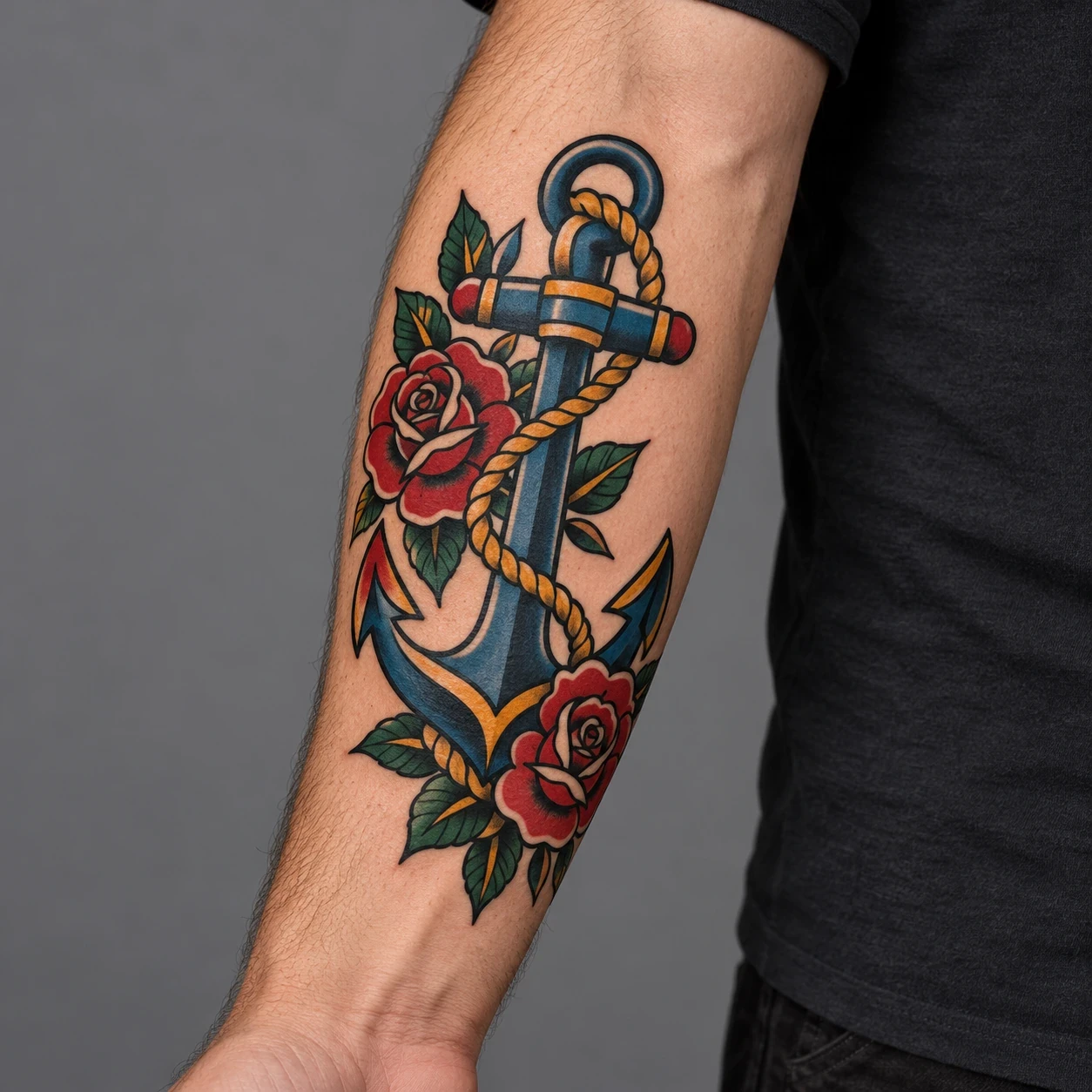
Pair the crab with rope, a compass rose or an anchor and you land squarely in traditional sailor territory — the same visual family as anchor tattoo designs.
Waves, sea turtles and a horizon line push it further toward a full marine scene.
Colour-Forward Crab
Red, orange and rust suit a crab naturally, and a bold colour crab holds up well if there is a solid black outline underneath.
If you want colour without hard edges, watercolor tattoo ideas show what that approach looks like in practice — just know it will need touch-ups sooner.
Practical Advice Before You Book
Size the crab to the number of legs you want visible, not to the space you have. Ten limbs crammed into two inches will heal as a blob, and no artist can fix that afterwards.
Budget honestly. Small simple crabs are typically an hour or two of work, while a detailed shaded piece runs several sessions — our guide to small tattoo costs covers how shops usually price this.
Follow whatever aftercare your artist gives you rather than advice from the internet, including ours; the general principles are covered in our tattoo aftercare guide, but your artist knows your skin and their ink.
If anything looks wrong while healing — spreading redness, swelling that increases after day three, heat, pus, or a fever — contact your artist and see a doctor. Dermatology bodies such as the American Academy of Dermatology publish plain guidance on tattooed-skin care, and infections and ink allergies are medical issues, not design ones. Nothing in this article is medical advice.
Common Mistakes I See With Crab Tattoos
The most frequent one is going too small. A crab is a detail-heavy animal, and shrinking it below about three inches forces the artist to drop legs or merge lines.
The second is copying a photograph directly. Real crabs photograph beautifully and tattoo badly, because the shell texture that looks great in a photo becomes noise in ink.
The third is skipping the reference conversation entirely. If the crab is about a specific place or a specific person, say so before the stencil, not after.
And the fourth is choosing style purely on what looks best on the day. Fresh watercolour and fresh fine line are stunning; three years in, they are a different piece.
Frequently Asked Questions
What does a crab tattoo symbolise?
A crab tattoo most often symbolises resilience, protection, emotional depth and transformation. The hard shell stands for self-protection and boundaries, while the moulting cycle — shedding the shell entirely in order to grow — represents renewal and personal change. Because the crab is also the symbol of Cancer, many crab tattoos carry a zodiac meaning as well. In my experience most people end up carrying two or three of these meanings at once rather than one.
Is a crab tattoo only for Cancer zodiac signs?
No. Plenty of crab tattoos have nothing to do with astrology — coastal heritage, fishing work, resilience and family are all common reasons. If you do want the zodiac reading to be obvious to other people, ask your artist to add the Cancer glyph or a small constellation, because a crab on its own usually reads as an animal rather than a birth sign. Without those cues, most viewers will not make the astrological connection.
How big should a crab tattoo be?
For a full crab with visible legs, I would not go below about three inches across, and four to five inches is more comfortable. Below that the leg joints and shell texture start merging as the tattoo heals and settles. If you want something genuinely small, a single claw or a heavily simplified silhouette works far better than a shrunken full crab. Your artist can usually show you a stencil at both sizes before you commit.
Where does a crab tattoo hurt least?
Generally the outer forearm, outer upper arm and shoulder cap are among the more tolerable placements, since there is muscle and fat between the needle and the bone. Ankles, ribs and the tops of the feet tend to be considerably sharper because the skin sits close to bone. Pain varies a lot between individuals, though, so treat any ranking as a rough guide rather than a promise.
Do crab tattoos age well?
It depends almost entirely on style and size rather than on the subject. Bold traditional and blackwork crabs typically hold up for decades with minimal touch-up work. Fine line and watercolour crabs usually look softer within a few years and may need refreshing sooner, particularly on high-friction spots like hands, feet and ankles. Sun exposure is the other big factor, and daily sunscreen on a healed tattoo genuinely helps.
Quick Summary
- A crab tattoo generally means resilience, protection, emotional depth, home and transformation.
- The moulting cycle is the strongest symbolism the animal offers — growth requires going unprotected first.
- Cancer zodiac pieces need a glyph or constellation to read as astrology rather than as an animal.
- Bold traditional and blackwork styles age best; fine line and watercolour need earlier touch-ups.
- Crabs are wider than they are tall, so flat, broad placements — forearm, shoulder, upper back — suit them best.
- Three inches is roughly the floor for a full crab with legible legs; go smaller and simplify to a claw instead.
- Bring your artist the actual species if the piece is about a specific coast or a specific person.
- Treat healing problems as medical, not cosmetic — call your artist and see a doctor if something looks wrong.
Turn Your Tattoo Ideas Into Designs in 2 Minutes
You do not have to spend hours on Pinterest hunting for the right crab. Describe what you want to the TattooBuild AI tattoo design generator and get design directions back in seconds.
Here is how it works:
- Open the studio: try a design or choose a plan.
- Describe your idea: theme, style, placement and size — details matter.
- Review the concepts: the AI generates designs based on what you described.
- Pick your favourite and take it to your artist as reference.
It is a starting point, not a substitute for an artist. In my experience the biggest benefit is walking into a consultation able to point at something instead of describing it.