The neck is the placement most men think about for years before they book it, and the one artists ask the most questions about before they agree to do it.
I have sat through two neck sessions of my own and watched a lot more from the other side of the shop, and the pattern is always the same. The design is rarely the hard part. The size, the angle and the honest conversation about visibility are.
It is also a genuinely painful spot — not the worst on the body, but it sits comfortably in the upper half of any tattoo pain ranking you will find. Thin skin, bone underneath, and a pulse you can feel in your ears the entire time.
What follows is a working guide rather than a gallery: which designs actually hold up on a neck, where on the neck to put them, and what to know before you commit to a piece you cannot cover with a sleeve.
Which Neck Placement Is Right for You?
Before you settle on a subject, settle on a panel. The neck is not one placement — it is four or five, and each one rewards a different kind of design.
| Placement | Pain Level | How Easy to Hide | Best Suited To |
|---|---|---|---|
| Back of neck | Moderate – bone close to the surface at the spine | Easiest, if you have hair or wear collars | Symmetrical single subjects: lions, trees, daggers, short script |
| Side of neck | Moderate to high – thin skin, constant pulse | Partly, with a high collar or long hair | Flowing designs: roses, birds, ornamental panels, portraits |
| Front of neck / throat | High – the most sensitive area of the three | Very difficult in most clothing | Bold, simple, high-contrast work only |
| Full neck wrap | High, and usually across multiple sessions | Not realistically hideable | Heavily tattooed men finishing an existing chest or sleeve |
| Behind the ear | Sharp but brief – small area, thin skin | Easy with hair down | Small symbols and single-line pieces |
What Makes the Neck Different From Every Other Placement
The neck moves more than almost anywhere else you can be tattooed. Every time you turn your head, swallow or look down at your phone, the skin stretches and slides over the muscle underneath.
That movement is why bold work outlasts delicate work here. Hairline-thin linework that looks immaculate on an inner forearm tends to soften faster on a neck, and the difference is visible within a few years rather than a few decades. If you are weighing sensitivity across the body, our tattoo pain chart puts the neck in context against other spots.
Sun exposure compounds it. Unless you live in a scarf, the neck catches light every day of the year, and ultraviolet exposure is the single biggest cause of fading in any tattoo.
Then there is the practical side: it is one of the few areas you cannot see properly on yourself. Every artist I have asked says the same thing — clients judge a neck piece from a phone photo taken at a bad angle, and it takes a mirror and some patience to actually read it.
None of that is a reason to avoid the placement. It is a reason to size up, simplify, and pick an artist who has healed necks before, not just tattooed them.
Neck Tattoo Designs That Actually Work on Men
These are the subjects I see hold up best, grouped by what they demand from the placement rather than by style label.
Lions and Big Cats
The lion is the most requested masculine neck subject I have come across, and it works for a structural reason as much as a symbolic one: a lion’s head is roughly circular, and a circle sits well on both the back of the neck and the side panel.
On the back of the neck it reads as a badge — symmetrical, centred on the spine, easy to frame. On the side it can be stretched and shaped around the muscle that runs from behind the ear to the collarbone, which gives the mane somewhere to flow.
The mistake is sizing it too small. A lion under about three inches loses the eyes and the mane texture within a few years, and those are the two things that make it read as a lion at all.
If you want the fine line version, ask your artist to healed-photo you an example of theirs that is at least two years old. That is the only honest test of whether their linework survives on a neck.
Crosses and Religious Imagery
Religious neck pieces are common and, done well, among the most durable — a crucifix, a rosary, praying hands and cross-with-rays designs all rely on strong vertical structure that suits the length of the neck.
The vertical axis matters. A cross running down the side of the neck follows the natural line of the muscle, which means it distorts less when you turn your head than a horizontal design would.
Radiating light behind the figure is the detail that separates a good one from a flat one. It needs to be shaded soft and then softened again in the healing, and inexperienced artists tend to lay it in too dark, so it blurs into a grey haze.
Script and Lettering
Lettering is the highest-risk category on the neck and the most rewarding when it lands. Thin script strokes are exactly what the neck erodes first, so size and font weight matter more than the words. Our guide to word tattoo ideas for men covers font choice in more depth.
The back of the neck is the safest panel for script, because it is broad, relatively flat and gives a two-line phrase room to sit without wrapping around a curve mid-word.
Read it out loud before you commit. Neck lettering is the placement I have seen the most regret attached to, almost always because the phrase was chosen in a fortnight and worn for a lifetime.
Keep it short. Two or three words in a heavy script survives; a full sentence in a thin one rarely does.
Birds: Doves, Ravens and Phoenixes
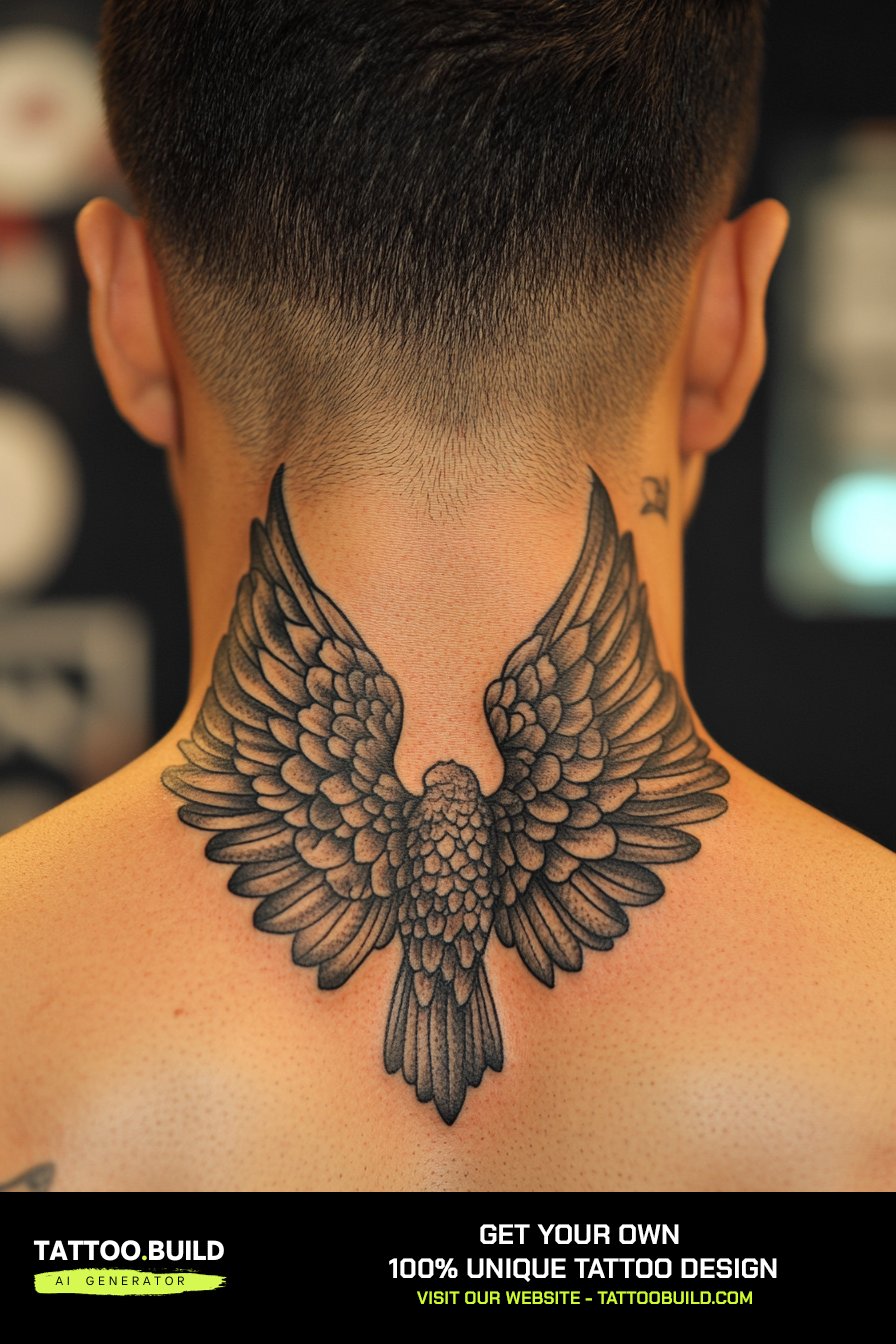
Birds are the most adaptable subject on this list because wings can be shaped to whatever panel you have. A dove reads gentle, a raven reads dark, a phoenix reads like a rebuild — and all three can be scaled from a two-inch side piece to a full wrap. If the last of those appeals, we have a full guide to phoenix tattoo ideas for men.
A spread-wing bird on the side of the neck lets the artist run one wing up toward the ear and one down toward the collarbone, which fills the panel without fighting the muscle.
Colour phoenixes are one of the few cases where I would argue for colour on a neck. Reds and oranges give the design something to lose over time and still read correctly once faded, in a way that pale colours do not.
Ornamental and Mandala Work
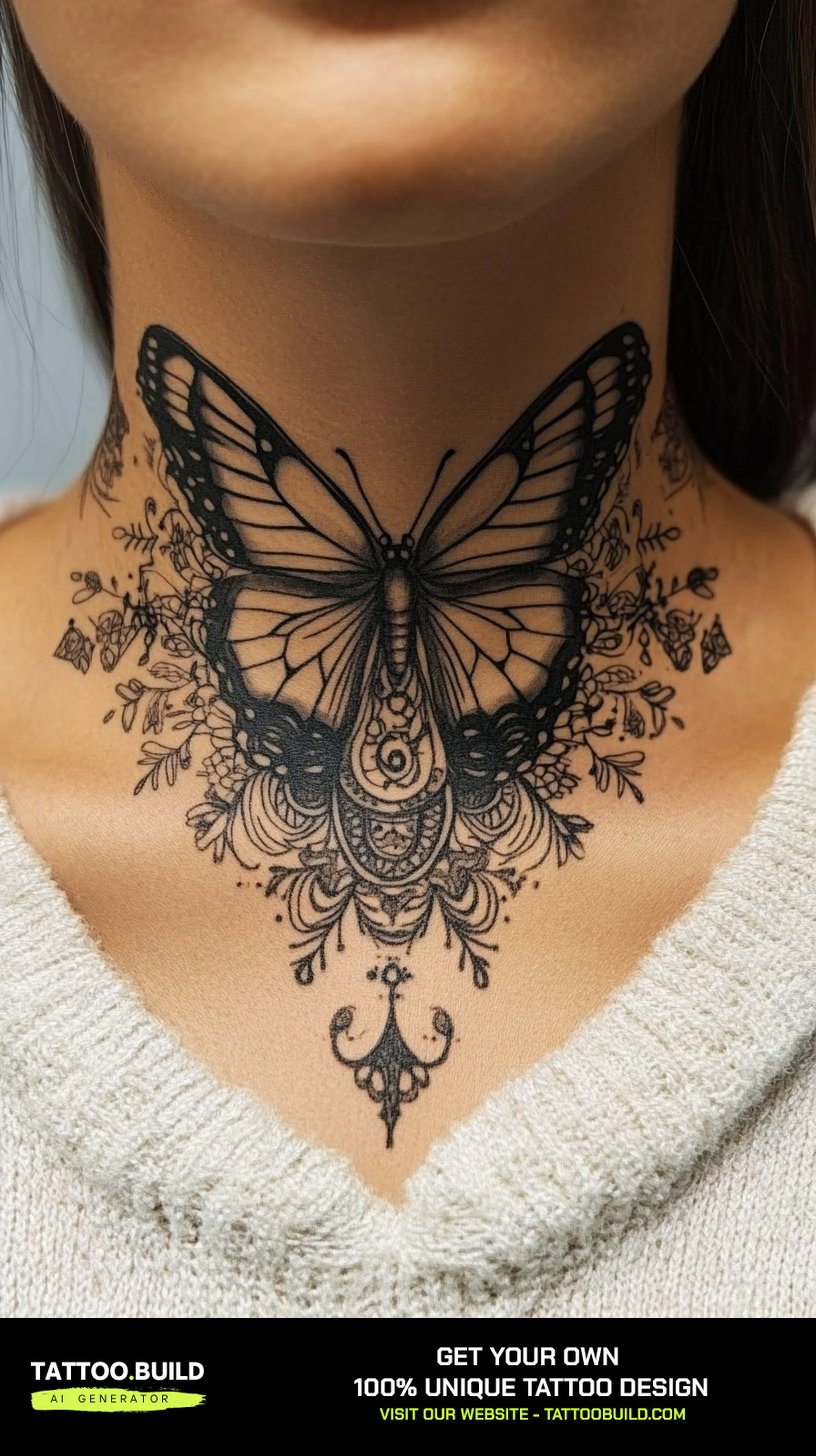
Ornamental neck work — mandalas, lace patterns, filigree panels — is designed to fit the body rather than sit on it, which makes it a natural fit for a curved surface. Our ornamental tattoo guide goes deeper into the style.
These pieces almost always want to be bigger than clients first imagine. A mandala that stops halfway up the neck tends to look unfinished; one that runs from the jawline down under the collar looks deliberate.
That is also the catch. Ornamental work on the neck usually commits you to eventually tattooing the chest or shoulder, because the pattern has to resolve somewhere. Ask your artist to sketch the full plan even if you only book the first session.
Dotwork shading in this style is slow and expensive, and it is worth budgeting for two sessions rather than trying to push it into one.
Mountains, Trees and Landscapes
Nature scenes suit the back of the neck better than anywhere else on the placement, because they need a horizontal horizon and that is the only panel that offers one.
A mountain range uses the natural width of the neck as its baseline, which is why these read cleanly even at modest sizes. A tree does the opposite — it grows upward into the hairline, which is a good use of space but means the finest branch tips sit in the thinnest skin.
Expect those tips to soften. In my experience the outer branches of a tree of life are the first detail to blur on any neck piece, and a good artist will deliberately thicken them beyond what looks right on paper.
Small Symbols: Crowns, Daggers and Hourglasses
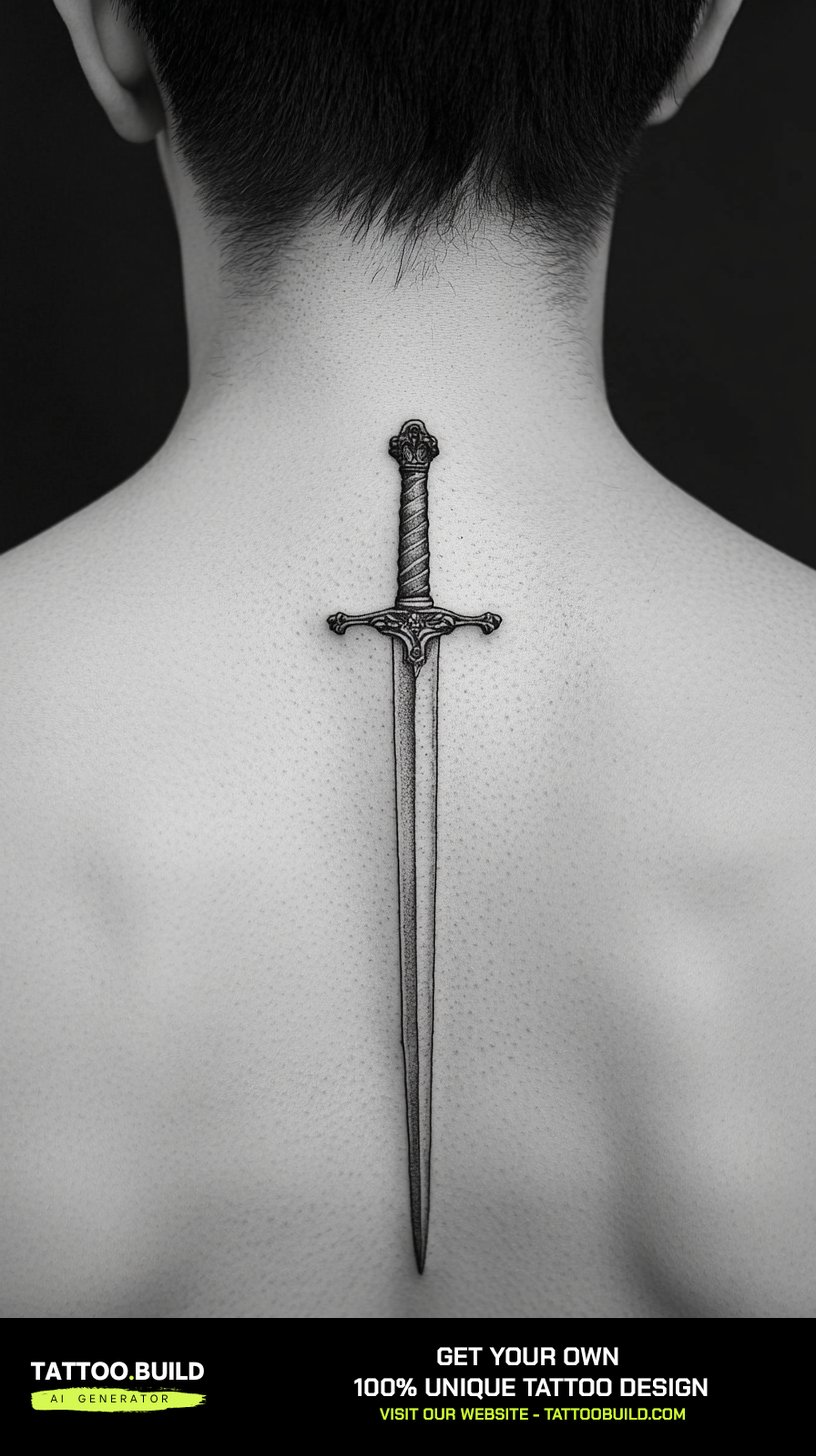
Not every neck tattoo needs to be a statement piece. Single-object designs — a crown under the ear, a dagger down the spine, an hourglass above the collar — are the most common first neck tattoos I see, and for good reason.
They are also the most forgiving. A simple high-contrast object holds its shape as it ages far better than a detailed scene at the same size.
The dagger down the back of the neck deserves a specific mention: a vertical object on the spine is the single most stable composition available on this placement, because the axis barely distorts when you move.
Placement height is the decision that matters here. An inch or two lower and a shirt collar covers it; an inch higher and it never does.
Skulls and Darker Imagery
Skulls, reapers and decorated calaveras fill the side panel of the neck well because a skull is roughly the same proportion as the space between the jaw and the collarbone. We cover the wider category in our skull tattoo ideas for men guide.
Heavy black is your friend here. Dark subjects age better on the neck than mid-grey ones, because the contrast that makes them readable is built into the design rather than into fine shading.
The one caution is visibility. A skull on the throat is the design most likely to attract a reaction you did not ask for, and it is worth being clear-eyed about that before booking rather than after.
Variations Worth Considering Before You Commit
If a full neck piece feels like too much, these are the middle-ground options I most often see men land on.
Start Behind the Ear
A small design tucked behind or just below the ear is the lowest-commitment entry to this area. It hurts briefly, heals fast, and disappears entirely under longer hair.
It also tells you something useful: how you actually feel about visible ink once it is on you rather than imagined.
Stay on One Side
A single-side piece gives you the visual impact of a neck tattoo while leaving the other side clear for a high collar or a turned head.
Most of the designs above scale down to this. A rose, a small bird or a short vertical line of script all work at a size that stops well short of the jaw.
Extend Something You Already Have
If you already have a chest piece or a shoulder, running it up onto the neck is usually a better-looking outcome than starting a fresh, unrelated design.
It reads as one considered body of work rather than two separate decisions, and it lets the neck section be simpler because it is not carrying the piece alone.
Healing and Aftercare on the Neck
Necks are among the more awkward areas to heal, mostly because of movement and friction. Our full tattoo aftercare guide covers the fundamentals; what follows is what is specific to this placement.
Collars are the main problem. For the first week, wear something with a wide or open neckline. A crew neck rubbing a fresh side-neck piece all day is the fastest way to pull ink out of it.
Sleep matters too. Most people move a lot at night, and a fresh neck tattoo pressed into a pillow for eight hours does not heal evenly — a clean pillowcase changed daily helps, as does sleeping on the untattooed side. Our breakdown of tattoo healing stages sets expectations for what each week should look like.
Keep hair product, cologne, aftershave and sunscreen away from it until it has fully closed. Once it has, daily sunscreen is the single most effective thing you can do for its longevity — the American Academy of Dermatology has straightforward guidance on caring for tattooed skin.
Follow your artist’s instructions over anything you read online, including this. And if you develop spreading redness, heat, swelling, pus or a fever, see a doctor rather than waiting — the Mayo Clinic lists the risks worth knowing about, and infection on the neck is not something to manage yourself. The US Food and Drug Administration also publishes consumer guidance on tattoo inks and reactions.
Common Mistakes — and What to Do If You Are Still Not Sure
The errors I see repeat are rarely artistic. They are almost always decisions made too fast.
- Going too small. The most common regret. Neck skin does not reward detail, and what looks bold on paper reads as a smudge at three inches.
- Booking with the wrong artist. Plenty of excellent tattooers rarely work on necks. Ask specifically for healed neck photos, not fresh ones.
- Choosing the words in a week. If it is script, sit with the phrase for a few months before you book.
- Ignoring the chest. Ornamental and wrap designs need somewhere to resolve. Plan the whole thing even if you only tattoo part of it.
- Assuming it can be undone. Cover-ups here are limited and removal is slow and expensive. Choose as if it is permanent, because functionally it is.
If none of this has settled it, that is a useful signal in itself. A chest piece gives you comparable scale with none of the visibility trade-off, and it is the placement I most often suggest to men who like the idea of a neck tattoo more than the reality of one.
And if this would be your first tattoo of any kind, start somewhere else. Our guide to first tattoo ideas for men is a better starting point than a neck — get one piece healed, learn how your skin behaves, then decide.
Frequently Asked Questions
How much does a neck tattoo hurt compared to an arm?
Noticeably more, in my experience, though not unbearably so. The skin on the neck is thin, it sits directly over muscle and cartilage, and you feel the machine through your jaw and ear in a way you never do on an outer bicep. The back of the neck near the spine and the front of the throat are the two spots most men flinch on. Most people cope fine with a session of one to two hours; if you have never been tattooed at all, this is not the place to start.
Will a neck tattoo stop me getting a job?
It depends enormously on the industry and the country, and anyone who tells you it never matters is selling something. Trades, hospitality, creative work and most tech environments are largely indifferent now. Client-facing corporate roles, some healthcare settings, law and certain uniformed services are still not. The honest test is to look at the people two levels above you in the job you actually want and see what they have on show.
How long does a neck tattoo take to heal?
The surface usually closes over in roughly two to three weeks, with the deeper skin settling over two to three months. Necks are awkward healers because the area moves constantly, collars rub it, and it collects sweat and hair product. Follow whatever aftercare your artist gives you rather than advice from the internet, and if you see spreading redness, heat, swelling or discharge, see a doctor rather than waiting it out.
Do neck tattoos fade faster than tattoos elsewhere?
Generally yes, and this is worth planning around. The neck gets constant sun, the skin is thin, and it flexes all day. Fine line and very small detail there tends to soften sooner than the same work on a thigh or an inner arm. Bolder linework, stronger black and a regular habit of sunscreen once healed are the practical answers; touch-ups every few years are normal, not a sign anything went wrong.
Can a neck tattoo be covered up or removed later?
Cover-ups on the neck are possible but constrained, because there is less surface area to work with and a heavier cover often reads as a solid dark patch. Laser removal works on the neck too, but it usually takes multiple sessions spread over a year or more, costs more than the tattoo did, and is handled by a qualified clinic rather than at home. Never attempt removal yourself with creams, salt or abrasion — it scars. The realistic advice is to treat a neck tattoo as permanent when you choose it.
Quick Summary
- Pick the panel before the design — back, side, front, wrap and behind-the-ear each suit different subjects.
- Go bolder and bigger than you think. Neck skin is thin, moves constantly and erodes fine detail first.
- Lions, crosses, birds, ornamental panels, landscapes, small symbols and skulls are the categories that consistently hold up.
- Vertical designs on the spine and side muscle distort least when you move your head.
- Script is the highest-risk choice: keep it short, keep the strokes heavy, and sit with the words for months.
- Ask any prospective artist for healed neck photos at least a year old — fresh photos tell you nothing about longevity.
- Heal it with open collars, a clean pillowcase and no product on the area; see a doctor for spreading redness, heat or discharge.
- Sunscreen every day once healed is the cheapest thing you can do to keep it sharp.