I have been writing about placement for years, and the neck is still the one that makes people hesitate longest before booking. A neck tattoo is not just a design decision — it is a visibility decision, and those are two separate conversations you should have with yourself before you sit down.
The good news is that “neck tattoo” covers far more ground than most people assume. The nape hides completely under loose hair. The throat does not hide at all. Between those two extremes there are five or six distinct placements, each with its own pain level, healing behaviour and design logic.
Below are 30+ neck tattoos for women, grouped by style rather than thrown at you in a random pile, plus the practical notes I wish someone had given me earlier — how the skin here actually takes ink, what ages badly, and which designs are worth scaling down. If you already know you want something discreet, our guide to small neck tattoo ideas for women narrows the field further.
Start with the gallery, then read the placement table. In my experience people change their mind about the design far less often than they change their mind about where it sits.
Which Neck Placement Is Right for You?
Every artist I have asked describes the neck as several different canvases that happen to be next to each other. This is roughly how they compare.
| Placement | How Visible | Pain (relative) | Best Suited To |
|---|---|---|---|
| Nape / back of neck | Hidden by loose hair or a collar | Moderate — the gentlest area of the neck | First neck tattoos, symmetrical designs, fine line work |
| Side of neck | Visible unless hair is down | High near the collarbone and jaw | Flowing designs that follow the muscle line |
| Behind the ear | Mostly hidden, glimpsed when hair moves | High — thin skin over bone | Small motifs, single-session pieces |
| Throat / front | Always visible | Very high | People already comfortable with visible work |
| Under the jaw | Visible from the side | Very high | Small script, ornamental accents |
| Nape to shoulder | Hidden by most tops | Moderate, rising toward the spine | Florals and larger multi-session pieces |
Pain is personal, so treat that column as a ranking rather than a promise. If you want a fuller picture across the whole body, the tattoo pain chart is a more complete reference than anything I can fit in one table.
What Actually Changes When You Tattoo the Neck
Neck skin is thin, it sits close to bone in several places, and it moves constantly. Those three facts drive almost every piece of advice in this article.
Movement is the part people underestimate. You turn your head hundreds of times a day, and unlike a forearm, you cannot rest the area while it heals.
That mobility affects the design too. A straight horizontal line across the side of the neck will read as straight from exactly one angle and slightly bent from every other, which is why experienced artists tend to steer clients toward curves, tapers and organic shapes here.
Ink also tends to spread a little more readily in thin, mobile skin than it does on an outer arm. In practice this means very tight detail — hair-thin script, dense micro-stippling — is more likely to soften over the years on the neck than in a sturdier spot.
None of this makes the neck a bad choice. It just means the designs that hold up here are the ones drawn with a little more breathing room between the lines than you would need elsewhere.
Neck Tattoo Ideas for Women, Style by Style
These are grouped by the kind of look they create rather than by subject, because in my experience that is how people actually shop for a tattoo.
1. Fine-Line Florals
Fine-line botanical work is the most requested category on the neck, and for good reason: flowers curve, and so does the neck.
A peony or lotus drawn with a light hand will sit along the sternocleidomastoid — the muscle running from behind the ear to the collarbone — and follow it naturally instead of fighting it. The nape suits bouquets and stems better, since it is flatter and reads as a rectangle.
One caution from watching these age: the very finest lines are the first thing to soften. Ask your artist to use a slightly heavier needle grouping than they would on a forearm, and accept that a fine-line neck piece may want a touch-up sooner than one on your thigh. Our broader fine line tattoo ideas guide covers that trade-off in more depth.
Birth flowers work particularly well here because they give a small design a reason to exist beyond decoration.
2. Bold Colour and Neo-Traditional Pieces
If fine line is the safe bet, saturated colour is the durable one. Heavier outlines and packed colour tend to hold their shape far longer than delicate greyscale.
The catch is size. A neo-traditional peony or a koi needs room for the outline, the shading and the negative space between them, so these are rarely small pieces — expect them to run from below the ear down toward the collarbone.
They also take longer to sit for. A saturated side-of-neck piece is usually a multi-hour session, sometimes split in two, and the neck is a hard place to stay still for that long.
Red is the colour I see people regret least on the neck, because it stays legible against most skin tones as it settles. If a single bloom is what you are after, the peony tattoo ideas collection has more colour references.
3. Animals and Nature Symbolism
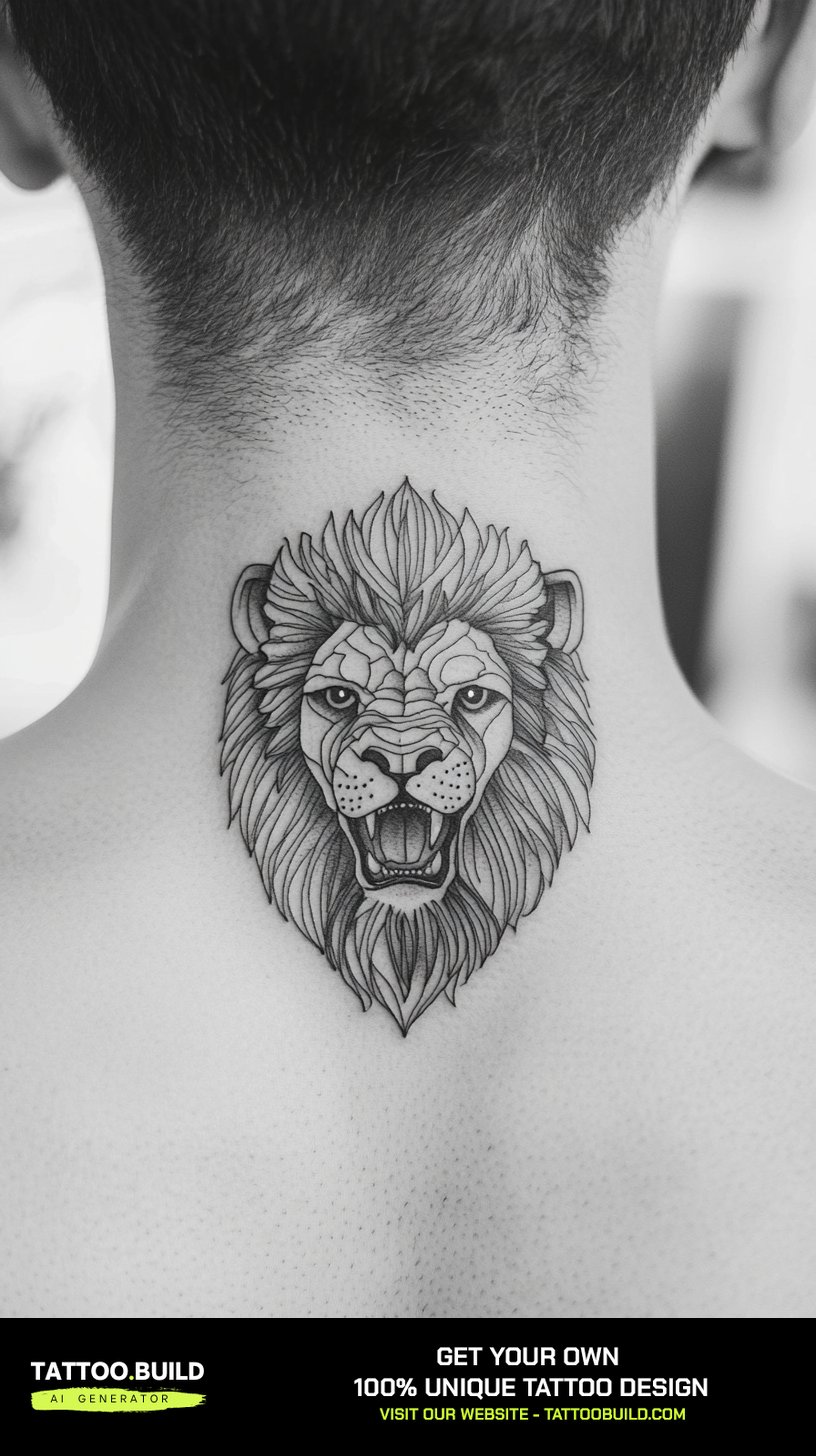
Animal designs on the neck tend to work best when they are small and centred on the nape, where there is a flat symmetrical field to work with.
An elephant and calf, a bare tree, a set of antlers — these read cleanly at two or three inches and do not need colour to make sense. That matters, because black and grey is the most forgiving palette on thin skin.
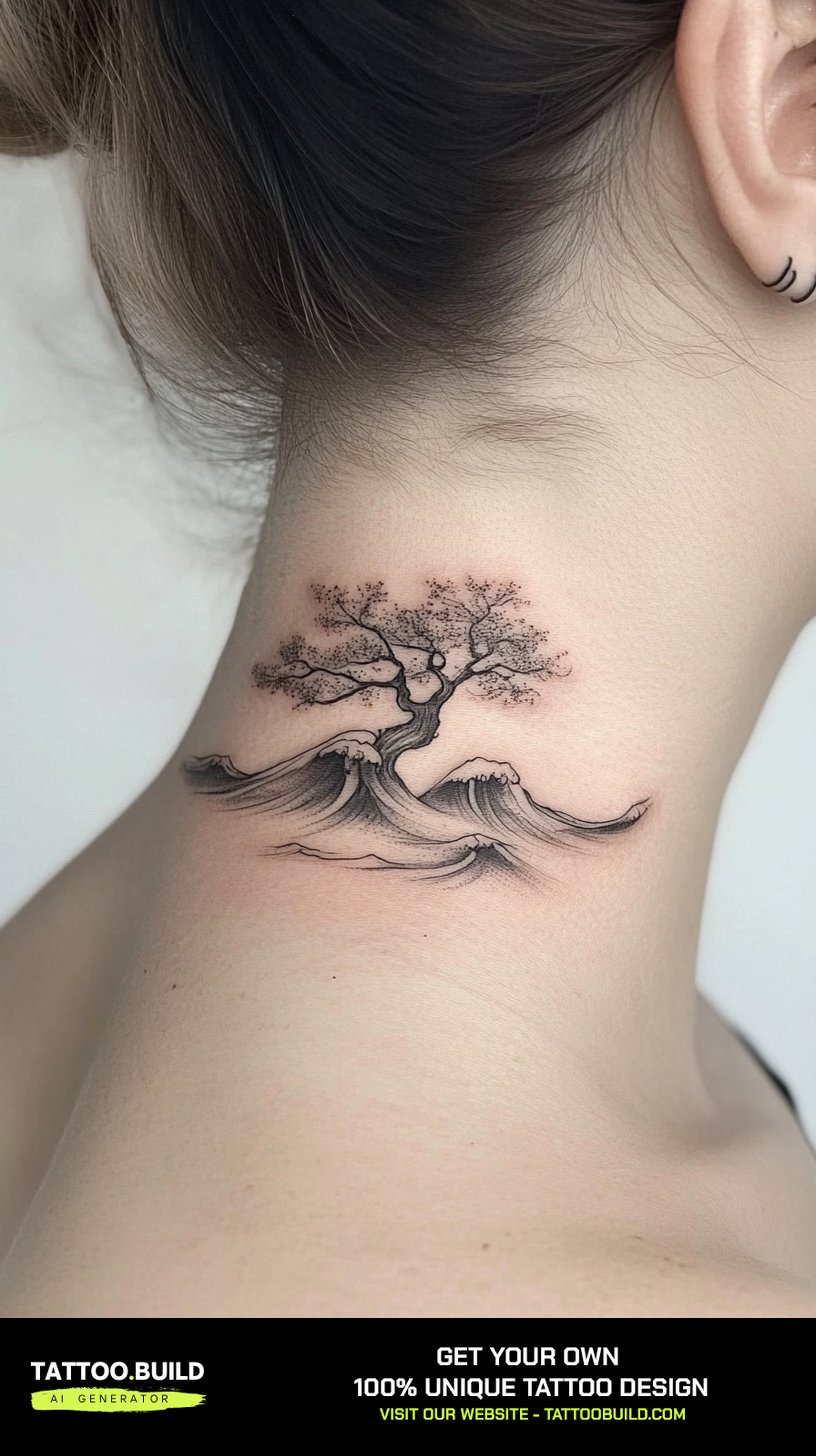
Trees in particular suit the nape because the root system can fan outward toward the shoulders and the canopy can taper up into the hairline, using a shape the body already gives you.
Keep the internal detail loose. Every artist I have asked says the same thing about small animal work here: the fur, feather or bark texture is what blurs first, so leaner is better.
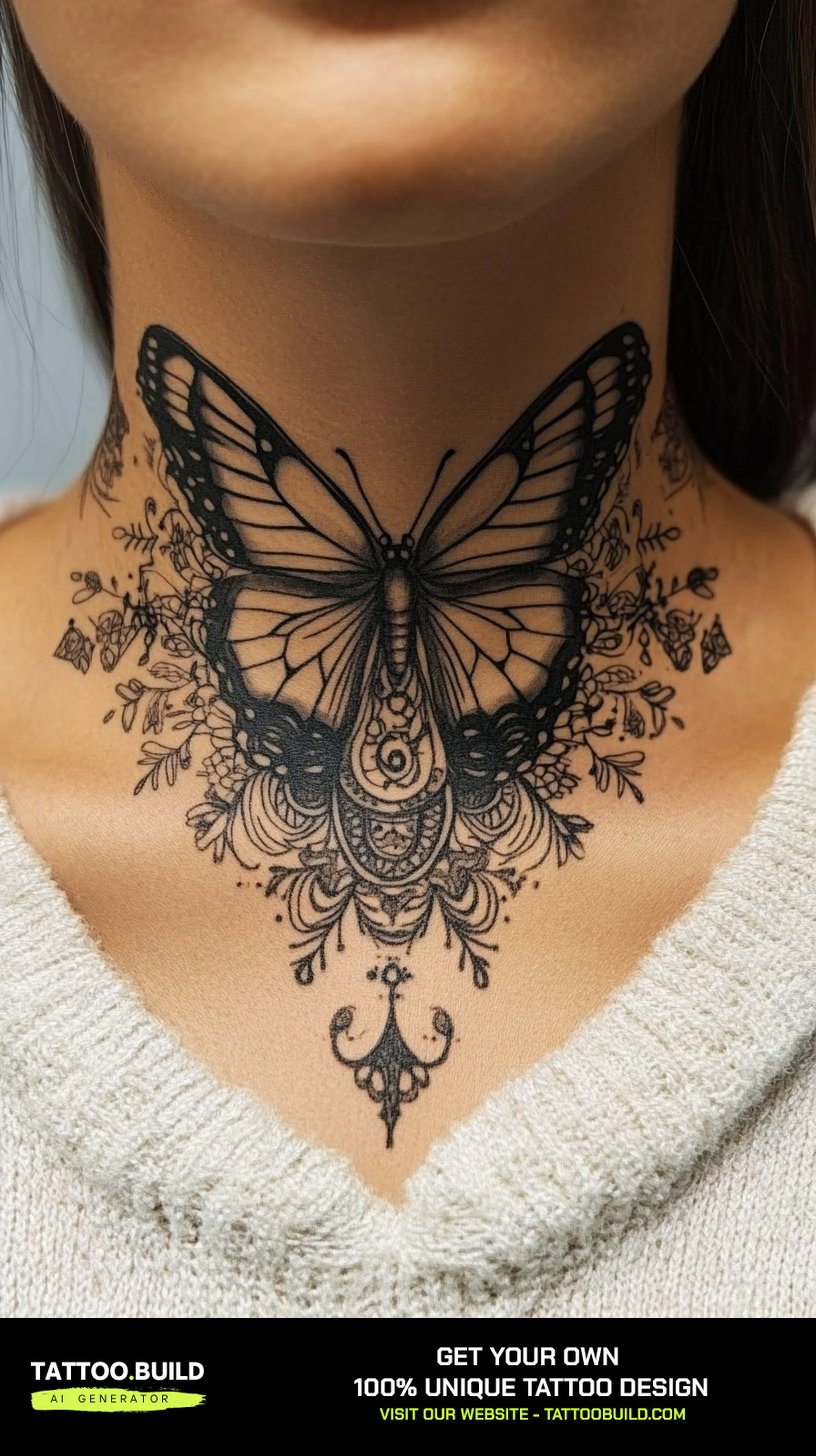
4. Butterflies and Ornamental Filigree
Ornamental work — filigree, mandala fragments, dotwork — is the style most often designed specifically for the neck rather than adapted to it.
A symmetrical butterfly centred on the nape uses the spine as an axis, which is why these designs look so deliberately placed. Move the same design to the side of the neck and it has to be redrawn asymmetrically to follow the curve.
Dotwork shading ages reasonably well here provided the dots are not packed too tightly. Dense stippling on thin skin has a tendency to merge into a solid grey patch over time.
If the butterfly is the part you are drawn to rather than the ornamental framing, there are far more variations in our butterfly tattoo ideas roundup.
5. Tiny Minimalist Designs
The smallest neck tattoos are also the easiest to live with, and they are what I usually suggest to anyone testing the water.
A cross, an aeroplane, a small anchor — most of these are under an hour in the chair, cost far less than a full piece, and disappear entirely under hair worn down.
There is a real design limit at this scale. Below roughly an inch, any internal detail will close up as the tattoo settles, so the designs that survive are the ones built from a handful of clean strokes.
Simple does not mean unconsidered. A single well-placed shape on the nape often reads as more intentional than a crowded one. The minimalist tattoo ideas guide is a useful place to look for shapes that hold up small.
6. Behind the Ear and Under the Jaw
These placements sit at the top of the neck and behave differently from everything below them.
The skin behind the ear is thin and sits directly over bone, which most people find genuinely sharp rather than merely uncomfortable. The upside is that the sessions are short, because nothing large fits there anyway.
Designs that trail — a feather, a stem, a chain of small shapes — work well because they can begin behind the ear and continue down onto the softer skin of the neck, spreading the discomfort across two different areas.
Visibility is the odd part: these are hidden from the front and obvious in profile. Worth thinking about if photographs matter to you. More options in our back of ear tattoos collection.
7. Dark and Statement Designs
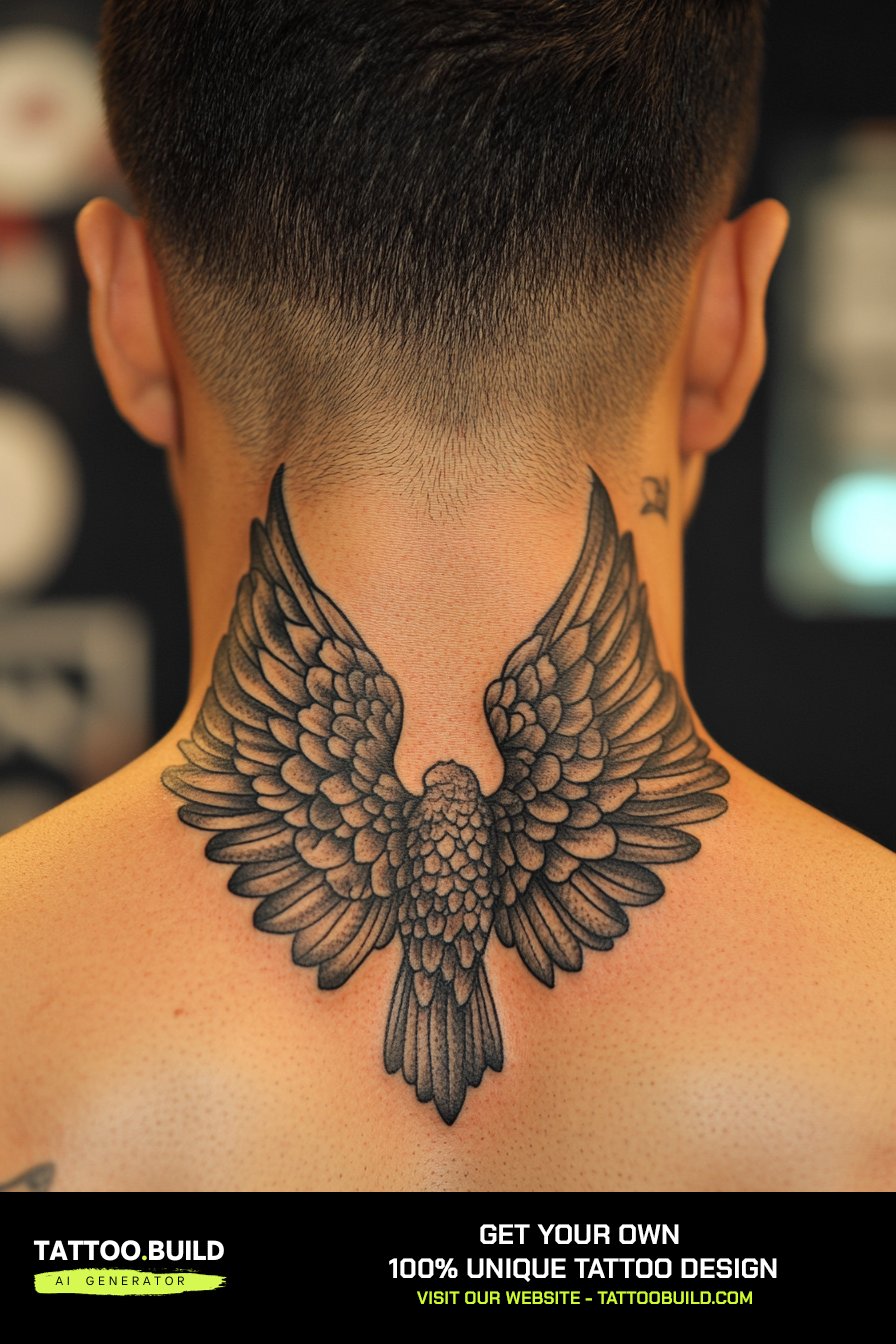
At the far end are the pieces that make no attempt to be discreet: skull and floral work across the throat, a wing covering the whole side of the neck, a phoenix running from ear to collarbone.
These are serious commitments in both time and pain. The front of the throat is one of the most sensitive spots on the body, and dense black shading there usually means several sessions.
They are also the hardest to cover later, which is worth naming plainly rather than glossing over. Neck work is technically removable, but laser on the neck is slow and expensive, and the results are less predictable than on a limb.
If you want this look, my honest advice is to sit with the reference for a few months before booking. The people I know who are happiest with throat work all decided slowly.
Variations Worth Considering
If nothing above fits, these two directions cover most of what is left.
Symbols and Line-Work Motifs
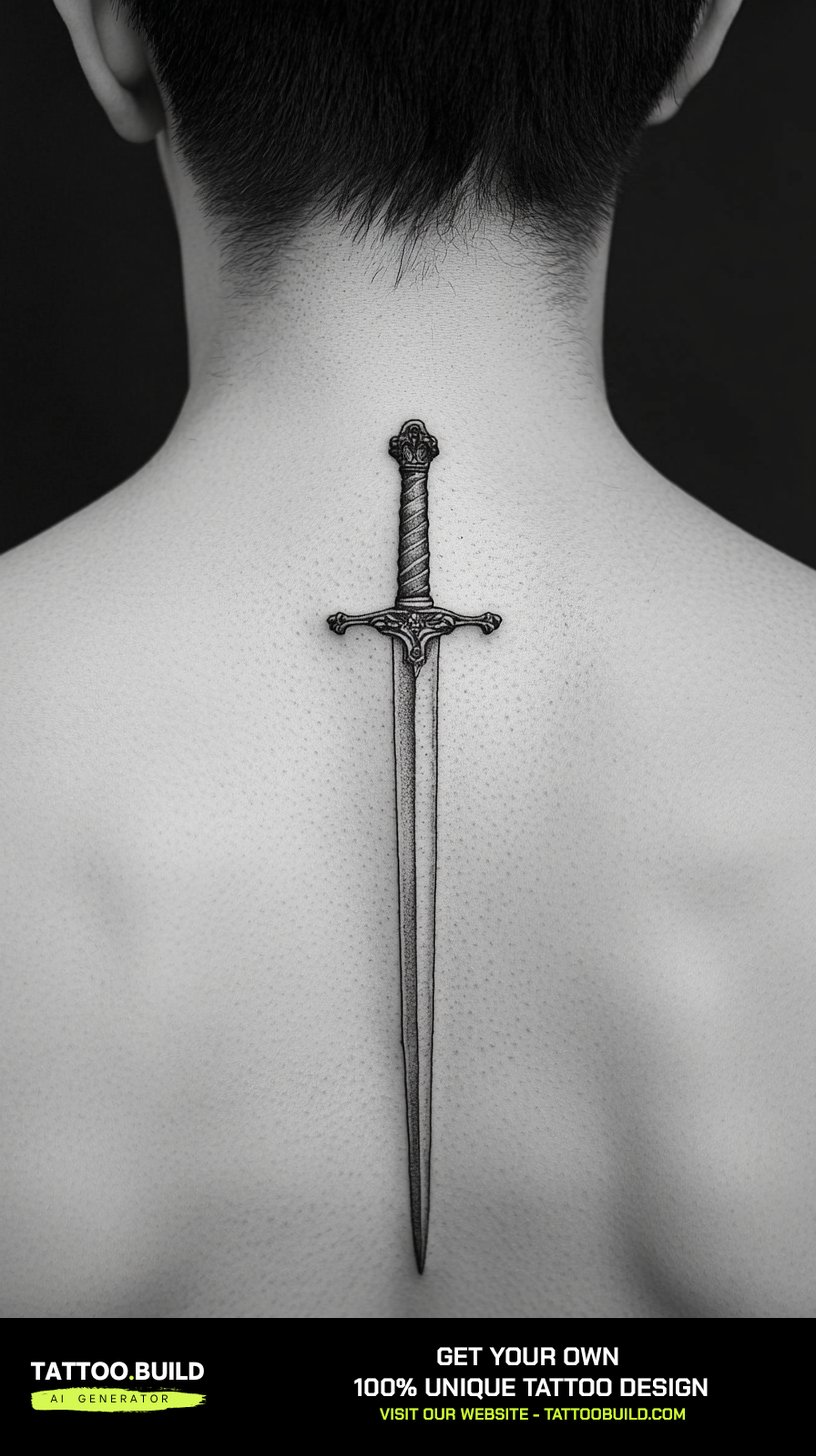
A dagger, an arrow, a ribbon bow — simple graphic symbols suit the neck because they can be scaled to almost any size without falling apart.
Vertical designs are the trick here. An arrow or a stem running down from the hairline follows the spine, which is one of the few genuinely straight lines the neck offers.
These also tend to be the most affordable neck pieces, since they are outline-driven and quick to execute.
Cosmic and Ocean-Inspired Designs
Waves, planets and landscape fragments have become common on the nape, and they suit the shape well — a wave in particular reads naturally as a horizontal band.
Japanese-influenced wave work scales down better than most people expect, provided the artist simplifies the foam rather than reproducing every curl.
Planets and celestial motifs sit at the other extreme: almost pure line, very little shading, and quick to sit for.
Healing and Aftercare on the Neck
Neck tattoos heal on roughly the same schedule as anywhere else — the surface usually settles within a couple of weeks, with the deeper layers taking longer — but the practical difficulties are specific to the area.
The three things that cause the most trouble are collars, hair and sleep. High necklines rub, long hair sticks to a healing tattoo, and most people roll onto their neck at night without noticing.
Wear low necklines for the first week or so, keep hair tied up and off the area, and follow whatever aftercare routine your artist gives you rather than one you read online. The American Academy of Dermatology publishes sensible general guidance on caring for tattooed skin if you want a medical source alongside it.
Sun exposure matters more on the neck than almost anywhere, because it is exposed year-round. Once the tattoo has fully healed, sunscreen is the single most effective thing you can do to keep it sharp.
If you notice spreading redness, swelling that increases after the first few days, heat, or discharge, that is a matter for a doctor rather than a forum — not a normal part of healing. The Mayo Clinic overview of tattoo risks covers infection and allergic reaction clearly, and nothing in this article is a substitute for a professional opinion.
Common Mistakes — and What to Do If You’re Still Not Sure
The mistake I see most often is choosing a design that was drawn flat and never adapted to a curved, moving surface. Ask to see the stencil on your own neck, in a mirror, before any needle touches skin.
The second is going too small with too much detail. A design that looks crisp on a screen at full width may be four centimetres wide in reality.
The third is booking a visible piece under time pressure — before a wedding, a trip, a new job. Neck work is the wrong place to be in a hurry.
If you are still undecided, it is worth looking sideways at placements that give a similar look with less exposure. A collarbone tattoo sits in the same visual zone but hides under most tops, and a spine tattoo gives you the same vertical line the nape offers with far more room to grow.
And if the hesitation is about a first tattoo rather than the neck specifically, start somewhere less exposed and come back to the neck once you know how your skin takes ink.
Frequently Asked Questions
Do neck tattoos hurt more than other placements?
For most people, yes — particularly the throat, the area under the jaw and the skin behind the ear, where there is little padding between skin and bone. The nape is noticeably gentler and is where I usually suggest people start. Pain is individual, though, and how you slept and ate that day matters more than most rankings admit. Shorter sessions help; almost nobody enjoys a four-hour sitting on the throat.
How long does a neck tattoo take to heal?
The surface usually looks settled within about two weeks, with the deeper layers continuing to recover for a month or more. The neck can feel slower simply because clothing, hair and sleeping position keep disturbing it. Keep the area uncovered by collars where you can and follow your artist’s aftercare instructions. If anything looks infected, see a doctor rather than waiting it out.
Will a neck tattoo affect my job?
It depends entirely on the industry and the employer, and attitudes have shifted considerably in the last decade. The nape and behind-the-ear placements are hidden in most professional settings, which is why they remain the most popular choices. Throat and side-of-neck work is visible in essentially every situation. If you are unsure about your own workplace, that uncertainty is itself a reason to choose a coverable placement.
What size works best on the neck?
Anything from a one-inch symbol on the nape to a full side-of-neck panel can work — the constraint is detail rather than size. Very small designs need to be built from a few clean strokes, because fine internal detail closes up as the tattoo settles. Larger pieces have more freedom but need to follow the neck’s curves rather than sit on top of them. Your artist should redraw, not just resize.
Are neck tattoos hard to remove?
Harder than most placements, and worth knowing before you commit. Laser removal on the neck is generally slower, more uncomfortable and less predictable than on a limb, and it often takes many sessions spread over a year or more. Coverage is sometimes easier than removal, but the options are limited by how much space the original piece takes. Treat a neck tattoo as permanent when you make the decision.
Quick Summary
- The nape is the easiest neck placement to live with — hidden by hair, less painful, and flat enough for symmetrical designs.
- The throat and under-jaw are the most painful and the least coverable; decide slowly.
- Fine-line florals are the most popular style here, but the finest lines soften first on thin, mobile skin.
- Saturated colour and heavier outlines hold their shape longer than delicate greyscale.
- Below about an inch, keep designs to a few clean strokes — internal detail will close up.
- Ask to see the stencil on your own neck in a mirror before the needle starts; flat drawings do not always sit right on a curve.
- Collars, loose hair and sleeping position are the three things that disrupt healing most.
- Removal on the neck is slower and less predictable than on a limb, so treat the decision as permanent.
Still browsing? Our wider collection of neck tattoos for women has another set of references to work through.