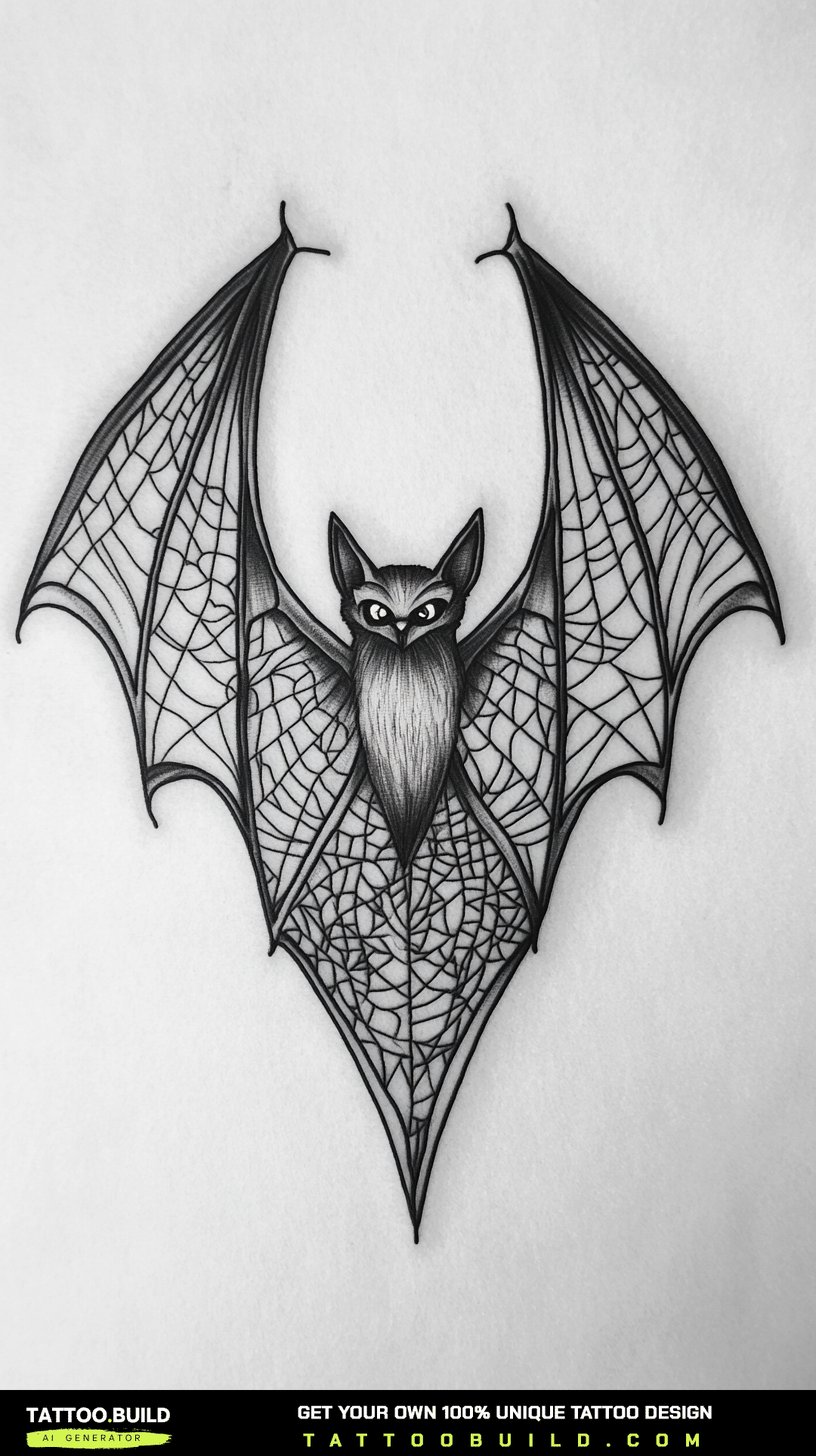
I have been collecting bat references for clients for years, and the pattern is always the same: people come in expecting Halloween and leave with something far more elegant. A bat tattoo drawing works because the wing is one of the few animal shapes that reads instantly at any size, from a two-inch sternum piece to a full back panel.
The 25 drawings below are all from our own sketchbook, and they cover the full range — fine line, blackwork, ornamental, botanical, and a few strange hybrids I would not have thought of myself.
If you already know you want something darker and more ornamental, it is worth looking at our gothic tattoo drawings alongside these, because the two styles borrow heavily from each other.
What follows is organised by the decision you actually have to make — style first, then subject matter, then placement. Skip to whichever part you are stuck on.
Which Bat Tattoo Style Is Right for You?
Style matters more than subject here. The same bat drawn in blackwork and in single-needle fine line will age in completely different directions.
| Style | Best For | Smallest Size That Works | How It Ages |
|---|---|---|---|
| Blackwork / solid silhouette | Bold, readable pieces on arms and calves | Around 2 inches wide | Excellent — solid black holds its edge longest |
| Fine line / single needle | Delicate ribs, sternum, inner arm | Around 3 inches wide | Softens noticeably; often needs a touch-up in 5–10 years |
| Ornamental / mandala wings | Symmetrical placements — spine, chest, back of arm | Around 4 inches wide | Good if the artist leaves real gaps between elements |
| Black and grey realism | Thigh, upper back, larger canvases | Around 5 inches wide | Mid-tones flatten over time; contrast is what survives |
| Neo-traditional with colour | Bats paired with flowers, moons or objects | Around 4 inches wide | Strong, thanks to heavy outlines holding the colour in |
If you are torn between two rows, the honest answer in most cases is to pick the one that suits the placement rather than the one that looks best on paper.
What Bat Tattoos Actually Mean
Bats carry almost opposite meanings depending on where you look, which is part of why they make such good tattoos.
In much of Western folklore the bat sits with night, death and the uncanny — the association that gives gothic and Halloween-leaning designs their pull.
In Chinese symbolism the reading flips almost entirely: the word for bat is a homophone for good fortune, and five bats together are a traditional emblem of blessings. Clients are usually surprised by this one.
The more practical reading, and the one I hear most often in the chair, is navigation — bats move confidently through the dark using echolocation. People choose them after coming out of a difficult stretch.
It is also worth knowing that bats are genuinely useful animals, not pests; Bat Conservation International is a good starting point if the ecological angle is part of why you want one. And if the night-sky reading is what draws you, our moon tattoo ideas pair naturally with almost every design below.
25 Bat Tattoo Drawings, Grouped by Style
Every drawing below is grouped with the two others it shares a decision with, so you can compare like with like rather than scrolling a single long column.
1. Botanical Bats With Blossoms and Peonies
Pairing a bat with flowers is the single most reliable way to make the design feel considered rather than spooky.
The trick is scale contrast — one or two large blooms under the bat works far better than a dozen small ones, which turn to grey mush as they settle.
In my experience these read best vertically: forearm, outer thigh, or down the side of the calf, with the bat at the top and the florals tapering below.
Ask your artist to keep clear negative space between the wing membrane and the nearest petal. Without that gap the two shapes merge into one blob within about a decade.
2. Skulls, Thorns and Gothic Framing
This is the group people picture when they hear “bat tattoo”, and it is the one that suffers most from over-detailing.
The skull-and-wings drawing below is my favourite of the three precisely because it commits — flat black wings, a clean white skull, and two small spots of red. Nothing else.
The thorn wreath is a different solution to the same problem: it frames the bat and makes the piece self-contained, so it does not need a background to look finished.
Circular framing devices like that wreath are the easiest way to fit a bat onto a shoulder or the back of the hand, where a wide wingspan would run out of room.
3. Ornamental and Mandala Wing Fills
Ornamental bats treat the wing membrane as a panel to decorate rather than a surface to shade.
When I tested this approach on my own arm the lesson was immediate: the pattern needs to be larger than feels right on paper, because linework tightens visually once it is in skin.
Anyone drawn to this group should look through our mandala tattoo ideas as well — the geometry principles transfer directly.
The spiderweb variation is the outlier here, and it is worth saying plainly that webbing carries prison-tattoo associations in some regions. Most artists I have asked will still do it happily, but it is a conversation worth having first.
4. Fine Line and Minimalist Bats
A minimal bat is harder to draw well than a detailed one, because there is nowhere to hide a bad wing shape.
Every artist I have asked says the same thing about small fine line work: go one size up from what you think you want. Our fine line tattoo ideas guide covers why in more detail.
The simplest drawing in this group has maybe fifteen lines in it and still reads as a bat from across a room — that is the standard to aim for.
These sit well on the inner forearm, the back of the upper arm, and behind the ear, though anything smaller than about two inches on the hand or foot will need touching up sooner than you would like.
5. Moons, Night Skies and Cloudwork
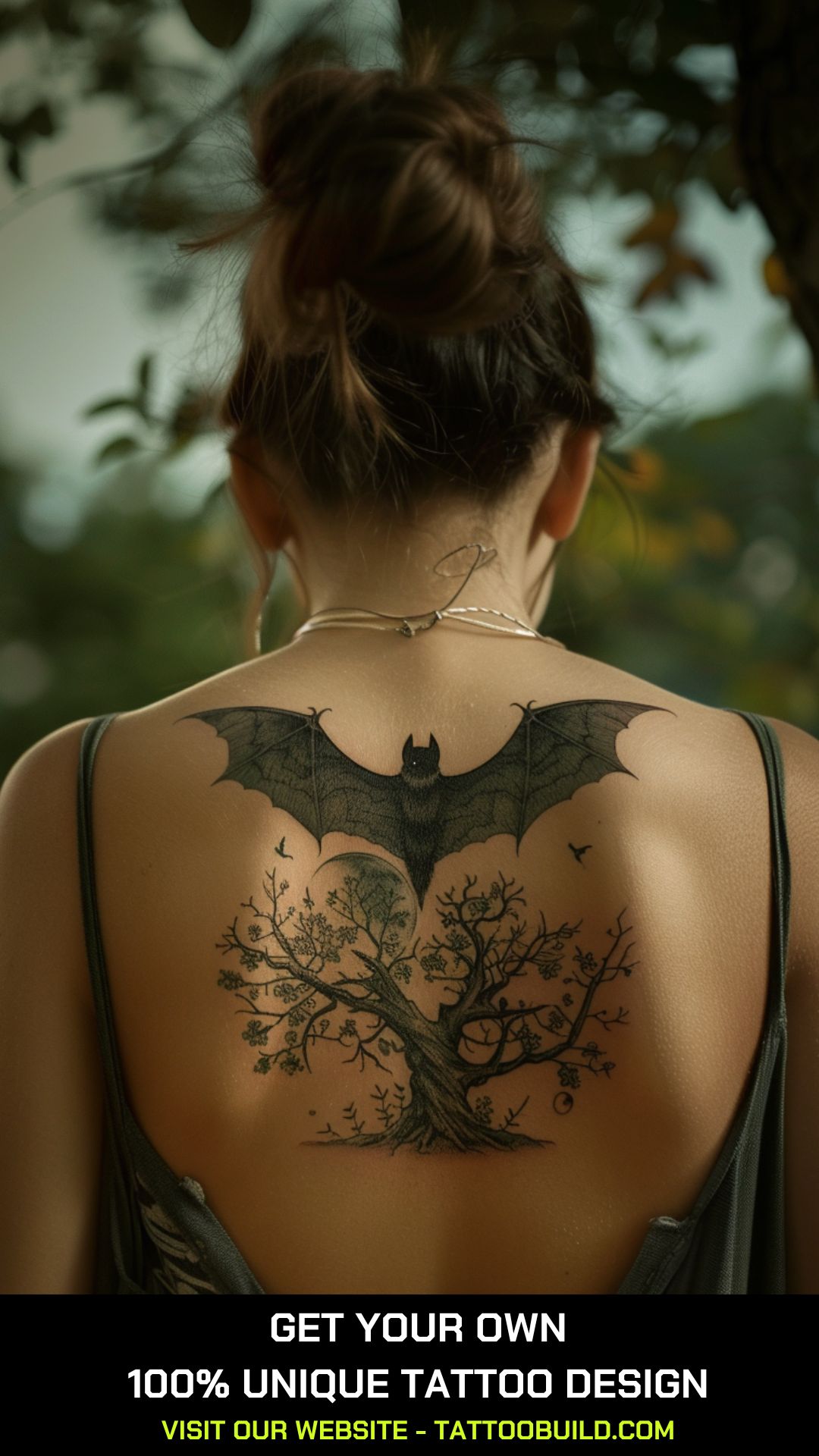
The bat-and-moon pairing is the most requested combination I see, and for good reason: the circle balances the wingspan.
Place the moon behind and slightly above the bat rather than directly below it — below reads as a logo, behind reads as a scene.
Stylised clouds are the underrated option in this group. They fill dead space without introducing another object competing for attention.
Dotwork moons look extraordinary fresh but flatten faster than solid shading, so if you want texture that lasts, ask for a mix of stipple and packed grey rather than stipple alone.
6. Hanging Bats and Branch Compositions
An upside-down bat is the most anatomically honest way to draw one, and it solves a layout problem at the same time.
Hanging poses are naturally narrow and tall, which makes them a near-perfect fit for the back of the arm, the spine, and the outside of the calf.
The branch or perch matters more than the bat. A thin, believable branch with two or three leaves is enough; anything more starts to look like a nature illustration.
In my experience clients who arrive wanting a flying bat and leave with a hanging one are almost always happier a year later — the composition simply sits better on a limb.
7. Bats Holding Objects: Lanterns, Roses and Pocket Watches
Giving the bat something to carry turns a motif into a small piece of storytelling.
The pocket watch is the most practical of the three, because the dangling chain lets you extend the design downward as far as the placement allows.
The lantern drawing works differently — the warm sepia linework pushes it toward storybook rather than gothic, which is a useful option if you want a bat that is not remotely menacing.
Keep the object simpler than the bat. If the watch face has Roman numerals and the wings have full detail, neither one wins.
8. Blackwork, Tribal and Hybrid Wings
Solid black is the most durable thing you can put in skin, and a bat silhouette is one of the shapes that benefits most.
If you want something that will still look sharp in twenty years, this group is the honest answer. Our blackwork tattoo ideas and linework tattoo ideas collections both go deeper on the technique.
The feathered-wing hybrid is the strangest drawing in this whole set, and I have only seen it done well a couple of times. It needs a large canvas and an artist who is comfortable with two different wing textures on one body.
The crystal cluster version shows a gentler way to add a focal point — an object rather than another creature, so nothing fights the bat for attention.
Variations Worth Considering
None of these needed a full section, but each one comes up in consultations often enough to be worth naming.
Micro Bats and Filler Placement
A one-inch bat silhouette makes excellent filler in a larger piece — tucked between larger elements rather than standing alone. Our tattoo sleeve filler ideas covers how to place these without crowding a sleeve.
Colour Accents on an Otherwise Black Design
The flame drawing above uses a single warm colour and nothing else, which is usually the right amount. Two spots of colour in a black and grey bat will draw the eye exactly where you want it.
Matching and Paired Bats
Mirrored bats work well for couples or siblings because the shape is symmetrical to begin with — one facing left, one facing right, same size, same style.
Bats as Part of a Larger Scene
A scatter of small bats behind a larger central subject is a common request, and it usually works. Keep them all the same style and shrink them consistently as they recede.
Placement, Sizing and Aftercare
Wingspan is the number to think about, not height. A bat that is four inches tall is often seven or eight inches wide, and that width is what decides whether it fits a forearm or needs a thigh.
Curved placements — the outside of the bicep, the ribs, the calf — distort a symmetrical wingspan. Ask for a stencil placed on the actual spot and look at it in a mirror before anyone starts.
For healing, follow whatever your artist tells you first; their instructions account for the specific ink and technique used. General dermatological guidance on washing, moisturising and sun protection is available from the American Academy of Dermatology, and it is a reasonable second reference.
Anything beyond normal tenderness — spreading redness, heat, pus, a fever, or a rash that appears weeks later — is a doctor visit, not a forum question. Nothing in this article is medical advice, and delayed reactions to certain pigments are well documented enough to take seriously.
Common Mistakes — and What to Do If You Are Still Not Sure
The mistake I see most often is choosing a drawing at the wrong scale for the body part, then shrinking it until the detail collapses.
The second is over-filling the wings. Membrane is thin and translucent in life; drawings that treat it as a solid decorated panel need bigger, bolder pattern than they usually get.
The third is skipping the consultation because the reference looks finished. Every drawing on this page is a starting point, not a stencil — a good artist will redraw it to your anatomy.
If the bat itself is not quite landing, the nearest alternatives are usually moth tattoo drawings for the same nocturnal, symmetrical feel, crow tattoo ideas for something darker with more narrative weight, or skull tattoo drawings if the gothic side is the real draw.
Frequently Asked Questions
Do bat tattoos always mean something dark?
No, and that surprises most people. In Chinese symbolism the bat is a traditional emblem of good fortune, while in much of Western folklore it sits closer to night and death. Plenty of clients choose one simply because bats navigate confidently in darkness. The meaning you attach to it matters more than any inherited reading.
How small can a bat tattoo realistically go?
A solid blackwork silhouette holds up at around two inches wide in most cases. Fine line work needs closer to three inches, because thin lines placed too close together tend to blur into one another as the tattoo settles. Anything smaller usually needs a touch-up sooner. Ask your artist to size the stencil on the actual placement before committing.
Where do bat tattoos sit best on the body?
Flat, wide areas suit the outstretched-wing designs best — upper back, chest, outer thigh, and the back of the calf. Hanging or upside-down compositions are narrow and tall, so they fit the back of the arm, the spine, and the inner forearm well. Curved placements like the bicep and ribs distort symmetry, so a stencil check in a mirror is essential.
Is a bat tattoo more painful in certain spots?
Placement drives pain far more than the design does. Ribs, sternum, spine and the inside of the arm are consistently reported as more uncomfortable than the outer arm, thigh or calf. Because wide-wing bats often want a bony, flat area, this is worth factoring in early. Sessions can be split if the piece is large.
How long does a bat tattoo usually take?
A small fine line bat is often a one-to-two hour appointment. A detailed black and grey bat with florals or a moon commonly runs three to five hours, and a large ornamental piece can need more than one session. Your artist will give you a realistic estimate once the final drawing is sized to your body.
Quick Summary
- Pick the style before the subject — blackwork, fine line and ornamental age in very different ways.
- Solid black silhouettes are the most durable option and stay readable at the smallest sizes.
- Fine line bats need roughly three inches of width to survive the first few years cleanly.
- Think in wingspan, not height; a four-inch-tall bat is often seven or eight inches wide.
- Pair the bat with one large element — a moon, a peony, a pocket watch — rather than several small ones.
- Hanging and upside-down poses fit limbs better than flying poses in most cases.
- Leave real negative space between the wing membrane and anything touching it.
- Follow your artist’s aftercare first, and see a doctor for anything beyond normal tenderness.