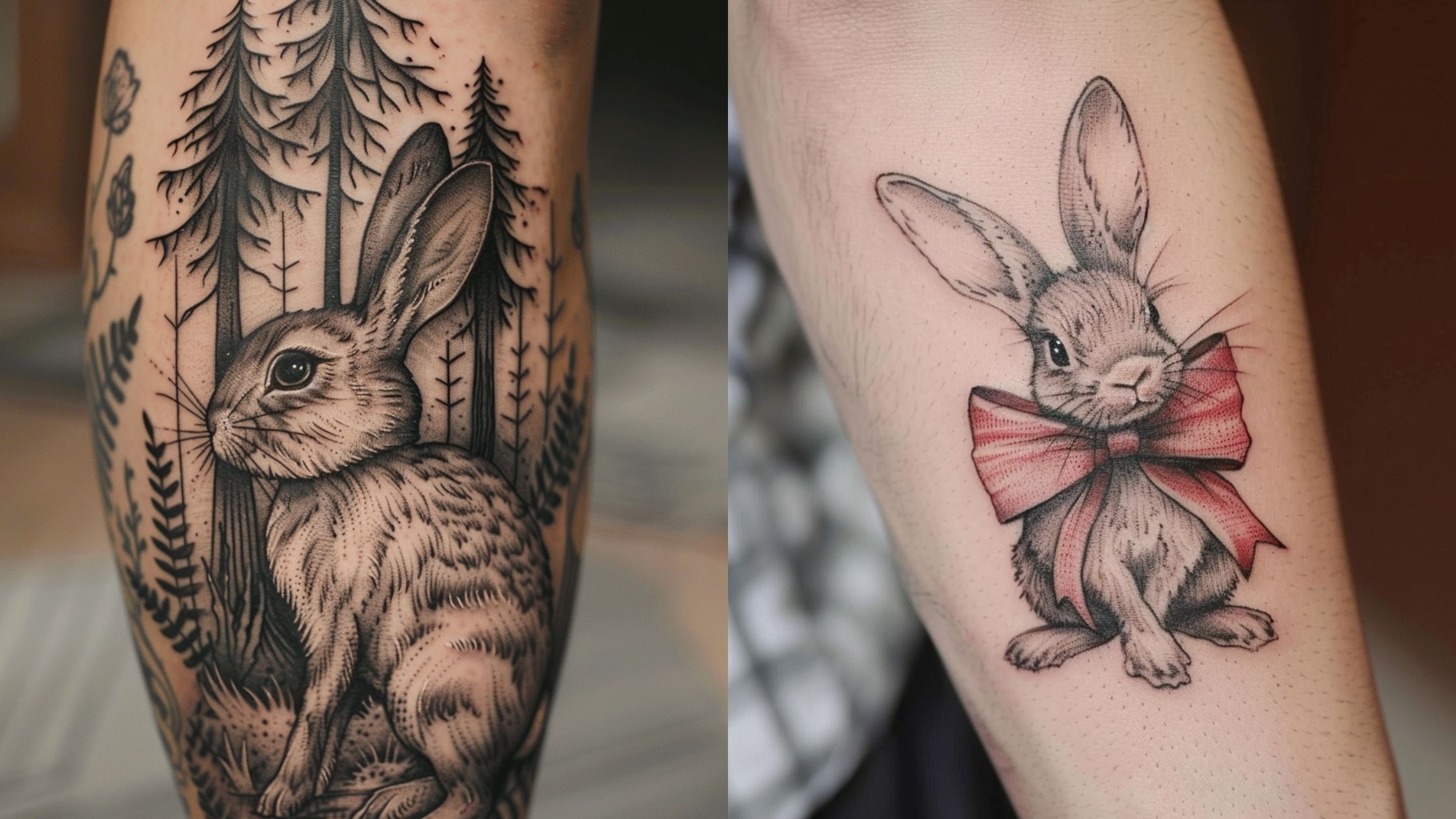
I have lost count of the number of times someone has walked into a studio asking for “just a small bunny” and left with something far more interesting. A bunny tattoo is one of the most flexible small-animal designs out there, because the same shape reads as sweet, eerie, lucky or deeply personal depending on how it is drawn.
Rabbits carry a lot of symbolic weight for such a small animal: fertility, spring, luck, quick thinking, and in several cultures, the moon itself.
This guide walks through 15 bunny tattoo directions I keep seeing work well on skin, plus honest notes on sizing, placement and how each style ages. If you want the broader animal category first, my rabbit tattoo ideas guide covers hares and jackrabbits too.
Every photo below is a real tattoo, grouped by style so you can see how the same subject changes character with linework alone.
Which Bunny Tattoo Style Is Right for You?
Before scrolling the gallery, it helps to know roughly which lane you are in. This is the comparison I sketch out for people who cannot decide.
| Style | Best for | Realistic size | How it ages |
|---|---|---|---|
| Realistic / black and grey | Pet portraits, detailed fur, a single statement piece | 4 in / 10 cm and up | Soft grey shading fades gently; fine fur detail softens over years |
| Fine line / minimalist | First tattoos, discreet placements, quick sessions | 1–2.5 in / 2.5–6 cm | Thin lines can blur or drop out; expect a touch-up eventually |
| Silhouette / blackwork | High contrast, bold shapes, low upkeep | 2–5 in / 5–12 cm | The most forgiving option here — solid black holds shape well |
| Illustrative / cartoon | Playful, nostalgic or character-led designs | 2–4 in / 5–10 cm | Bold outlines keep the shape readable long term |
| Floral / botanical bunny | Softer, feminine compositions and larger areas | 4–8 in / 10–20 cm | Depends on line weight; leave breathing room between elements |
| Tribal / neo-traditional | Graphic impact and heavier saturation | 3–6 in / 8–15 cm | Very durable, though heavy black takes longer to heal |
What a Bunny Tattoo Actually Means
Meaning is not fixed, and anyone who tells you a rabbit means exactly one thing is selling something. What a bunny tattoo says depends on culture, composition and what you bring to it.
The most common reading in Western tattooing is innocence, softness and new beginnings — a nod to spring, to renewal, and to the animal’s association with fertility.
Luck is the second big one. The rabbit’s foot charm is the obvious reference, and plenty of people choose a bunny after a run of bad years as a small, private hopeful gesture.
Then there is the lunar connection. Many East Asian traditions describe a rabbit living on the moon, pounding rice or an elixir of immortality, which is why bunny-and-moon compositions feel older and more mythic than cute. You can read the folklore background on the moon rabbit if that thread interests you.
The rabbit is also one of the twelve animals of the Chinese zodiac, so a bunny tattoo is a natural birth-year piece for anyone born in a Rabbit year, including 1987, 1999, 2011 and 2023.
And sometimes it is simply a pet. Some of the most meaningful bunny tattoos I have seen were memorials for a specific rabbit, with the ear markings drawn exactly right.
15 Bunny Tattoo Ideas Worth Saving
These are grouped by style rather than by placement, because style is the decision that changes everything else.
1. Realistic Bunny Tattoo
A realistic bunny is all about fur direction and the eye. Get those two right and the piece reads instantly; get them wrong and it looks like a grey blob.
This is the style I steer people toward for pet memorials, because a good black-and-grey artist can capture the specific set of a rabbit’s ears and the shape of its cheek line.
Size is the honest constraint here. Below about four inches there simply is not room for the shading gradients that make fur look like fur, and the detail will pack in over time.
Forearms, outer upper arms and thighs give the flattest canvas. In my experience clients who insisted on squeezing a realistic rabbit onto a wrist ended up back for a rework within a few years.
2. Cartoon Bunny Tattoo
Cartoon bunnies are the most forgiving option on this list. Bold outlines, flat fills, no fussy gradients.
They are also the most personal, because most people choosing this route have a specific rabbit in mind — a childhood cartoon, a book illustration, a game character.
If you go this way, ask your artist to redraw the character rather than copy an existing image. It avoids copyright headaches and usually produces a better tattoo.
Every artist I have asked prefers a slightly thicker line weight on cartoon work than clients expect. Lines spread a little as they settle, and thin cartoon linework loses its punch.
3. Floral Bunny Tattoo
Pairing a rabbit with flowers is the single most requested bunny variation I have come across, and it works because it doubles the symbolism.
Birth-month flowers are a common pick, but so are wildflowers, poppies and forget-me-nots for memorial pieces.
The design trap is crowding. When flowers wrap tightly around the rabbit with no negative space, the whole thing greys out from a few feet away.
Ask for the bunny to stay the darkest, highest-contrast element and let the botanicals sit lighter behind it.
4. Minimalist Bunny Tattoo
A minimalist bunny is often just an ear silhouette, a small hopping shape, or a single continuous line.
It is the most common first tattoo in this category, and for good reason: short session, low pain, easy to hide.
The honest downside is longevity. Very small, very fine designs blur as ink spreads slightly in the skin, so plan on a touch-up at some point rather than treating it as a failure.
If this is your lane, browse more minimalist tattoo ideas before committing to a shape.
5. Silhouette Bunny Tattoo
Solid black silhouettes are, technically speaking, the most durable design on this page.
There is no fine detail to lose, no gradient to fade unevenly. A filled rabbit shape at two inches will still read clearly in twenty years.
The trade-off is that silhouettes live or die on the outline. A slightly wrong ear angle cannot be rescued with shading later.
I always ask for a stencil to be placed and photographed from a few feet away before the needle touches skin. Silhouettes are judged at conversation distance, not at arm’s length.
6. Bunny and Moon Tattoo
This is the composition I find most interesting, because it pulls the design out of "cute" and into folklore.
A crescent moon with a rabbit seated inside it, or a rabbit silhouetted against a full moon, references lunar rabbit stories found across East Asian and Mesoamerican traditions.
Compositionally it is also just easier: the moon gives the artist a frame, which solves the "floating animal" problem that makes small animal tattoos look unfinished.
Spines, forearms and shoulder blades suit it well. There are more framing options in my moon tattoo ideas collection.
7. Bunny and Carrot Tattoo
Playful, unpretentious, and often the choice of people who do not want their tattoo to be deep.
There is nothing wrong with that. Some of the happiest tattoo clients I have met were the ones who wanted something that simply made them smile.
A splash of orange makes this one of the few bunny designs that genuinely benefits from colour. In black and grey, the carrot can read as an odd cone shape.
Keep the composition tight — rabbit and carrot touching or overlapping — so it reads as one tattoo rather than two.
8. Tribal Bunny Tattoo
Tribal and neo-tribal treatments turn the rabbit into a graphic shape: heavy black, sharp points, strong negative space.
It is the most unexpected direction on this list, and the one that ages best alongside silhouettes.
One caution worth stating plainly: many patterns marketed as "tribal" come from specific living cultures, particularly Polynesian traditions. If you want an authentic pattern rather than a generic graphic style, talk to an artist from that tradition.
For pattern context, my tribal tattoo ideas guide goes deeper on line weight and layout.
9. Bunny Outline Tattoo
An outline bunny keeps the shape but leaves the inside empty, which makes it feel lighter than a silhouette without losing readability.
This is the middle ground I recommend most often when someone likes minimalist work but wants a design bigger than two inches.
Line weight matters more than anything. Very fine lines on a large outline look weak; slightly heavier lines carry the shape.
If you like the aesthetic, see the wider fine line tattoo ideas gallery for how these hold up at different scales.
10. Bunny Couple Tattoo
Two rabbits, one on each person, or a pair in a single piece. Rabbits are an obvious fit for partner tattoos given the fertility symbolism.
The version I like best splits a single composition: one person gets the rabbit facing left, the other facing right, so they only line up side by side.
Match the style and the artist, not just the subject. Matching tattoos done years apart by different artists rarely look like a pair.
More pairings in matching tattoo ideas for couples.
11. Bunny and Forest Tattoo
Placing the rabbit in a landscape — ferns, pines, tall grass — is how you get a small subject to fill a large space.
This is the natural route for a half sleeve or a full calf piece, and it lets the artist use depth: sharp rabbit in front, softer trees behind.
The mistake is even contrast throughout. If the forest is as dark as the rabbit, your eye has nowhere to land.
Ask for one clear focal point and let everything else drop back.
12. Bunny and Heart Tattoo
Straightforward and sentimental — a rabbit holding, sitting beside or forming a heart shape.
It is a common memorial choice for a pet rabbit, and a common friendship or family piece.
Keep the heart simple. Ornate hearts fight with the animal for attention and the composition ends up muddled.
Small versions sit nicely on the inner wrist, the ankle or behind the ear.
13. Bunny and Book Tattoo
A reading rabbit is a quiet, specific little design, and one of my favourites on this list.
It works because it is unexpected: the viewer registers "rabbit" and then notices the book, which gives the tattoo a second beat.
Storybook associations run deep here — Alice’s White Rabbit, Peter Rabbit, Watership Down — so it suits readers and writers without needing an explanatory quote.
Resist adding text. Small lettering next to a small illustration is the first thing to blur.
14. Bunny with Glasses Tattoo
Adding glasses is the fastest way to give a rabbit a personality rather than just a species.
Round frames read as bookish, square frames read as modern, and the choice genuinely changes how the tattoo feels.
Technically, glasses are the fiddly part. Thin frame lines crossing the face need to be planned so they do not merge with the eye shading.
I would not go below three inches on this one. It is the detail, not the rabbit, that sets the minimum size.
15. Bunny with Bow Tattoo
A bow at the neck or ear is a small addition that shifts the whole tone toward soft and decorative.
It has become noticeably more popular alongside the wider coquette-style trend, which is worth knowing before you commit — trend-linked details date faster than the subject itself.
If you like the look but want longevity, keep the bow small and the rabbit anatomically neutral.
Ribbon detail also gives an artist a natural place to add a name or date later without redrawing the piece.
If a Bunny Is Not Quite Right
Sometimes the rabbit is close but not exact. These are the variations I suggest most often.
Hare Instead of Rabbit
Hares are longer-limbed, sharper-featured and less domestic-looking. If "cute" is the thing putting you off, a hare gives you the same symbolism with a wilder edge.
Ears Only
Two ear shapes, nothing else. It is abstract enough to stay personal, and it is about as small and low-commitment as a tattoo gets.
Jackalope
The antlered rabbit of American folklore. It reads as folk-art rather than sweet, and antlers give the composition height that a plain rabbit lacks.
Rabbit Skull
A darker take that keeps the silhouette recognisable. It pairs unusually well with botanical work, since the contrast between bone and bloom does the storytelling.
Moon Phases With a Rabbit
A row of phases with a small rabbit worked into one of them. It suits spines and forearms, and it is the version that ages best because the shapes are simple.
Placement, Sizing and Aftercare Notes
Placement decides how a bunny tattoo ages more than the design does. Areas with a lot of movement or friction — fingers, palms, feet, inner wrists — lose detail fastest.
For a first bunny tattoo I usually suggest the outer forearm, the upper arm or the calf. Flat, low-friction, easy to keep clean, and comfortable to sit through. If you are weighing placements, the tattoo pain chart is a more useful starting point than anecdotes.
Small delicate placements are still worth having — there are plenty of good options in wrist tattoo ideas — just go in knowing a touch-up is likely.
On healing, follow your artist’s written instructions rather than anything you read online, including this page. Practices differ by studio and by the wrap they use.
Broadly: keep it clean, keep it lightly moisturised, keep it out of the sun, and do not soak it in a bath, pool or hot tub while it is healing. The American Academy of Dermatology has straightforward guidance on caring for tattooed skin.
If you see spreading redness, swelling that worsens after a few days, pus, or you develop a fever, that is a doctor’s visit, not a forum question. Allergic reactions to pigment are uncommon but real, and the FDA’s overview of tattoo safety is worth reading before your first appointment.
Never attempt to tattoo or remove a tattoo yourself. Home kits and DIY removal methods cause scarring and infection, and removal in particular belongs with a qualified practitioner.
Common Mistakes — and What to Do If You Are Still Not Sure
The mistake I see most often is going too small for the chosen style. A realistic rabbit at two inches is not a smaller version of a good tattoo; it is a different, worse tattoo.
The second is bringing a reference photo and asking for an exact copy. Good artists will adapt a reference for skin — line weight, contrast, how it wraps around a limb — and that adaptation is the value you are paying for.
The third is booking with whoever is available. Style specialisation matters enormously; a superb blackwork artist may not be the right choice for soft realistic fur.
If you are still undecided, sit with the idea for a few weeks and keep a folder of saved images. If the same style keeps reappearing, that is your answer.
Still exploring? Getting a tattoo for the first time covers what to expect at the appointment, and cute tattoo ideas has more small-scale designs in a similar mood.
Frequently Asked Questions
What does a bunny tattoo symbolise?
Most commonly innocence, fertility, luck and new beginnings. In several East Asian traditions the rabbit is linked to the moon, which gives bunny-and-moon designs a more mythic reading. The rabbit is also one of the twelve Chinese zodiac animals, so it works as a birth-year piece. Ultimately the meaning is whatever you attach to it — plenty of people simply loved a particular rabbit.
How small can a bunny tattoo be?
A simple silhouette or outline works down to about one inch and still reads clearly. Anything with fur detail, glasses or fine botanical work needs three to four inches at minimum. The limiting factor is not the rabbit but the smallest detail inside it. If you are unsure, ask your artist to print the stencil at two sizes and hold both against the skin.
Does a bunny tattoo hurt?
That depends far more on placement than on the design. Fleshy areas like the outer forearm, upper arm and calf are generally the most tolerable; ribs, sternum, ankles and inner wrists are noticeably sharper. A small minimalist bunny is often done in under an hour, which limits the discomfort. Pain tolerance varies a lot between people, so treat any chart as a rough guide.
Should a bunny tattoo be in colour or black and grey?
Black and grey suits realistic, silhouette, outline and tribal styles, and it ages more predictably. Colour genuinely helps in two cases: a carrot, and a botanical piece where the flowers carry the design. If you have a pet rabbit with distinctive markings, a skilled black-and-grey artist can usually capture them without colour.
How long does a bunny tattoo take to heal?
The surface usually looks settled in about two to three weeks, while the deeper layers continue settling for a few months. Small line-work pieces tend to heal faster than heavily saturated blackwork. Follow the aftercare your artist gives you, and avoid swimming and direct sun until it has fully closed. If anything looks infected, see a doctor rather than waiting it out.
Quick Summary
- Pick the style first — realistic, minimalist, silhouette, illustrative, floral or tribal — because it decides size, cost and how the piece ages.
- Silhouettes and bold outlines age best; very fine minimalist work will likely need a touch-up.
- Realistic bunny tattoos need roughly four inches or more to hold fur detail.
- Bunny-and-moon designs tap into genuine folklore and solve the "floating animal" problem with a built-in frame.
- Colour is optional, and only clearly earns its place in carrot and botanical compositions.
- Outer forearm, upper arm and calf are the most forgiving placements; fingers and feet are the least.
- Book by style specialisation, not availability, and let your artist adapt the reference for skin.
- Follow your artist’s aftercare, and see a doctor for spreading redness, worsening swelling or fever.