If you have been scrolling for a rabbit tattoo that is charming without tipping into twee, this is the collection I would have wanted when I started gathering references. A rabbit tattoo works because it can be read two completely different ways – soft and sweet, or quiet and a little strange – and the style you pick decides which one you get.
I have spent a lot of time looking at these designs, and the pattern is consistent: the ones people still love years later are the ones where the style matched the meaning rather than fighting it.
Below you will find thirty-plus real rabbit and hare designs sorted by style, plus what each one costs you in healing time, placement and future touch-ups. If you are torn between a rabbit and its softer cousin, our bunny tattoo ideas gallery covers the cuter end of the spectrum.
Take what is useful, ignore the rest, and bring three references to your consultation instead of one.
Which Rabbit Tattoo Style Is Right for You?
Before the galleries, here is the honest comparison I wish someone had handed me – not just how each style looks, but how it behaves over time.
| Style | Best Size | How It Ages | Suits You If |
|---|---|---|---|
| Fine line / minimalist | Small (5–8 cm) | Thin lines soften and can blur; may need a touch-up | You want something quiet you can cover with a sleeve |
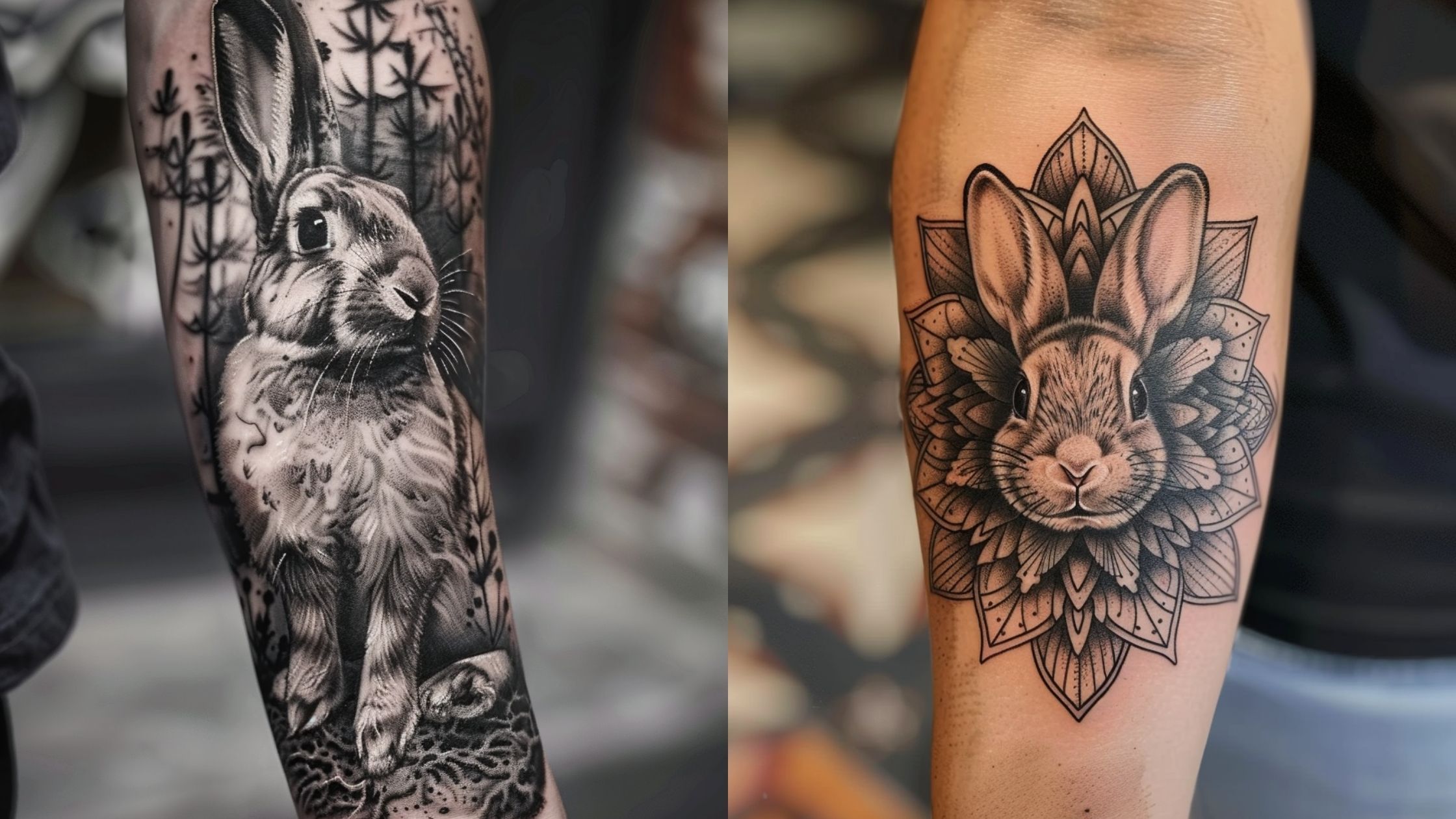
| Black and grey realism | Medium to large (12 cm+) | Ages well when the artist leaves breathing room in the fur | You want the animal itself to be the whole piece |
| Cartoon / illustrative | Small to medium | Bold outlines hold shape longer than almost anything else | You want it playful and instantly readable |
| Watercolour | Medium | Washes fade fastest, especially in sun-exposed spots | You love colour and accept future touch-ups |
| Mandala / geometric | Medium to large | Dotwork holds up well if it is not packed too tightly | You want symmetry and a meditative feel |
| Floral rabbit | Medium | Depends on the flowers – solid petals last longer than wispy ones | You want softness and a natural frame around the animal |
If you only take one thing from that table, make it this: bold outlines age better than delicate ones, and colour fades faster than black. Neither fact should stop you choosing what you actually want.
What Rabbit Tattoos Actually Mean
Rabbits and hares carry meaning in an unusual number of unrelated cultures, which is part of why the design is so flexible.
In East Asian folklore the hare lives on the moon, pounding medicine or rice cake depending on which version you grew up with. That is the association behind most celestial rabbit pieces I see.
In Western tradition the pull is toward spring, fertility and renewal – the Easter connection most people already know. The rabbit’s reputation for prolific breeding does most of the work there.
There is also a quieter reading that comes up constantly in consultations: rabbits are prey animals that survive through alertness and speed rather than force. Several people have told me their tattoo is about that specifically.
And then there is luck. The rabbit’s foot charm is well known enough that a rabbit tattoo reads as a good-luck piece to most viewers without any explanation. In my experience that is the meaning people assume unless you tell them otherwise.
Rabbit Tattoo Ideas by Style
These are grouped by how they are drawn rather than what they show, because style is the decision that changes everything downstream – cost, size, healing and how the piece looks in ten years.
1. Realistic Rabbit Tattoos
Realism is the most demanding option on this list and the one where the artist matters most.
Fur is not drawn as texture in a good realistic rabbit tattoo – it is built from hundreds of short, directional strokes with deliberate gaps of bare skin left between them.
Those gaps are the reason well-done realism ages gracefully. When an artist packs the fur solid to make it look impressive on day one, it tends to blur into a grey mass within a few years.
Ask to see healed photos, not fresh ones. Fresh realism always looks good; healed realism is the actual test. Plan for at least a palm-sized piece, because detail this fine does not survive being shrunk.
2. Fine Line and Minimalist Rabbit Tattoos
This is the most requested version I come across, and for good reason: it is small, discreet and reads instantly.
The best minimalist rabbits use silhouette rather than detail. Ears, a curved back, one suggestion of a haunch – that is usually enough.
The trade-off is honest and worth knowing before you book. Very thin lines spread slightly as they heal, so a design with lines close together can lose its gaps over time.
I generally suggest going one size larger than feels necessary and keeping at least a couple of millimetres between parallel lines. Our fine line tattoo guide and minimalist tattoo ideas both go deeper on that.
3. Cartoon and Illustrative Rabbit Tattoos
If you want the design to still be obvious from across a room in fifteen years, this is the safest style on the page.
Bold outlines with flat colour inside them is essentially the American traditional formula, and it survives ageing better than almost anything else.
Cartoon rabbits also let you push expression in a way realism cannot. A slightly smug bunny is funny; a photorealistic smug bunny is unsettling.
The main mistake I see here is over-detailing. A cartoon design should have fewer elements than you think it needs, because simplicity is the entire point of the style.
4. Floral Rabbit Tattoos
Pairing a rabbit with flowers is the easiest way to make the piece feel composed rather than like a sticker.
Flowers give the design an outer edge and a natural place to stop, which solves the awkward floating-animal problem that plagues standalone designs.
Choose the blooms deliberately. Daisies and cherry blossom keep it light; peonies and roses make it heavier and more traditional.
Every artist I have asked prefers wrapping the florals partly around the limb rather than laying them flat, because it makes the tattoo look correct from more angles. The tattoo sits on a curved surface, and the florals should acknowledge that.
5. Watercolour Rabbit Tattoos
Watercolour rabbits are the most striking designs in this collection and the highest maintenance.
The version that lasts always has real structure underneath – a proper black or dark line drawing with the colour washes sitting behind it, not instead of it.
Pure watercolour with no linework looks incredible for the first year or two and then softens noticeably, particularly on arms and legs that catch daily sun.
If you love the look, commit to sunscreen and accept that a touch-up every few years is part of the deal. Our watercolour tattoo guide covers the longevity question in more depth.
6. Rabbit and Carrot Tattoos
The most obvious pairing on the list, and it works precisely because it is obvious.
A carrot gives you a second colour, a strong vertical or diagonal line, and a bit of humour without needing a whole scene.
It also solves a compositional problem – a rabbit alone often has nothing to do with its front paws, and a carrot fixes that instantly.
Keep the carrot proportionally larger than realistic. In my experience the oversized version reads as intentional comedy, while an accurate one just looks like a small orange smudge from a distance.
7. Mandala and Geometric Rabbit Tattoos
This is where a rabbit stops being cute and starts being symbolic.
The strongest versions put the mandala behind the animal as a halo or backdrop rather than filling the rabbit’s body with pattern, which tends to muddy the silhouette.
Dotwork needs space. Densely packed dots merge as they heal, so a good artist will leave more white than looks right at first glance.
Expect this to be a longer sitting than the size suggests, because symmetry is slow work. See mandala tattoo ideas if you want to compare geometric approaches first.
8. Fantasy Rabbit Tattoos
Wings, crowns, armour, keys – the fantasy category is where people go when the plain animal does not carry enough meaning.
Adding one strong element works. Adding three turns the piece into a puzzle nobody will decode, including you.
Winged rabbits in particular need vertical space, which makes the upper arm, thigh or back the sensible placements.
Pick the single element that carries your meaning and let everything else stay quiet. That restraint is what separates a fantasy tattoo from a cluttered one.
Rabbit Tattoo Variations Worth Considering
If none of the main styles fit, these three variations come up constantly and each solves a different problem.
Rabbit and Butterfly
Two soft shapes that balance each other, and a straightforward way to layer transformation onto a symbol of new beginnings.
Keep the butterfly noticeably smaller than the rabbit, otherwise the two compete and neither wins. Our butterfly tattoo ideas page has size and placement notes that apply here too.
Celestial and Moon Rabbits
The direct nod to moon-hare folklore, and my favourite version of this tattoo when someone wants meaning over cuteness.
Small scattered stars are useful practically as well as symbolically – they fill negative space so the rabbit does not look like it is floating. If that direction appeals, moon tattoo ideas is worth a look.
Whimsical Props and Storybook Scenes
A teacup, a ball, a tiny instrument – a single prop turns a static animal into a moment, which is why these designs feel personal.
The rule I would hold to is one prop only. Two props and the tattoo becomes a scene, and scenes need a lot more skin than most people budget for.
Placement, Sizing and Aftercare
Rabbits are vertical animals, so they want vertical space. The forearm, outer upper arm, calf and thigh all suit them naturally, while the ribs and collarbone force awkward compromises with the ears.
For size, the practical floor for anything with fur detail is roughly the length of your hand. Below that, an artist has to start deleting information, and the first thing to go is exactly the texture that made you want realism.
On pain, spots directly over bone – ankle, wrist, ribs, elbow – are reliably harder than fleshy areas like the outer thigh. Our tattoo pain chart maps this out properly if you are choosing between two placements.
For healing, follow your artist’s instructions over anything you read online, including this page. Wash gently, moisturise thinly, skip the gym and the pool for the first week or so, and keep it out of direct sun for a couple of months. Our aftercare guide covers the routine, and the American Academy of Dermatology is the right source for the dermatological side.
Still Not Sure? The Mistakes Worth Avoiding
The most common regret I hear about is going too small. A rabbit shrunk below its detail threshold heals into a grey blob, and no artist can rescue that later without reworking the whole piece.
The second is choosing an artist by price rather than portfolio. If the shop’s gallery has no animal work in it, that is information, not a technicality.
The third is copying a reference exactly. Bring two or three images that show what you like about each, then let the artist compose something that fits your body – that is the part you are actually paying for.
And the fourth: never let anyone tattoo you outside a licensed studio, and never attempt it or any DIY removal yourself. The FDA’s guidance on tattoo safety explains why the ink and the sterilisation both matter. A licensed studio is not a formality; it is the whole safety margin.
Frequently Asked Questions
What does a rabbit tattoo symbolise?
Most commonly luck, gentleness, fertility and new beginnings, though the exact reading depends heavily on the culture you are drawing from. In East Asian folklore the hare on the moon is a figure of patience and quiet service, while in parts of Western and Celtic tradition the hare is linked to spring and rebirth. Plenty of people I have spoken to simply chose one because a rabbit meant something in their own family. In my experience the personal meaning almost always outlasts the symbolic one, so do not feel obliged to adopt a tradition that is not yours.
How much does a rabbit tattoo cost?
It depends far more on size, detail and your artist’s hourly rate than on the subject itself. A small fine line bunny on the wrist is usually a shop-minimum piece, while a detailed black and grey hare on the forearm can run several hours. Colour and heavy dotwork add time because both need multiple passes. Ask for a quote with a reference image attached rather than a number over the phone, and see our guide on what a small tattoo costs for a fuller breakdown.
Where is the best place to put a rabbit tattoo?
The forearm and upper arm are the two spots I recommend most often, because both give a rabbit’s ears and body enough vertical room without distorting. Wrists and ankles suit minimalist versions but force the artist to simplify the fur. Thighs and backs are the right call for anything with a mandala, floral frame or full scene. Bear in mind that spots with thin skin over bone tend to hurt more.
Do rabbit tattoos look childish?
They can, but that is a design choice rather than something inherent to the subject. A cartoon bunny with a carrot reads as playful on purpose; a black and grey hare with realistic fur and a serious eye does not read as childish at all. When people tell me they want the meaning without the cuteness, I usually steer them toward a hare rather than a domestic rabbit, since the longer limbs and leaner face change the tone completely.
How long does a rabbit tattoo take to heal?
The surface usually feels settled within two to three weeks, while the deeper layers keep repairing for a few months, so colour can look slightly cloudy before it clarifies. Keep it clean, keep it moisturised lightly rather than heavily, and keep it out of the sun. Watch for spreading redness, heat, swelling that worsens after the first few days, or discharge – those are signs to contact your artist and, if they persist, a doctor. Nothing here is medical advice, and clinical sources such as the Mayo Clinic are the right place to read about real risks.
Quick Summary
- Pick the style before the subject. Fine line, realism, cartoon, watercolour and mandala behave completely differently over time.
- Bold outlines age best. Cartoon and traditional approaches stay readable longest; watercolour fades fastest.
- Go one size up. Most regrets in this category come from a design that was too small for its own detail.
- Rabbits want vertical space. Forearm, upper arm, calf and thigh are the easiest placements for the ears and body.
- Meaning is flexible. Luck, spring, rebirth, alertness and moon folklore are all legitimate readings – choose yours deliberately.
- One added element, not three. Flowers, a butterfly, stars or a single prop; more than that and the design gets noisy.
- Vet the portfolio for healed animal work, not fresh photos, especially for realism and dotwork.
- Follow your artist’s aftercare, and see a doctor rather than the internet if healing looks wrong.