Chess tattoos have quietly become one of my favourite categories to research, because almost nobody gets one purely for decoration — the piece is always standing in for something the wearer has lived through.
In my experience talking to artists about these designs, the request usually arrives with a story attached: a career pivot, a divorce survived, a long illness outlasted, a decision that took years to make.
Chess gives you a ready-made vocabulary for all of that. The board is a closed system with clear rules, and every piece carries a defined role, which is why a single knight on a forearm reads as intentional rather than random.
This guide walks through what each piece actually communicates, which styles hold up on skin over a decade, and where these designs sit best on the body. If you are drawn to the crowned pieces specifically, it is worth reading alongside our guide to king tattoo meaning and design before you book.
Which Chess Tattoo Style Is Right for You?
Chess imagery survives in almost every tattoo style, but the styles age very differently once the ink has settled.
Here is how the four most common approaches compare, based on what artists consistently tell me about touch-up frequency and healed results.
| Style | Best For | Typical Size | Ageing Notes |
|---|---|---|---|
| Black and grey realism | Single hero pieces, portraits of a king or queen | 6 inches and up | Soft grey wash can lighten; plan a touch-up around year five |
| Fine line | Minimal pawns, small board fragments | 1–3 inches | Thin lines spread over time, especially on hands and wrists |
| Blackwork / bold traditional | Knights, rooks, high-contrast board patterns | 3–8 inches | Usually the most durable option over decades |
| Geometric / dotwork | Abstract boards, stylised piece silhouettes | 4–10 inches | Holds shape well; dense dotwork may soften slightly |
Why Chess Imagery Works So Well on Skin
Chess pieces are, in design terms, already solved shapes. Each one is a silhouette you can identify from across a room, which is exactly what a tattoo needs.
The standard piece shapes most of us picture come from the Staunton pattern, introduced in the mid-1800s and still the design used in official competition — you can read the background on the game and its pieces at Britannica.
That standardisation matters more than people expect. Because the shapes are universal, your artist does not have to explain the subject, and viewers do not have to guess.
The board adds a second layer: high contrast, repeating geometry, and natural perspective lines. A checkered plane is one of the few backgrounds that reads clearly even when it fades a little.
Cost scales with all of this. A single small pawn is usually a shop-minimum job, while a full board-and-pieces composition is priced by the hour — our breakdown of how much a small tattoo costs is a reasonable starting point for budgeting.
Chess Tattoo Ideas by Piece and Meaning
Choosing the piece is the real decision. Everything else — style, size, placement — follows from it.
1. The King: Survival Over Power
The king is the most requested piece and the most misunderstood one. In the game it is not powerful — it moves one square at a time and spends most of the match being protected.
That is precisely why it makes a better tattoo than people assume. A king tattoo reads as “everything depends on me staying standing,” not “I am the strongest.”
Every artist I have asked about this design says the same thing: the crown detail is where it lives or dies. Give the cross-topped crown enough room to hold its shape, which usually means at least four inches of height.
A toppled king — the resignation gesture in chess — is a common variation, and it usually marks an ending the wearer chose. If you want the crown motif without the full piece, our minimal crown tattoo guide covers the simpler route.
2. The Queen: Range and Autonomy
The queen moves any distance in any direction, which makes her the most capable piece on the board.
As a tattoo she tends to mean freedom of movement rather than dominance — the ability to go wherever you decide to go.
When I have seen queen pieces paired with something else, it is most often a king on a partner, a parent, or a sibling. It is one of the few matching-tattoo ideas that does not feel dated after a few years.
The coronet on a queen is finer than the king’s crown, so ask your artist to slightly exaggerate the spacing between points. In most cases the detail closes up as the ink settles.
3. The Knight: The Unconventional Route
The knight is the only piece that jumps over others, and it is the only one that moves in an L-shape.
People who pick it almost always describe taking an indirect path to where they ended up — a late career change, an unusual education, an immigration story.
It also happens to be the best-looking piece from a purely graphic standpoint. The horse head profile gives an artist a real subject to work with rather than a symmetrical turned shape.
The knight is the piece I would recommend for anyone who wants a small tattoo that still looks like something. Even at two inches the profile stays readable in solid black.
4. The Pawn: Potential and Promotion
The pawn is the smallest piece, and it is the only one that can become something else entirely.
Reach the far side of the board and a pawn promotes — usually to a queen. That single rule is why so many people choose it over the flashier pieces.
A common composition is a pawn casting a queen-shaped shadow. It works, but only at moderate size — under three inches the shadow reads as a smudge rather than a silhouette.
Simple pawn outlines are also the cheapest entry point into this whole category, which makes them a reasonable first tattoo.
5. The Rook and the Bishop: The Overlooked Pair
The rook is a tower, and it moves in straight lines only. As a tattoo it stands for structure, home, and holding a position.
Its castellated top is genuinely fun to render in blackwork, and it stacks well vertically along a forearm or the outside of a calf.
The bishop moves diagonally and never leaves its starting colour, which reads as faith, conviction, or staying inside a chosen lane.
Both pieces are undervalued simply because they are less obvious. If you want a chess tattoo that is not the fifth king in your friend group, start here.
6. Full Boards and Chess Sleeves
Once you introduce the board itself, the tattoo stops being a symbol and becomes a scene.
Boards in perspective are demanding work — the checker grid has to follow the curve of the arm or it will look bent once it is healed on a limb.
In my experience the strongest sleeve compositions use the board as a floor for two or three pieces rather than filling the whole arm with squares.
If you are thinking at this scale, it is worth reading our broader guide to sleeve tattoo ideas before committing to a layout.
7. Chess Combined With Animals
Pairing a chess piece with an animal is the most common way people add emotion to what is otherwise a cold, geometric subject.
The lion is the usual choice, because it carries the same authority as a king without needing a crown to explain it.
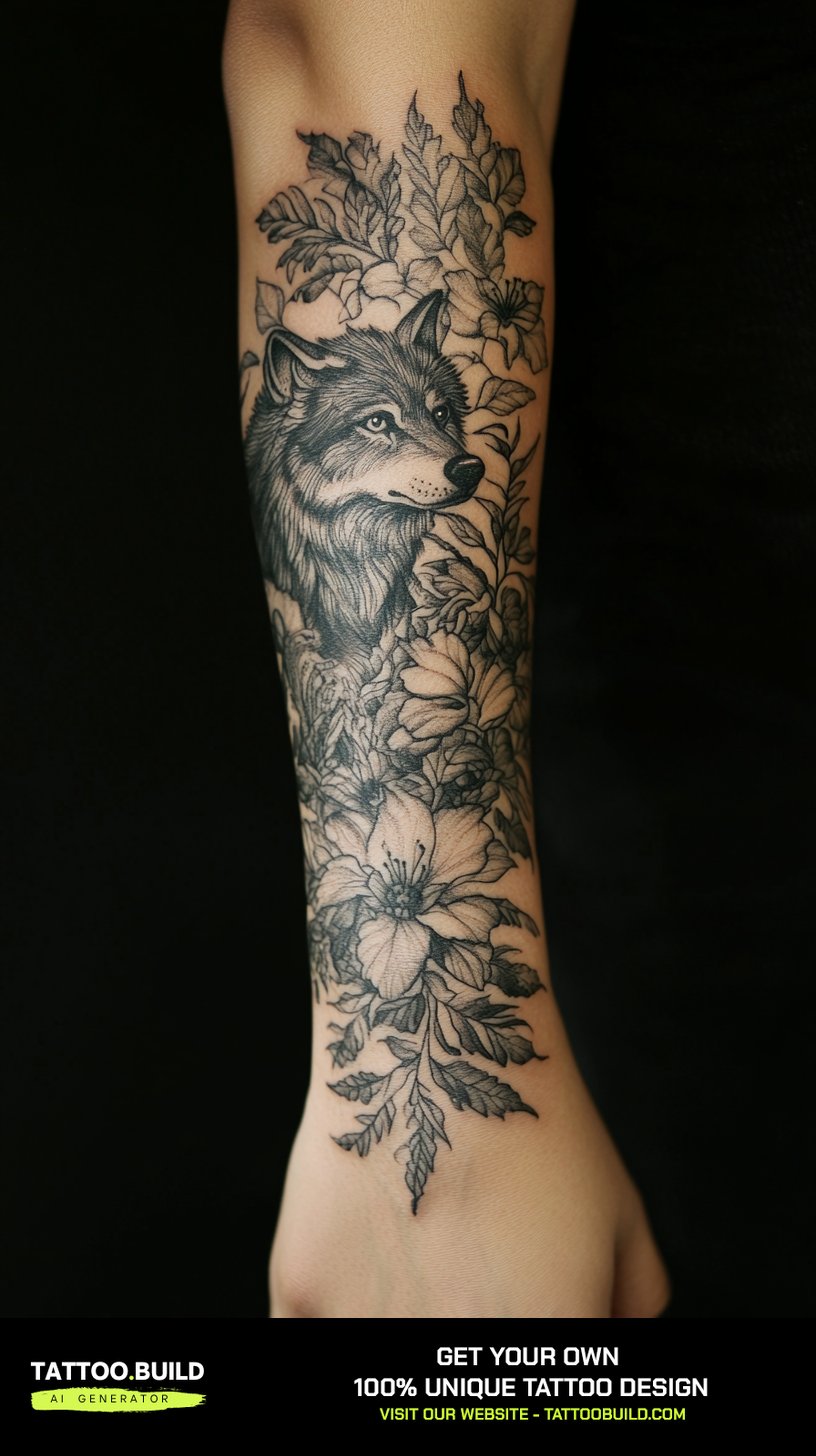
Wolves show up in these compositions too, usually alongside a knight, which fits — both are about moving in ways others do not expect.
The risk with combination pieces is that neither element gets enough room. If you are set on this, budget more space than you think you need, and see our lion tattoo ideas for how the animal is usually handled on its own.
8. Chess and Clock Designs
The chess clock is the second most common companion object, and it changes the meaning of the whole tattoo.
A piece on its own is about the decision. A piece next to a clock is about the decision being made under pressure, with time running out.
Analogue clock faces are the more forgiving option here — the hands give the artist a strong diagonal line to balance the vertical of the piece.
Roman numerals age better than fine Arabic numerals at small sizes. Our clock tattoo ideas guide goes deeper on getting the face right.
9. Hyper-Realistic Chess Pieces
Realism is where chess tattoos get expensive, and where the choice of artist matters more than the choice of design.
A convincing realistic piece depends almost entirely on how the light falls across the turned wood or marble, not on the outline.
When I have compared healed realism work against fresh photos, the pieces that held up best were the ones with strong dark anchors — deep shadow under the base and along one full edge.
Ask to see healed photos of at least three years old before booking realism. Fresh work looks good on almost everyone’s portfolio; healed work does not.
Minimal Variations and Smaller Alternatives
Not every chess tattoo needs to be a scene. Some of the best ones I have seen are barely two inches across.
Fine Line and Minimalist Pieces
A single-weight outline of a piece is the cleanest version of this idea, and it suits people who want the meaning without the visual noise.
Be realistic about longevity. Very fine lines spread as skin ages, and on high-friction areas they can need a redraw within five to ten years. Our fine line tattoo ideas guide covers the trade-offs honestly.
Geometric and Abstract Boards
You can imply chess without drawing a single piece. A fragment of checkered plane, warped or dissolving into squares, does the job.
This is a good option if you like the idea but do not want an obviously “themed” tattoo. Angular treatments in this vein sit closer to geometric tattoo designs than to traditional chess work.
Notation and Text Variations
Algebraic notation — the short codes that record moves, like Qd8 or e4 — makes a discreet alternative for people who actually play.
A specific game, a specific move, a specific date. It means nothing to anyone else, which is exactly the point for some wearers.
Placement, Sizing, and Aftercare
Chess pieces are tall and narrow, which means placement is less flexible than it is for round or floral subjects.
The forearm, the outside of the calf, and the spine all follow that vertical shape naturally. The wrist and ankle work for single small pieces — see our wrist tattoo ideas for how much detail actually survives at that size.
Avoid squeezing a detailed board onto a curved, high-movement area like the inner elbow or the side of the hand. In most cases the grid distorts and the tattoo fades faster.
On aftercare, follow the specific instructions your artist gives you rather than generic advice from the internet. The American Academy of Dermatology publishes sensible general guidance on caring for tattooed skin and on what warning signs to take seriously.
If you develop spreading redness, heat, swelling that worsens after the first few days, pus, or a fever, contact a doctor rather than waiting it out. This article is design guidance, not medical advice, and an infection or allergic reaction needs a professional to look at it in person.
Common Mistakes and Still Not Sure?
The most frequent mistake is going too small for the concept. A pawn-casting-a-queen-shadow idea needs room; a two-inch version of it just looks blurry.
The second is over-explaining. Adding a quote, a date, a clock, a lion and a full board to one design leaves nothing for the viewer to read.
The third is copying a reference photo exactly. Bring three or four images to show the mood you want and let your artist compose something that fits your body.
If you are still weighing this up, our guide on getting a tattoo for the first time covers consultations, pricing conversations, and what to expect in the chair.
Frequently Asked Questions
What does a chess tattoo symbolise?
Broadly, chess tattoos symbolise strategy, patience, and decisions made with consequences attached. The specific meaning depends on the piece: a king usually points to survival and responsibility, a knight to taking an unconventional path, and a pawn to potential and transformation. Many wearers also use them to mark a period when they had to think several moves ahead. There is no fixed rule, so the meaning is ultimately whatever you attach to it.
Which chess piece makes the best small tattoo?
The knight, in my experience. Its horse-head profile is asymmetrical and instantly recognisable, so it still reads clearly at around two inches. The pawn is the next best option because its shape is simple enough that nothing gets lost. Kings and queens are harder to shrink, since their crowns rely on fine detail that tends to close up as the ink settles.
How much does a chess tattoo cost?
A small single piece is usually charged at the shop minimum, which varies a lot by city and studio. Larger work — a detailed king, a board in perspective, or a sleeve — is normally priced by the hour, and realism sits at the higher end of any studio’s rate. Ask for a written estimate at the consultation rather than over message. Prices differ enough between regions that any figure quoted online is a rough guide at best.
Do chess board tattoos age well?
Boards with bold, well-separated squares generally age well because the contrast stays readable even after some softening. Very fine grids are the risk — as lines spread over years, the light squares can begin to close up and the pattern turns muddy. Placement matters too: flatter, lower-friction areas like the outer forearm tend to hold a grid better than hands or feet. A good artist will size the squares with this in mind.
Can I add to a chess tattoo later?
Yes, and chess is one of the easier themes to extend because the board gives you a natural way to connect new elements. Tell your artist at the first session that you may expand it, so they can leave the composition open rather than closing it off with a border. Adding pieces, a board floor, or background shading later is usually straightforward. Working with the same artist keeps the style consistent.
Quick Summary
- Pick the piece first — it carries the meaning, and everything else follows from it.
- The king reads as survival and responsibility, not raw power.
- The knight is the most recognisable piece at small sizes.
- The pawn is the cheapest entry point and the easiest to build on later.
- Blackwork and bold linework usually outlast fine line and soft grey wash.
- Give crowns and coronets extra spacing, because fine detail closes up as ink settles.
- Vertical placements — forearm, calf, spine — suit the tall shape of chess pieces.
- Follow your artist’s aftercare instructions, and see a doctor for any sign of infection.